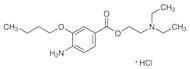
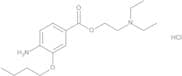
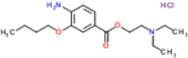
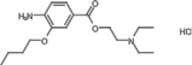
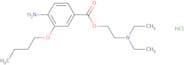
CAS 5987-82-6
:Oxybuprocainhydrochlorid
Beschreibung:
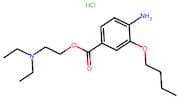
Oxybuprocainhydrochlorid, auch bekannt als Proxymetacain, ist ein Lokalanästhetikum, das zur Esterklasse der Anästhetika gehört. Es wird häufig in der Augenheilkunde verwendet, da es die Fähigkeit hat, eine Oberflächenanästhesie während verschiedener Augenverfahren bereitzustellen. Die Substanz erscheint als weißes bis off-white kristallines Pulver und ist in Wasser löslich, was die Anwendung in wässrigen Lösungen erleichtert. Oxybuprocainhydrochlorid wirkt, indem es Natriumkanäle blockiert, wodurch die Ausbreitung von Nervenimpulsen gehemmt wird und es zu einem vorübergehenden Verlust des Gefühls im Zielbereich kommt. Der Wirkungseintritt ist relativ schnell, und die Dauer der Anästhesie kann je nach verwendeter Konzentration und spezifischer Anwendung variieren. Die Verbindung wird im Allgemeinen gut vertragen, obwohl mögliche Nebenwirkungen lokale Reizungen oder allergische Reaktionen umfassen können. Aufgrund seiner Wirksamkeit und Sicherheitsprofil wird Oxybuprocainhydrochlorid in klinischen Einrichtungen weit verbreitet eingesetzt, insbesondere bei Verfahren, die das Auge betreffen, wie Tonometrie und Kataraktoperation.
Formel:C17H28N2O3·ClH
InChl:InChI=1S/C17H28N2O3.ClH/c1-4-7-11-21-16-13-14(8-9-15(16)18)17(20)22-12-10-19(5-2)6-3;/h8-9,13H,4-7,10-12,18H2,1-3H3;1H
InChI Key:InChIKey=PRGUDWLMFLCODA-UHFFFAOYSA-N
SMILES:C(OCCN(CC)CC)(=O)C1=CC(OCCCC)=C(N)C=C1.Cl
Synonyme:- 2-(Diethylamino)ethyl 4-amino-3-butoxybenzoate hydrochloride
- 2-[(4-amino-3-butoxybenzoyl)oxy]-N,N-diethylethanaminium chloride
- Benoxil
- Benoxinate Hcl
- Benzoic acid, 4-amino-3-butoxy-, 2-(diethylamino)ethyl ester, hydrochloride (1:1)
- Benzoic acid, 4-amino-3-butoxy-, 2-(diethylamino)ethyl ester, monohydrochloride
- Boxinate
- Cebesine
- Conjucaine
- Conjuncain
- Dorsacaine
- Dorsacaine hydrochloride
- Lacrimin
- Minims
- Novesin
- Novesine
- Oxybuprocaine HCL
- Oxybuprocaine hydrochloride
- Weitere Synonyme anzeigen
Sortieren nach
Reinheit (%)
0
100
|
0
|
50
|
90
|
95
|
100
15 Produkte.
Oxybuprocaine Hydrochloride
CAS:Formel:C17H28N2O3·HClReinheit:>98.0%(T)(HPLC)Farbe und Form:White to Light yellow powder to crystalMolekulargewicht:344.88OXYBUPROCAINE HYDROCHLORIDE CRS
CAS:OXYBUPROCAINE HYDROCHLORIDE CRSFormel:C17H29ClN2O3Farbe und Form:Added ModifiedMolekulargewicht:344.8768Oxybuprocaine hydrochloride
CAS:Oxybuprocaine hydrochlorideFormel:C17H28N2O3HClReinheit:99.8%Farbe und Form:WhiteMolekulargewicht:344.18667Benoxinate Hydrochloride
CAS:Aromatic amino-alcohol-phenols, aromatic amino-acid-phenols and other aromatic amino compounds with oxygen functionFormel:C17H28N2O3·HClFarbe und Form:Off-White White PowderMolekulargewicht:308.20999Oxybuprocaine hydrochloride
CAS:Oxybuprocaine hydrochloride (Oxybuprocaine HCl), a local anesthetic, is used especially in otolaryngology and ophthalmology.Formel:C17H29ClN2O3Reinheit:>99.99%Farbe und Form:White Crystalline PowderMolekulargewicht:344.88Benoxinate hydrochloride
CAS:Formel:C17H29ClN2O3Farbe und Form:White to off-white powder or crystalsMolekulargewicht:344.88Oxybuprocaine Hydrochloride
CAS:Kontrolliertes ProduktFormel:C17H28N2O3·ClHFarbe und Form:NeatMolekulargewicht:344.88Benoxinate Hydrochloride
CAS:Kontrolliertes ProduktApplications Benoxinate is a local anesthetic used in ophthalmology to numb the surface of the eye for a variety of procedures.
References Ogbuehi, K.C., et al.: Clin. Ophthalmol., 6, 871 (2012); Hung, C.H., et al.: Anesthesia. Anal., 110, 238 (2009); Schmidt, A.C., et al.: Pharma. Res., 22, 2121 (2005);Formel:C17H28N2O3·ClHFarbe und Form:NeatMolekulargewicht:344.88Oxybuprocaine hydrochloride
CAS:Kontrolliertes ProduktOxybuprocaine hydrochloride is a local anesthetic that belongs to the group of x-ray diffraction data. It is a chemical compound that has been shown to be effective in inducing anesthesia in humans. Oxybuprocaine hydrochloride binds to proteins, such as benzalkonium chloride, and inhibits cell growth. It also has an anti-inflammatory effect by preventing the release of prostaglandins. Oxybuprocaine hydrochloride stabilizes chemical bonds and does not react with oxygen or water, making it a suitable candidate for use in eye drops and other solutions for application to skin cells. As well as this, oxybuprocaine hydrochloride can be used as a contrast agent for x-rays when dissolved in human serum or nutrient solution and can be detected using an electrochemical detector.Formel:C17H29ClN2O3Reinheit:Min. 95%Farbe und Form:White PowderMolekulargewicht:344.88 g/mol2-(Diethylamino)ethyl 4-amino-3-butoxybenzoate hydrochloride
CAS:Formel:C17H29ClN2O3Reinheit:99+%Farbe und Form:SolidMolekulargewicht:344.88Oxybuprocaine hydrochloride
CAS:Kontrolliertes ProduktOxybuprocaine hydrochloride is a local anesthetic agent that blocks nerve conduction and inhibits the generation of action potentials. It has a high lipid solubility, which allows for rapid onset and short duration of action. Oxybuprocaine hydrochloride is used in the treatment of corneal ulcers, eye disorders, and other conditions where pain relief is desired. The safety and efficacy of oxybuprocaine hydrochloride has been studied in pregnant women, fetal bovine serum, and other animal models. In vitro studies demonstrated that it is chemically stable when exposed to benzalkonium chloride or benoxinate. Clinical relevance in humans has been established by demonstrating that human serum does not contain sufficient quantities of oxybuprocaine to cause toxicity.Formel:C17H29ClN2O3Reinheit:Min. 95%Molekulargewicht:344.88 g/mol