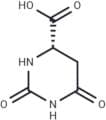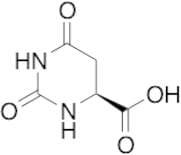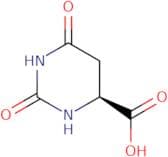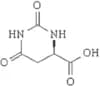
CAS 5988-19-2
:L-Dihydroorotsäure
Beschreibung:
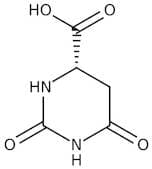
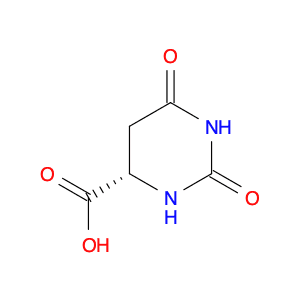
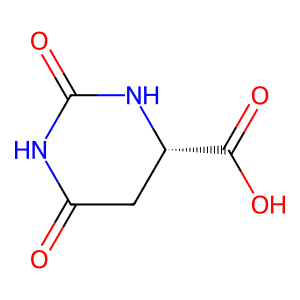
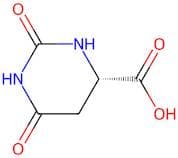
L-Dihydroorotsäure, mit der CAS-Nummer 5988-19-2, ist ein Pyrimidinderivat, das eine entscheidende Rolle in der Biosynthese von Nukleotiden spielt, insbesondere im de novo-Syntheseweg von Pyrimidinen. Es ist ein weißes bis off-white kristallines Feststoff, das in Wasser löslich ist und eine leicht saure Natur aufweist. Die Verbindung zeichnet sich durch ihre Fähigkeit aus, Oxidation zu durchlaufen und Orotinsäure zu bilden, die ein wichtiger Vorläufer in der Synthese von Nukleinsäuren ist. L-Dihydroorotsäure ist an verschiedenen biologischen Prozessen beteiligt, einschließlich des Zellstoffwechsels und der Regulierung des Zellwachstums. Seine Strukturformel umfasst eine Dihydroorotinsäure-Einheit, die einen Pyrimidinring mit zwei Carbonsäuregruppen aufweist. Diese Verbindung ist von Interesse in der Pharmakologie und Biochemie, insbesondere wegen ihrer potenziellen therapeutischen Anwendungen bei Erkrankungen, die mit dem Nukleotidstoffwechsel zusammenhängen. Darüber hinaus dient sie als Substrat für Enzyme wie die Dihydroorotat-Dehydrogenase, die ein Ziel für bestimmte Krebs- und Immunsuppressiva ist.
Formel:C5H6N2O4
InChl:InChI=1/C5H6N2O4/c8-3-1-2(4(9)10)6-5(11)7-3/h2H,1H2,(H,9,10)(H2,6,7,8,11)/t2-/m0/s1
InChI Key:InChIKey=UFIVEPVSAGBUSI-REOHCLBHSA-N
SMILES:C(O)(=O)[C@@H]1CC(=O)NC(=O)N1
Synonyme:- (4S)-2,6-Dioxo-1,3-diazinane-4-carboxylic acid
- (4S)-Hexahydro-2,6-dioxo-4-pyrimidinecarboxylic acid
- (S)-2,6-Dioxohexahydropyrimidine-4-carboxylic acid
- 4-Pyrimidinecarboxylic acid, hexahydro-2,6-dioxo-, (4S)-
- 4-Pyrimidinecarboxylic acid, hexahydro-2,6-dioxo-, (S)-
- <span class="text-smallcaps">L</span>-5,6-Dihydroorotic acid
- <span class="text-smallcaps">L</span>-Dihydroorotate
- <span class="text-smallcaps">L</span>-Dihydroorotic acid
- Hydroorotic acid, <span class="text-smallcaps">L</span>-
- L-Dihydroorotic acid
- Hydroorotic acid, L-
- L-Dihydroorotate
- Adenosine-5'-diphosphoric acid Na2
- Guanosine-5-diphosphate disodiun
- 2,6-Dioxohexahydro-4-pyrimidinecarboxylic acid
- Guanosine-5-monophosphate disodiun
- Adenosine-5-triphosphoric acid Na2
- Deoxyribonucein acid(fish sperm)
- DIHYDRO-L-OROTIC ACID
- Guanosine-5'-triphosphate disodiun
- Inosine-5-triphosphate trisodium
- L-HYDROOROTIC ACID
- Ribonuclein acid,yeast
- (S)-2,6-Dioxohexahydro-4-pyrimidinecarboxylic acid
- (S)-(+)-HYDROOROTIC ACID
- L-4,5-Dihydroorotic acid~(S)-(+)-2,6-Dioxohexahydro-4-pyrimidinecarboxylic acid
- t-Ribonuclein acid,yeast
- (S)-Dihydroorotate
- Weitere Synonyme anzeigen
Sortieren nach
Reinheit (%)
0
100
|
0
|
50
|
90
|
95
|
100
9 Produkte.
L-Dihydroorotic acid, 98%
CAS:L-Dihydroorotic acid a metabolite. This Thermo Scientific Chemicals brand product was originally part of the Alfa Aesar product portfolio. Some documentation and label information may refer to the legacy brand. The original Alfa Aesar product / item code or SKU reference has not changed as a part ofFormel:C5H6N2O4Reinheit:98%Molekulargewicht:158.11(4S)-2,6-dioxo-1,3-diazinane-4-carboxylic acid
CAS:Formel:C5H6N2O4Reinheit:98%Farbe und Form:SolidMolekulargewicht:158.1121L-Dihydroorotic acid
CAS:L-Dihydroorotic acid, found in eukaryotes, is involved in pyrimidine metabolism and several disorders including orotic aciduria.Formel:C5H6N2O4Reinheit:99.88% - 99.93%Farbe und Form:White To Off-White Crystalline PowderMolekulargewicht:158.11L-Dihydroorotic acid
CAS:Kontrolliertes ProduktApplications L-Dihydroorotic acid is used as a reactant in the preparation of long acting Gonadotrophin-releasing hormone (GnRH) antagonist containing p-ureido-phenylalanine.
References Jiang, G., et al.: J. Med. Chem., 44, 453 (2001);Formel:C5H6N2O4Farbe und Form:NeatMolekulargewicht:158.11L-Dihydroorotic acid
CAS:L-Dihydroorotic acid is a natural compound that can be found in plants, animals and humans. It has been shown to have an important role in mitochondrial functions, as it is involved in the synthesis of NADH and ATP. L-Dihydroorotic acid can also be used as a substrate for enzymatic reactions, such as dehydrogenase or dihydroorotate dehydrogenase. The rate constants for these reactions are high, which makes L-dihydroorotic acid a good model system for studying biochemical properties. L-dihydroorotic acid also inhibits cyclin D2/CDK4 protein kinases.Formel:C5H6N2O4Reinheit:Min. 95%Farbe und Form:White PowderMolekulargewicht:158.11 g/mol