CAS 59880-97-6
:N-Formyl-L-methionyl-L-leucyl-L-phenylalanin
Beschreibung:
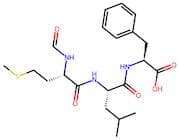
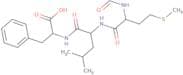
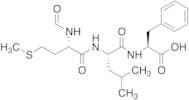
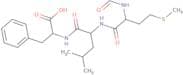
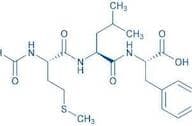
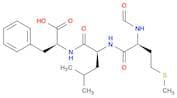
N-Formyl-L-methionyl-L-leucyl-L-phenylalanin, mit der CAS-Nummer 59880-97-6, ist ein synthetisches Peptid, das aus drei Aminosäuren besteht: Methionin, Leucin und Phenylalanin, mit einer Formylgruppe, die am Aminoterminus des Methioninrestes angebracht ist. Diese Verbindung zeichnet sich durch ihre spezifische Aminosäuresequenz aus, die zu ihrer biologischen Aktivität und potenziellen Anwendungen in der biochemischen Forschung beiträgt. Peptide wie dieses zeigen oft Eigenschaften wie Löslichkeit in polaren Lösungsmitteln, Stabilität unter physiologischen Bedingungen und die Fähigkeit, mit biologischen Rezeptoren oder Enzymen zu interagieren. Die Anwesenheit der Formylgruppe kann die Reaktivität des Peptids und seine Rolle in verschiedenen biochemischen Wegen beeinflussen. N-Formyl-L-methionyl-L-leucyl-L-phenylalanin kann auch als Modellverbindung zur Untersuchung der Peptidsynthese, der Struktur-Aktivitäts-Beziehungen und der Mechanismen der peptidvermittelten Signalübertragung in biologischen Systemen dienen. Seine einzigartige Struktur macht es zu einem interessanten Thema in Bereichen wie der medizinischen Chemie und der Pharmakologie.
Formel:C8H12ClNO
InChl:InChI=1/C21H31N3O5S/c1-14(2)11-17(23-19(26)16(22-13-25)9-10-30-3)20(27)24-18(21(28)29)12-15-7-5-4-6-8-15/h4-8,13-14,16-18H,9-12H2,1-3H3,(H,22,25)(H,23,26)(H,24,27)(H,28,29)/t16-,17-,18-/m0/s1
InChI Key:InChIKey=PRQROPMIIGLWRP-BZSNNMDCSA-N
SMILES:[C@H](C(N[C@@H](CC1=CC=CC=C1)C(O)=O)=O)(NC([C@H](CCSC)NC=O)=O)CC(C)C
Synonyme:- 3: PN: WO2010089019 PAGE: 22 claimed protein
- 4-(2-Aminoethyl)Phenol Hydrochloride (1:1)
- 4-Hydroxy-phenethylamine hydrochloride
- <span class="text-smallcaps">L</smallcap>-Phenylalanine, N-[N-(N-formyl-<smallcap>L</smallcap>-methionyl)-<smallcap>L</span>-leucyl]-
- <span class="text-smallcaps">L</smallcap>-Phenylalanine, N-formyl-<smallcap>L</smallcap>-methionyl-<smallcap>L</span>-leucyl-
- For-Met-Leu-Phe-OH
- Formyl-Met-Leu-Phe-OH
- N-Formyl-<span class="text-smallcaps">L</smallcap>-methionyl-<smallcap>L</smallcap>-leucyl-<smallcap>L</span>-phenylalanine
- N-Formyl-Met-Leu-Phe
- N-Formyl-Met-Leu-Phe-OH
- N-Formyl-methionyl-leucyl-phenylalanine
- N-formylmethionylleucylphenylalanine
- NSC 350593
- L-Phenylalanine, N-formyl-L-methionyl-L-leucyl-
- L-Phenylalanine, N-[N-(N-formyl-L-methionyl)-L-leucyl]-
- N-Formyl-L-methionyl-L-leucyl-L-phenylalanine
- fMLF
- 4-HYDROXYPHENYLETHYLAMINE HCL
- 4-HYDROXYPHENETHYLAMINE HYDROCHLORIDE
- fMLP (misnomer but widely used)
- F-MET-LEU-PHE
- TYRAMINE MONOHYDROCHLORIDE
- 4-(2-AMINOETHYL)PHENOL HYDROCHLORIDE
- P-HYDROXYPHENETHYLAMINE HYDROCHLORIDE
- TYRAMINE HCL(P)
- TYRAMINE HCL
- TIMTEC-BB SBB003808
- P-(2-AMINOETHYL)PHENOL HYDROCHLORIDE
- 2-(4-HYDROXYPHENYL)ETHYLAMMONIUM CHLORIDE
- TYROSAMINE HCL
- TYROSAMINE HYDROCHLORIDE
- TYRAMINE
- 2-(4-HYDROXYPHENYL)ETHYLAMINE HYDROCHLORIDE
- 4-HYDROXYPHENYLETHYLAMINE HYDROCHLORIDE
- 2-(4-HYDROXYPHENYL)ETHYLAMINE HCL
- Weitere Synonyme anzeigen
Sortieren nach
Reinheit (%)
0
100
|
0
|
50
|
90
|
95
|
100
14 Produkte.
N-Formyl-L-methionyl-L-leucyl-L-phenylalanine
CAS:Formel:C21H31N3O5SReinheit:>98.0%(HPLC)Farbe und Form:White to Almost white powder to crystalMolekulargewicht:437.56Chemotactic Peptide
CAS:For cellular and molecular biology applicationsFormel:C21H31N3O5SFarbe und Form:White to pale cream, Lyophilized PowderMolekulargewicht:437.56For-Met-Leu-Phe-OH
CAS:There is evidence that pretreatment of human polymorphonuclear neutrophils (PMN) with fMLF results in the inhibition of TNF-α secretion, which indicates that this typical proinflammatory agent could play, at least at determined conditions, an antiinflammatory role.Formel:C21H31N3O5SReinheit:99.7%Farbe und Form:White PowderMolekulargewicht:437.56TYRAMINE HYDROCHLORIDE
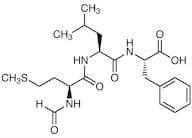
CAS:Formel:C21H31N3O5SReinheit:97%Farbe und Form:SolidMolekulargewicht:437.5529N-formyl-[U-13C-15N]-Met-Leu-Phe-OH
CAS:N-formyl-[U-13C-15N]-Met-Leu-Phe-OHReinheit:98%Molekulargewicht:437.55g/molN-Formyl-Met-Leu-Phe
CAS:N-Formyl-Met-Leu-Phe (N-Formyl-MLF) (fMLF) is a synthetic peptide that acts as an agonist at formyl peptide receptors (FPR; Ki = 0.8 pM).Formel:C21H31N3O5SReinheit:98.69% - 98.69%Farbe und Form:SolidMolekulargewicht:437.55N-Formyl-Met-Leu-Phe
CAS:Custom research peptide; min purity 95%. For different specs please use the Peptide Quote ToolFormel:C21H31N3O5SMolekulargewicht:437.6 g/molChemotactic Peptide
CAS:As a chemotactic peptide, For-Met-Leu-Phe (FMLP) has chemotactic properties, which means it can attract cells. For example it is a chemoattractant for phagocytic leukocytes and neutrophils. Neutrophils which have seven transmembrane G-protein coupled receptors are activated during the acute inflammatory response by FMLP and other chemotactic factors which bind to its surface receptors. This results in the activate of NF- κB, MAPK and PI3K pathways. In particular FMLP is known to induce Interleukin-8 (IL-8) which is responsible for both tissue damage and the pathogenesis of inflammatory processes resulting from neutrophils. Chemotactic peptide have been used to study the function of polymorphonuclear leukocytes and other white blood cells in inflammation. Chemotactic peptides are often used as fluorescent probes to measure intracellular metabolic responses to chemoattractant stimulation. This product is available as a 0.5mg vial.Formel:C21H31N3O5SReinheit:Min. 95%Molekulargewicht:437.55 g/molN-Formyl-Met-Leu-Phe
CAS:Kontrolliertes ProduktApplications N-Formyl-Met-Leu-Phe is an inducer of superoxide release and agonist for FPR1.
Formel:C21H31N3O5SFarbe und Form:NeatMolekulargewicht:437.55Chemotactic Peptide
CAS:Chemotactic peptides are peptides that possess chemotactic properties, which means they attract cells. One well-known chemotactic peptide is For-Met-Leu-Phe (FMLP) and is a chemoattractant for phagocytic leukocytes and neutrophils. During the acute inflammatory response chemotactic factors activate neutrophils which have seven transmembrane G-protein coupled receptors. FMLP bind to these G-protein coupled receptors on the surface of neutrophils and activate NF- κB, MAPK and PI3K pathways. In particular FMLP is known to induce Interleukin-8 (IL-8) which is responsible for both tissue damage and the pathogenesis of inflammatory processes resulting from neutrophils. Chemotactic peptide have been used to study the function of polymorphonuclear leukocytes and other white blood cells in inflammation. Chemotactic peptides are often used as fluorescent probes to measure intracellular metabolic responses to chemoattractant stimulation.Formel:C21H31N3O5SReinheit:Min. 95%Molekulargewicht:437.55 g/mol





![N-formyl-[U-13C-15N]-Met-Leu-Phe-OH](/_next/image/?url=https%3A%2Fstatic.cymitquimica.com%2Fproducts%2F54%2Fthumb%2FOR1023295.jpg&w=3840&q=75)