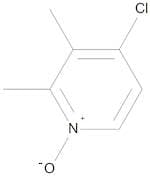
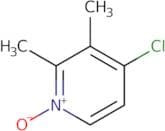
CAS 59886-90-7
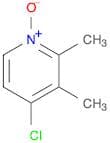
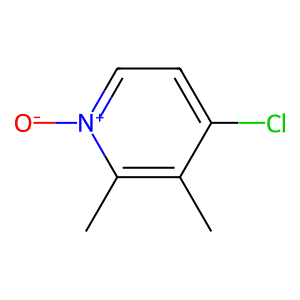
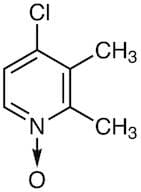
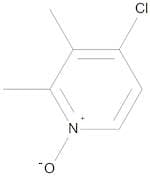
:4-Chlor-2,3-dimethylpyridin-N-oxid
- 2,3-Dimethyl-4-chloropyridineN-oxide
- 2,3-dimethyl-4-chloropydine N-oxide
- 4-Chloro-2,3-Dimethyl-1-Oxo-1,2-Dihydropyridinium
- 4-Chloro-2,3-Dimethylpyridine 1-Oxide
- 4-Chloro-2,3-dimethylpyridine-N-oxide
- NSC 275262
- Pyridine, 4-chloro-2,3-dimethyl-, 1-oxide
Pyridine, 4-chloro-2,3-dimethyl-, 1-oxide
CAS:Formel:C7H8ClNOReinheit:98%Farbe und Form:SolidMolekulargewicht:157.59754-Chloro-2,3-dimethylpyridine N-oxide
CAS:4-Chloro-2,3-dimethylpyridine N-oxideReinheit:95%Farbe und Form:SolidMolekulargewicht:157.60g/mol4-Chloro-2,3-dimethylpyridine N-Oxide
CAS:Formel:C7H8ClNOReinheit:>98.0%(GC)(T)Farbe und Form:White to Light yellow to Light orange powder to crystalMolekulargewicht:157.604-Chloro-2,3-dimethylpyridine N-Oxide
CAS:Kontrolliertes ProduktFormel:C7H8ClNOFarbe und Form:NeatMolekulargewicht:157.604-Chloro-2,3-dimethylpyridine N-Oxide
CAS:Kontrolliertes ProduktApplications An intermediate in the synthesis of rabeprazole (R070500).
Formel:C7H8ClNOFarbe und Form:NeatMolekulargewicht:157.64-Chloro-2,3-dimethylpyridine 1-oxide
CAS:Formel:C7H8ClNOReinheit:97.0%Farbe und Form:SolidMolekulargewicht:157.64-Chloro-2,3-dimethylpyridine N-oxide
CAS:4-Chloro-2,3-dimethylpyridine N-oxide is a chemical compound that belongs to the class of medicines. It is used in the manufacture of hydrogen peroxide, which is an oxidizing agent and a bleaching agent. 4-Chloro-2,3-dimethylpyridine N-oxide has been used as a reagent for organic synthesis and as a catalyst in organic reactions. This compound also has the ability to inhibit proton pumps, which are membrane proteins that pump protons across biological membranes. The presence of sodium impurities can lead to scaling problems because it affects the solubility of 4-chloro-2,3-dimethylpyridine N-oxide. The exothermic reaction with chlorine leads to the formation of chloride, sulfoxide, and chloride ions. These products are more soluble than 4-chloro-2,3-dimethylpyridine N-oxide itself.
Formel:C7H8ClNOReinheit:Min. 95%Farbe und Form:Off-White PowderMolekulargewicht:157.6 g/mol