CAS 60-32-2
:6-Aminocapronsäure
Beschreibung:
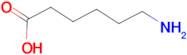
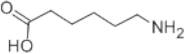
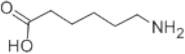
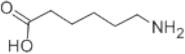
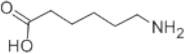
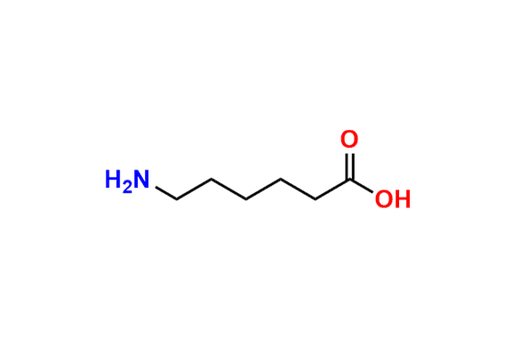
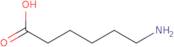
6-Aminocapronsäure, auch bekannt als ε-Aminocapronsäure, ist eine sechsatomige Aminosäure mit der chemischen Formel C6H13NO2. Sie weist eine Aminogruppe (-NH2) und eine Carbonsäuregruppe (-COOH) in ihrer Kohlenstoffkette auf, was sie zu einer vielseitigen Verbindung in biochemischen Anwendungen macht. Dieses farblose, kristalline Feststoff ist in Wasser löslich und zeigt aufgrund seiner Carbonsäuregruppe eine leicht saure Natur. 6-Aminocapronsäure wird hauptsächlich in der Synthese von Polyamiden, insbesondere Nylon-6, verwendet und dient als Baustein in verschiedenen chemischen Reaktionen. Darüber hinaus hat es Anwendungen in der Medizin, insbesondere als antifibrinolytisches Mittel zur Verringerung von Blutungen während der Operation. Die Verbindung wird allgemein als sicher angesehen, wenn sie angemessen verwendet wird, kann jedoch bei einigen Personen Nebenwirkungen verursachen. Ihre strukturellen Eigenschaften ermöglichen es ihr, an verschiedenen biochemischen Wegen teilzunehmen, was sie sowohl in industriellen als auch in pharmazeutischen Kontexten bedeutend macht.
Formel:C6H13NO2
InChl:InChI=1S/C6H13NO2/c7-5-3-1-2-4-6(8)9/h1-5,7H2,(H,8,9)
InChI Key:InChIKey=SLXKOJJOQWFEFD-UHFFFAOYSA-N
SMILES:C(CC(O)=O)CCCN
Synonyme:- 177 J.D.
- 6-Amino-n-hexanoic acid
- 6-Aminohexanoate
- 6-Aminohexanoic acid
- A 14719
- ACS
- Acepramin
- Acepramine
- Acide aminocaproique
- Acido Aminocaproico
- Acikaprin
- Afibrin
- Amicar
- Amikar
- Aminocaproic acid
- Aminocapronsaure
- Aminokapron
- An 0064-1
- Caplamin
- Capramol
- Caprocid
- Caproic acid, ε-amino-
- Caprolisin
- Cl 10304
- Cy 116
- E-Aminocaproic Acid
- Eaca
- Eacs
- Epsamon
- Epsicapron
- Epsikapron
- Epsilcapramin
- Epsilon S
- Epsilon-Aminocapronsaeure
- H-6-Aca-OH
- H-6-Ahx-OH
- H-EAhx-OH
- Hemocaprol
- Hemopar
- Hepin
- Hexanoic acid, 6-amino-
- Ipsilon
- Nsc 212532
- Nsc 26154
- Nsc 400230
- Respramin
- epsilon-Aminocaproic acid
- ε-Amino-n-caproic acid
- ε-Amino-n-hexanoic acid
- ε-Aminohexanoic acid
- ε-Leucine
- ε-Norleucine
- ω-Aminocaproic acid
- Weitere Synonyme anzeigen
Filtern nach
Reinheitsanteil
0
100
|
0
|
50
|
90
|
95
|
100
- Niedrigster Preis
- Höchster Preis
- Niedrigste Reinheit
- Höchste Reinheit
- Schnellste Lieferung
6-Aminocaproic Acid extrapure, 99%
CAS:Formel:C6H13NO2Reinheit:min. 99%Farbe und Form:White, Crystalline powder, Clear, ColourlessMolekulargewicht:131.17Aminocaproic Acid IP
CAS:Formel:C6H13NO2Reinheit:98.5 - 101.0%Farbe und Form:Colourless or white, Crystals, crystalline powder, 20% aq. solution clear and colourless for 24 hrs.Molekulargewicht:131.17Aminocaproic Acid BP, 98.5-101%
CAS:Formel:C6H13NO2Reinheit:98.5 - 101.0%Farbe und Form:Whiteor almost white , Colourless, Crystalline powder, Crystals, Clear on standing standing 24hrs., Colourless, Solution S is colourless and remains clear on standing 24 hrs.Molekulargewicht:131.17Aminocaproic Acid USP, 98.5-101%
CAS:Formel:C6H13NO2Reinheit:98.5 -101.5% (On anhydrous bassis)Farbe und Form:White or almost white , colourless, Crystalline powder or crystalsMolekulargewicht:131.17Aminocaproic acid
CAS:Aminocaproic acid is a non-specific lysing agent that is used in the treatment of acute blood clots. Aminocaproic acid has minimal toxicity and low-dose effects, and can be used for the treatment of thrombotic disorders. It also has biological properties that are different from those of aminocaproate, which can lead to a more rapid dissolution of the clot. Aminocaproic acid is an organic compound that belongs to the class of dicarboxylic acids. It is synthesized from two molecules of aminoacetic acid by the enzyme aminocaproic acid synthetase. The synthesis occurs in a two-step process: first, caprylic acid reacts with ATP to form aminopropyl-adenylate (APA), followed by hydrolysis by APA lyase to form aminocaproic acid.Formel:C6H13NO2Farbe und Form:PowderMolekulargewicht:131.17 g/mol