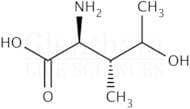
CAS 6001-78-8
:4-Hydroxyisoleucin
Beschreibung:
4-Hydroxyisoleucin ist ein natürlich vorkommendes Aminosäurederivat, das hauptsächlich in den Samen der Hülsenfrucht Mucuna pruriens vorkommt. Es wird als nicht-proteinogene Aminosäure klassifiziert, was bedeutet, dass es während der Translation nicht in Proteine eingebaut wird. Diese Verbindung ist bemerkenswert für ihre potenziellen gesundheitlichen Vorteile, insbesondere im Kontext der metabolischen Regulation und der Insulinempfindlichkeit. 4-Hydroxyisoleucin ist bekannt dafür, die Insulinsekretion als Reaktion auf Glukose zu erhöhen, was es in der Diabetesforschung von Interesse macht. Die Substanz zeichnet sich durch ihre Hydroxylgruppe aus, die zu ihrer Löslichkeit in Wasser und ihrer Reaktivität beiträgt. Sie wurde hinsichtlich ihrer Rolle bei der Förderung des Muskelwachstums und des Fettabbaus sowie ihrer potenziellen antioxidativen Eigenschaften untersucht. Die molekulare Struktur umfasst eine verzweigte Kettenkonfiguration, die typisch für Isoleucin-Derivate ist und ihre biologische Aktivität beeinflusst. Insgesamt ist 4-Hydroxyisoleucin eine Verbindung von großem Interesse in der Ernährungswissenschaft und Pharmakologie, mit laufenden Forschungen, die ihre therapeutischen Anwendungen untersuchen.
Formel:C6H13NO3
InChl:InChI=1/C6H13NO3/c1-3(4(2)8)5(7)6(9)10/h3-5,8H,7H2,1-2H3,(H,9,10)
SMILES:CC(C(C)O)C(C(=O)O)N
Synonyme:- 4-Hydroxy-L-isoleucine
- 2-Amino-4-Hydroxy-3-Methylpentanoic Acid (Non-Preferred Name)
- (2S,3R)-2-Amino-4-hydroxy-3-methylpentanoic acid
- L-erythro-Pentonic acid, 2-amino-2,3,5-trideoxy-3-methyl-, (4ξ)-
- L-4-Hydroxyisoleucine
- (4S)-4-Hydroxy-L-isoleucine
Sortieren nach
Reinheit (%)
0
100
|
0
|
50
|
90
|
95
|
100
2 Produkte.
Corosolic acid
CAS:Corosolic acid, a natural compound found in the bark of the Chinese Corosolic tree, has been shown to have hypoglycemic effects in mice. This compound inhibits the activity of glucose-6-phosphatase and phosphoenolpyruvate carboxykinase (PEPCK), two enzymes responsible for gluconeogenesis. Corosolic acid also stimulates insulin release from pancreatic β cells by activating protein kinase B (also called Akt) and inhibiting protein kinase C. These effects are mediated through modulation of target enzymes such as protein kinases A and C, glycogen synthase kinase 3β, and GSK3β. The molecular docking analysis has shown that corosolic acid binds to these enzymes with high affinity.Formel:C30H48O4Reinheit:Min. 95%Molekulargewicht:472.7 g/mol