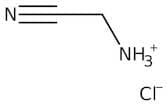
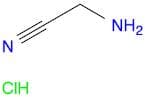
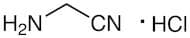
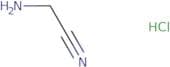
CAS 6011-14-9
:Acetonitril, 2-amino-, Hydrochlorid (1:1)
- 2-Aminoacetonitrile hydrochloride
- 2-AminoacetonitrileHydrochloride
- Acetonitrile, 2-amino-, hydrochloride (1:1)
- Acetonitrile, amino-, monohydrochloride
- Alpha-Aminoacetonitrilehydrochloride
- Amino acetonitrile HCL
- Amino-Acetonitrile sulfate
- Amino-Acetonitrilmonohydrochloride
- Aminoacetonitrile hydrochloride
- Aminoacetonitrile monohydrochloride
- Aminoacetonitrilemonohydrochloride
- Cyanomethanamine hydrochloride
- Cyanomethanaminium Chloride
- Glycinonitrile,Monohydrochloride
- Weitere Synonyme anzeigen
Aminoacetonitrile hydrochloride, 98+%
CAS:Used as pharmaceutical intermediates, organic synthetic raw material transportation. This Thermo Scientific Chemicals brand product was originally part of the Alfa Aesar product portfolio. Some documentation and label information may refer to the legacy brand. The original Alfa Aesar product / itemFormel:C2H5ClN2Reinheit:98+%Farbe und Form:White to pale brown, powderMolekulargewicht:92.532-Aminoacetonitrile hydrochloride
CAS:2-Aminoacetonitrile hydrochlorideReinheit:98%Molekulargewicht:92.53g/molAminoacetonitrile Hydrochloride
CAS:Formel:C2H4N2·HClReinheit:>98.0%(T)Farbe und Form:White to Light yellow powder to crystalMolekulargewicht:92.53Aminoacetonitrile Hydrochloride
CAS:Kontrolliertes ProduktApplications Aminoacetonitrile is a useful synthetic intermediate. It is a reagent used to synthesize dipeptide nitriles as reversible and potent cathepsin S inhibitors. It can also used to prepare substituted cyclic ureas as possible HIV protease inhibitors.
References Ward, Y., et al.: J. Med. Chem., 45, 5471 (2002); Wilkerson, W., et al.: J. Med. Chem., 40, 4079 (1997)Formel:C2H5ClN2Farbe und Form:White To Off-WhiteMolekulargewicht:92.53Aminoacetonitrile hydrochloride
CAS:Formel:C2H5ClN2Reinheit:95%Farbe und Form:Solid, Crystalline Powder or PowderMolekulargewicht:92.53Aminoacetonitrile HCl
CAS:Aminoacetonitrile HCl is a chemical compound that has been used in pharmaceutical preparations for the treatment of autoimmune diseases. It has been shown to inhibit the growth of Streptococcus faecalis and other bacteria by forming reversible covalent bonds with proteins, which inhibits enzymatic activity and protein synthesis. Aminoacetonitrile HCl also reacts with amino groups on proteins, leading to an acylation reaction that prevents interactions with other molecules. This effect is specific to toll-like receptor (TLR) signaling, which plays a role in the immune response to infection. Aminoacetonitrile HCl has also been shown to be effective against cancer cells and restenosis in animal models.
Formel:C2H4N2·HClReinheit:Min. 95%Farbe und Form:White PowderMolekulargewicht:92.53 g/mol