CAS 60115-45-9
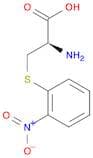
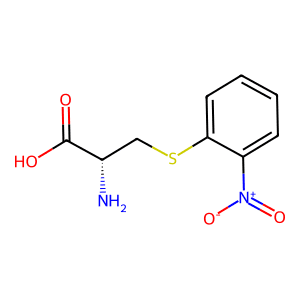
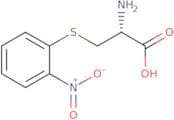
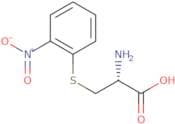
:S-(2-nitrophenyl)-L-cystein
- L-Cysteine, S-(2-nitrophenyl)-
(R)-2-Amino-3-((2-nitrophenyl)thio)propanoic acid
CAS:Formel:C9H10N2O4SReinheit:95%Farbe und Form:SolidMolekulargewicht:242.2517(R)-2-Amino-3-((2-nitrophenyl)thio)propanoic acid
CAS:(R)-2-Amino-3-((2-nitrophenyl)thio)propanoic acidReinheit:95%Molekulargewicht:242.26g/molS-2-Nitrophenyl-L-cysteine
CAS:S-2-Nitrophenyl-L-cysteine is a synthetic substrate that is used to measure the activity of bacterial enzyme nitroreductase. It has been shown to be an efficient method for determining the kinetic parameters and reaction mechanism of nitroreductase. The reaction can be carried out at different pH values, and it is possible to determine the substrate binding affinity and hydrogen bond formation by comparing the rates at different pH levels. Trifluoroacetic acid is used as a catalyst in this reaction, which causes an increase in the rate of reaction by promoting proton transfer from water to the substrate.
Formel:C9H10N2O4SReinheit:Min. 95%Farbe und Form:PowderMolekulargewicht:242.25 g/molS-2-Nitrophenyl-L-cysteine
CAS:S-2-Nitrophenyl-L-cysteine is a high quality research chemical that is a versatile building block for the synthesis of other fine chemicals. CAS No. 60115-45-9, it is a useful intermediate in the synthesis of complex compounds and has been used as a reaction component in the production of speciality chemicals. S-2-Nitrophenyl-L-cysteine can be used as a reagent to produce high purity products and has been shown to be an effective scaffold for the synthesis of new drugs.
Formel:C9H10N2O4SReinheit:Min. 98.0 Area-%Molekulargewicht:242.26 g/molRef: 3D-N-4106
25gNachfragen50gNachfragen100gNachfragen250gNachfragen500gNachfragen-Unit-ggNachfragen