CAS 6018-41-3
:Methylcoumalat
Beschreibung:
Methylcoumalat, mit der CAS-Nummer 6018-41-3, ist eine organische Verbindung, die zur Klasse der Cumarin-Derivate gehört. Sie ist durch ihre Esterfunktionalität gekennzeichnet, die aus der Reaktion von Cumarsäure und Methanol entsteht. Diese Verbindung erscheint typischerweise als farblose bis blassgelbe Flüssigkeit mit einem angenehmen, süßen Aroma, was sie für die Duft- und Geschmacksindustrie von Interesse macht. Methylcoumalat ist bekannt für seine Löslichkeit in organischen Lösungsmitteln, während seine Löslichkeit in Wasser begrenzt ist. Sie zeigt eine moderate Flüchtigkeit und kann licht- und wärmeempfindlich sein, was ihre Stabilität beeinträchtigen kann. In Bezug auf die Reaktivität kann Methylcoumalat an verschiedenen chemischen Reaktionen teilnehmen, einschließlich Hydrolyse und Transesterifizierung. Ihre potenziellen Anwendungen gehen über Aromatisierung und Duft hinaus, da sie auch als Baustein in der organischen Synthese dienen kann. Sicherheitsdaten zeigen, dass, wie viele organische Verbindungen, sie mit Vorsicht behandelt werden sollte, um Inhalation oder Hautkontakt zu vermeiden.
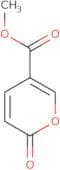
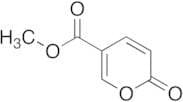
Formel:C7H6O4
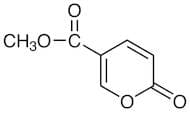
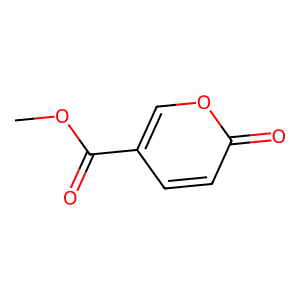
InChl:InChI=1S/C7H6O4/c1-10-7(9)5-2-3-6(8)11-4-5/h2-4H,1H3
InChI Key:InChIKey=HHWWWZQYHPFCBY-UHFFFAOYSA-N
SMILES:C(OC)(=O)C=1C=CC(=O)OC1
Synonyme:- 2H-Pyran-5-carboxylic acid, 2-oxo-, methyl ester
- 2H-Pyran-5-carboxylic acid, 2-oxo-, methyl ester (8CI)(9CI)
- 5-(Carbomethoxy)-2-pyrone
- 5-(Methoxycarbonyl)-2-pyrone
- Coumalic acid, methyl ester
- Cumalic acid methyl ester
- Glutaconic acid, 4-(hydroxymethylene)-, δ-lactone, methyl ester
- Methyl 2-oxo-2H-pyran-5-carboxylate
- Methyl 2-pyrone-5-carboxylate
- Methyl cumalate
- Nsc 137387
- Nsc 34627
- Weitere Synonyme anzeigen
Sortieren nach
Reinheit (%)
0
100
|
0
|
50
|
90
|
95
|
100
7 Produkte.
Methyl Coumalate
CAS:Formel:C7H6O4Reinheit:>96.0%(GC)Farbe und Form:White to Orange to Green powder to crystalMolekulargewicht:154.12Methyl coumalate, 98%
CAS:Methyl coumalate is a 2-pyrone and acts as dienophile in Diels-Alder reaction. It reacts with 1,3-butadienes at 100C to yield tetrahydrocoumarins and 4-methoxycarbonyltricyclo[3.2.1.02,7]octenes. It also reacts with cyclohexadiene to afford tetrahydronaphthalene-2-carboxylate. It undergoes Diels-AlFormel:C7H6O4Reinheit:98%Farbe und Form:White to cream to pale yellow, PowderMolekulargewicht:154.12Ref: IN-DA00E923
1kgNachfragen5kgNachfragen1g22,00€250mg22,00€5g37,00€10g48,00€25g75,00€50g123,00€100g196,00€250g326,00€500g573,00€Methyl 2-oxo-2H-pyran-5-carboxylate
CAS:Methyl 2-oxo-2H-pyran-5-carboxylateReinheit:97%Farbe und Form:White-Pale Yellow PowderMolekulargewicht:154.12g/mol2-Oxo-2H-pyran-5-carboxylic acid methyl ester
CAS:2-Oxo-2H-pyran-5-carboxylic acid methyl ester is an activated form of 2-oxopyran. It reacts with nucleophiles, such as malic acid, to form ethyl esters. This reaction is an example of the Friedel-Crafts reaction, which is a type of electrophilic aromatic substitution. The rate of this reaction depends on the activation energies and fluorescence properties of the reactants. The mechanism for this reaction is that the double bond in the carbonyl group is ruptured by attacking nucleophiles, resulting in a release of hydrogen gas and formation of carboxylic acid derivatives. The product can be isolated using a solvent extraction technique or purified using column chromatography.Formel:C7H6O4Reinheit:Min. 98 Area-%Farbe und Form:PowderMolekulargewicht:154.12 g/molMethyl 2-Oxo-2H-pyran-5-carboxylate
CAS:Formel:C7H6O4Reinheit:97%Farbe und Form:Solid, Crystalline Powder or PowderMolekulargewicht:154.121