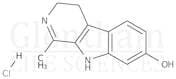
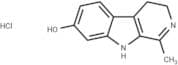
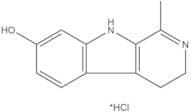
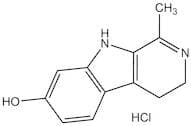
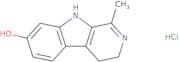
![3H-Pyrido[3,4-b]indol-7-ol, 4,9-dihydro-1-methyl-, hydrochloride (1:1)](/_next/image/?url=https%3A%2Fstatic.cymitquimica.com%2Fcas-image%2Fthumb-webp%2F343320-harmalol-hcl.webp&w=3840&q=75)
CAS 6028-07-5
:3H-Pyrido[3,4-b]indol-7-ol, 4,9-dihydro-1-methyl-, Hydrochlorid (1:1)
Beschreibung:
3H-Pyrido[3,4-b]indol-7-ol, 4,9-dihydro-1-methyl-, Hydrochlorid (1:1), mit der CAS-Nummer 6028-07-5, ist eine chemische Verbindung, die zur Klasse der Indolderivate gehört. Diese Substanz weist eine verschmolzene Struktur aus Pyridin und Indol auf, die zu ihren einzigartigen chemischen Eigenschaften beiträgt. Sie wird typischerweise als Hydrochloridsalz angetroffen, was ihre Löslichkeit in Wasser erhöht und sie für verschiedene Anwendungen, einschließlich biologischer Studien, geeigneter macht. Die Verbindung kann biologische Aktivität zeigen, die möglicherweise Neurotransmittersysteme beeinflusst oder als Vorläufer in synthetischen Wegen dient. Ihre molekulare Struktur umfasst eine Hydroxylgruppe, die an Wasserstoffbrückenbindungen teilnehmen kann, was ihre Reaktivität und Wechselwirkungen mit anderen Molekülen beeinflusst. Die Eigenschaften der Verbindung, wie Schmelzpunkt, Löslichkeit und Stabilität, können je nach Umweltbedingungen und dem Vorhandensein anderer Substanzen variieren. Wie bei vielen organischen Verbindungen sollten Sicherheitsdaten konsultiert werden, um den Umgang und potenzielle Gefahren in Laborumgebungen zu verstehen.
Formel:C12H13ClN2O
InChl:InChI=1/C12H12N2O.ClH/c1-7-12-10(4-5-13-7)9-3-2-8(15)6-11(9)14-12;/h2-3,6,13-14H,4-5H2,1H3;1H
InChI Key:InChIKey=BSWAWVOHMZNXOS-UHFFFAOYSA-N
SMILES:CC=1C2=C(C=3C(N2)=CC(O)=CC3)CCN1.Cl
Synonyme:- 1-Methyl-3,4-Dihydro-Beta-Carbolin-7-Ol Hydrochloride Monohydrate
- 1-Methyl-3H,4H,9H-pyrido[3,4-b]indol-7-ol hydrochloride
- 1-methyl-2,3,4,9-tetrahydro-7H-beta-carbolin-7-one hydrochloride
- 3H-Pyrido[3,4-b]indol-7-ol, 4,9-dihydro-1-methyl-, hydrochloride (1:1)
- 3H-Pyrido[3,4-b]indol-7-ol, 4,9-dihydro-1-methyl-, monohydrochloride
- Harmalol, hydrochloride
- NSC 640461
- HARMALOL HCL
- TIMTEC-BB SBB003241
- Harmidol hydrochloride
- 4,9-dihydro-1-methyl-3h-pyrido(3,4-b)indol-7-olhydrochloride
- Weitere Synonyme anzeigen
Sortieren nach
Reinheit (%)
0
100
|
0
|
50
|
90
|
95
|
100
5 Produkte.
Harmalol hydrochloride
CAS:Harmalol hydrochloride, a β-carboline from Peganum harmala seeds, inhibits CYP1A1 and shows vasorelaxant and antioxidant properties.Formel:C12H13ClN2OReinheit:99.88%Farbe und Form:SolidMolekulargewicht:236.7Harmalol hydrochloride
CAS:Natural alkaloidFormel:C12H12N2OHClReinheit:≥ 80.0 % (HPLC)Farbe und Form:PowderMolekulargewicht:236.7Harmalol Hydrochloride
CAS:Kontrolliertes ProduktHarmalol is a natural compound that has been used for centuries as a traditional medicine. Harmalol is found in the seeds of the Indian Madder plant, and it has been shown to be an effective treatment for malaria. Harmalol also inhibits mitochondrial membrane potential and induces apoptosis in murine hepatoma cells. In addition, harmalol inhibits drug-metabolizing enzymes, such as CYP3A4 and CYP2D6, which could lead to drug interactions. The effects of harmalol on mitochondrial membrane potential can be measured using a redox potential assay. Harmalol can also be analyzed using analytical methods such as chromatographic analysis or response element binding assays. Harmalol has also been shown to inhibit TNF-α production in human serum cells.Formel:C12H13ClN2OReinheit:Min. 95%Farbe und Form:PowderMolekulargewicht:236.7 g/mol