CAS 60283-51-4
:(Met(O)5)-Enkephalin
Beschreibung:
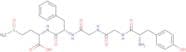
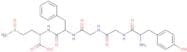
(Met(O)5)-Enkephalin, auch bekannt als eine modifizierte Form des endogenen Opioidpeptids Enkephalin, ist gekennzeichnet durch den Austausch des Methionin-Rests durch ein Sulfoxid-Derivat, was seine Stabilität und Bioaktivität verbessert. Diese Verbindung gehört zur Familie der Opioidpeptide, die eine entscheidende Rolle bei der Schmerzmodulation und Neurotransmission spielt. Die Modifikation an der Methionin-Position verändert seine pharmakologischen Eigenschaften und könnte seine Affinität zu Opioidrezeptoren erhöhen. (Met(O)5)-Enkephalin weist eine spezifische Struktur auf, die es ihm ermöglicht, mit dem Mu-Opioidrezeptor zu interagieren, was zu seinen analgetischen Effekten beiträgt. Darüber hinaus könnte seine Löslichkeit und Stabilität in biologischen Systemen aufgrund der Modifikationen verbessert werden, was es zu einem interessanten Thema in der medizinischen Chemie und der Arzneimittelentwicklung macht. Die einzigartigen Eigenschaften der Verbindung, einschließlich ihrer peptidischen Natur und der modifizierten Aminosäure, positionieren sie als wertvolles Werkzeug zur Untersuchung der Interaktionen von Opioidrezeptoren und zur Entwicklung neuer analgetischer Therapien.
Formel:C27H35N5O8S
InChl:InChI=1/C27H35N5O8S/c1-41(40)12-11-21(27(38)39)32-26(37)22(14-17-5-3-2-4-6-17)31-24(35)16-29-23(34)15-30-25(36)20(28)13-18-7-9-19(33)10-8-18/h2-10,20-22,33H,11-16,28H2,1H3,(H,29,34)(H,30,36)(H,31,35)(H,32,37)(H,38,39)/t20-,21-,22-,41?/m0/s1
SMILES:CS(=O)CC[C@@H](C(=O)O)N=C([C@H](Cc1ccccc1)N=C(CN=C(CN=C([C@H](Cc1ccc(cc1)O)N)O)O)O)O
Synonyme:- H-Tyr-Gly-Gly-Phe-Met(O)-OH
- L-tyrosylglycylglycyl-N-[(1S)-1-carboxy-3-(methylsulfinyl)propyl]-L-phenylalaninamide
Sortieren nach
Reinheit (%)
0
100
|
0
|
50
|
90
|
95
|
100
2 Produkte.
(Met(O)5)-Enkephalin
CAS:Met-enkephalin is a molecule that is formed from two of the three parts of the endorphin molecule, which are Tyr-Gly-Gly-Phe and Met(O)OH. It is a neurotransmitter that has been shown to inhibit pain in humans and animals. In coelomocytes, met-enkephalin binds to receptors on the cell membrane and inhibits the release of dopamine by binding to dopamine receptors. The sulfoxide group of this molecule can be reduced to form enkephalinase, which is an enzyme that cleaves Met(O)OH from the peptide chain. This process is not known to occur in humans or other mammals. Met-enkephalin has been localized in ganglia cells in animals, but not humans. It has also been found in messenger RNA (mRNA) for translation into protein, but it does not appear to be translated into protein in humans or other mammals.Formel:C27H35N5O8SReinheit:Min. 95%Molekulargewicht:589.66 g/mol(Met(O)5)-Enkephalin
CAS:Enkephalins are a group of endogenous peptides that are the most potent natural analgesic and have been shown to relieve pain by inhibiting neurotransmitters. The (Met(O)5)-enkephalin analog is a structural analog of the enkephalin peptide with a sulfoxide linkage at position 5. This analog has been shown to inhibit acetylcholine release from intestinal ganglia, which may be related to its effects on postsynaptic potentials and glutamate release. This compound also absorbs in the small intestine, where it is taken into the blood stream and transported to the brain. The (Met(O)5)-enkephalin analog has been shown to reduce pain in Sprague-Dawley rats, as well as inhibit intestinal transit time and stimulate intestinal motility.
Formel:C27H35N5O8SReinheit:Min. 95%Molekulargewicht:589.67 g/mol