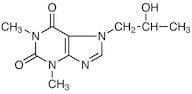
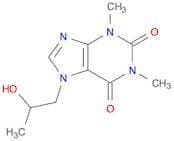
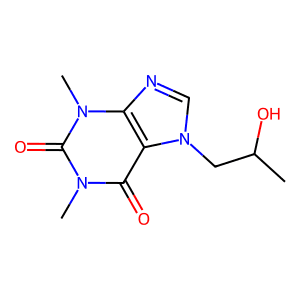
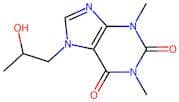
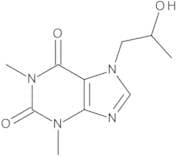
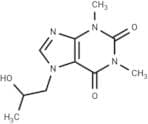
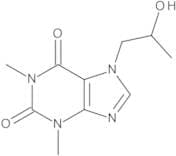
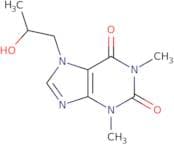
CAS 603-00-9
:Proxiphyllin
- (±)-Proxyphyllin
- 1,3-Dimethyl-7-(2-hydroxypropyl)xanthine
- 1H-Purine-2,6-dione, 3,7-dihydro-7-(2-hydroxypropyl)-1,3-dimethyl-
- 2,6-Dioxo-3,7-dihydro-7-(2-hydroxypropyl)-1,3-dimethylpurine
- 2-Hydroxypropyl-7-theophylline
- 3,7-Dihydro-7-(2-hydroxypropyl)-1,3-dimethyl-1H-purine-2,6-dione
- 7-(2-Hydroxypropyl)Theophylline
- 7-(2-hydroxypropyl)-1,3-dimethyl-3,7-dihydro-1H-purine-2,6-dione
- 7-(β-Hydroxypropyl)-1,3-dimethylxanthine
- Brontyl
- Hydroxypropyltheophylline
- Monophylline
- NSC 163343
- Oxypropyltheophylline
- Proxiphylline
- Proxy-Retardoral
- Proxyphylline
- Purophyllin
- Sanwaphyllin
- Sigophyl
- Spantin
- Spasmolysin
- Thean
- Theoden
- Theon
- Theophylline, 7-(2-hydroxypropyl)-
- Weitere Synonyme anzeigen
Proxyphylline
CAS:Formel:C10H14N4O3Reinheit:>98.0%(HPLC)(N)Farbe und Form:White to Almost white powder to crystalMolekulargewicht:238.25PROXYPHYLLINE CRS
CAS:PROXYPHYLLINE CRSFormel:C10H14N4O3Farbe und Form:Crystalline Powder. White. Powder.Molekulargewicht:238.24327-(2-hydroxypropyl)-1,3-dimethyl-2,3,6,7-tetrahydro-1H-purine-2,6-dione
CAS:Formel:C10H14N4O3Reinheit:98%Farbe und Form:SolidMolekulargewicht:238.24327-(2-Hydroxypropyl)theophylline
CAS:7-(2-Hydroxypropyl)theophyllineReinheit:99%Molekulargewicht:238.24g/molProxyphylline
CAS:Proxyphylline (7-(2-Hydroxypropyl)theophylline) is a dual of adenosine A1/A2a receptor inhibitor and phosphodiesterase (PDE) inhibitor.Formel:C10H14N4O3Reinheit:99.48%Farbe und Form:SolidMolekulargewicht:238.247-(2-Hydroxypropyl)-1,3-dimethyl-1H-purine-2,6(3H,7H)-dione
CAS:Formel:C10H14N4O3Reinheit:95.0%Molekulargewicht:238.2477-(beta-Hydroxypropyl)theophylline
CAS:Kontrolliertes ProduktApplications A metabolite of Theophylline in human plasma.
References Young, R., et al.: J. Med. Chem., 28, 201 (1993), Abraham, M., et al.: J. Pharm. Sci., 83, 1085 (1994), Caron, G., et al.: J. Med. Chem., 48, 3269 (2005),Formel:C10H14N4O3Farbe und Form:NeatMolekulargewicht:238.24Proxylphylline
CAS:Kontrolliertes ProduktProxylphylline is a methylxanthine drug that is used to treat bronchial asthma. It is an anti-inflammatory agent that acts by inhibiting phosphodiesterases, which are enzymes that break down cyclic nucleotides such as cAMP and cGMP. Proxylphylline has been shown to have inotropic effects on the heart, increasing the force of contraction and decreasing the time between contractions. This drug also reverses the bronchoconstricting effects of allergens. Proxylphylline is absorbed into cells through a chloride channel and then converted to theophylline before it inhibits phosphodiesterases. Theophylline is metabolized in the liver to 3-methylxanthine, 1-methyluric acid, and 1-methylurate.
Reinheit:Min. 95%Ref: 3D-FP43739
Ausgelaufenes produkt