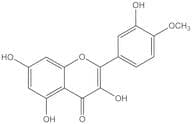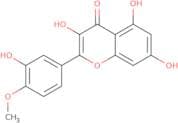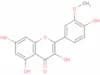
CAS 603-61-2
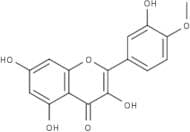
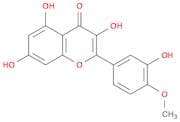
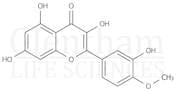
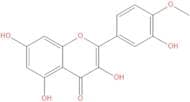
:Tamarixetin
- 3,3′,5,7-Tetrahydroxy-4′-methoxyflavone
- 3,5,7-Trihydroxy-2-(3-hydroxy-4-methoxyphenyl)-4H-1-benzopyran-4-one
- 3,5,7-Trihydroxy-2-(3-hydroxy-4-methoxyphenyl)chromen-4-one
- 3,5,7-trihydroxy-2-(3-hydroxy-4-methoxyphenyl)-2,3-dihydro-4H-chromen-4-one
- 3,5,7-trihydroxy-2-(3-hydroxy-4-methoxyphenyl)-4H-chromen-4-one
- 4'-Methoxy-3,3',5,7-tetrahydroxy-flavone
- 4'-Methoxyquercetin
- 4'-Methylquercetin
- 4'-O-Methylquercetin
- 4H-1-Benzopyran-4-one, 3,5,7-trihydroxy-2-(3-hydroxy-4-methoxyphenyl)-
- 4H-1-Benzopyran-4-one, 3,5,7-trihydroxy-2-(3-hydroxy-4-methoxyphenyl)- (9CI)
- Brn 0324993
- Flavone, 3,3',5,7-tetrahydroxy-4'-methoxy-
- Flavone, 3,3′,5,7-tetrahydroxy-4′-methoxy-
- Flavone, 4'-methoxy-3,3',5,7-tetrahydroxy-
- Quercetin, 4'-methyl ether
- Tamaraxetin
- Tamarixetin
- 3,5,7-Trihydroxy-2-(3-hydroxy-4-methoxyphenyl)-4-benzopyrone
- Weitere Synonyme anzeigen
Tamarixetin
CAS:Tamarixetin analytical standard provided with w/w absolute assay, to be used for quantitative titration.Formel:C16H12O7Reinheit:(HPLC) ≥98%Farbe und Form:PowderMolekulargewicht:316.28Tamarixetin
CAS:Tamarixetin is a natural flavonoid, derived from quercetin, with anti-inflammatory and antioxidant properties, guarding against cardiac hypertrophy.Formel:C16H12O7Reinheit:98.52% - 99.21%Farbe und Form:SolidMolekulargewicht:316.26Ref: TM-TN1039
1mg86,00€5mg177,00€1mL*10mM (DMSO)215,00€10mg260,00€25mg440,00€50mg642,00€100mg888,00€Tamarixetin
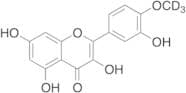
CAS:Oxygen-heterocyclic compoundFormel:C16H12O7Reinheit:≥ 90.0 % (HPLC)Molekulargewicht:316.264'-O-Methyl-d3 Quercetin (>85%)
CAS:Kontrolliertes ProduktApplications 4'-O-Methyl-d3 Quercetin is the labeled analogue of 4'-O-Methyl Quercetin (M326580), a major metabolite of the flavanoid Quercetin (Q509500) with antioxidant properties. It helps to protect H9c2 cardiomyoblasts against H2O2-induced oxidative stress via the modulation of PI3K/Akt and ERK1/2 signaling pathways.
Not a dangerous good if item is equal to or less than 1g/ml and there is less than 100g/ml in the package
References Duenas, M. et al.: Eur. Food Res. Technol., 232, 103 (2011); Ameho, C.K. et al.: J. Nutrit. Biochem., 19, 467 (2008); Angeloni, C. et al.: Biochimie, 89, 73 (2007)Formel:C16H9D3O7Reinheit:>85%Farbe und Form:NeatMolekulargewicht:319.284'-O-Methyl quercetin
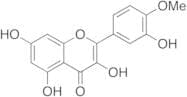
CAS:4'-O-Methyl quercetin is a naturally occurring flavonoid, which is a derivative of quercetin. It is primarily sourced from various plants where it functions as part of the plant’s defense mechanism. This compound exhibits its mode of action by influencing cellular pathways, particularly those involved in oxidative stress and inflammation. It achieves this by modulating signaling pathways and interacting with cellular receptors, thereby exerting antioxidant and anti-inflammatory effects.Formel:C16H12O7Reinheit:Min. 95%Farbe und Form:Yellow SolidMolekulargewicht:316.26 g/mol4'-O-Methyl Quercetin
CAS:Applications A major metabolite of the flavanoid Quercetin (Q509500) with antioxidant properties. It helps to protect H9c2 cardiomyoblasts against H2O2-induced oxidative stress via the modulation of PI3K/Akt and ERK1/2 signaling pathways.
Not a dangerous good if item is equal to or less than 1g/ml and there is less than 100g/ml in the package
References Duenas, M. et al.: Eur. Food Res. Technol., 232, 103 (2011); Ameho, C.K. et al.: J. Nutrit. Biochem., 19, 467 (2008); Angeloni, C. et al.: Biochimie, 89, 73 (2007);Formel:C16H12O7Farbe und Form:NeatMolekulargewicht:316.26