CAS 608-68-4
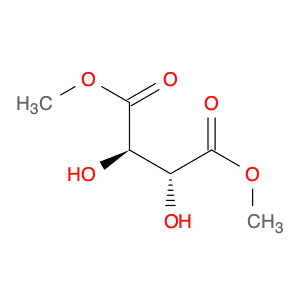
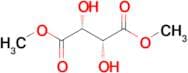
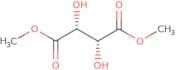
:1,4-Dimethyl 2,3-dihydroxy- (2R,3R)butandioat
Beschreibung:
1,4-Dimethyl 2,3-Dihydroxy-(2R,3R)butanedioat, mit der CAS-Nummer 608-68-4, ist eine chemische Verbindung, die durch ihre spezifische Stereochemie und funktionelle Gruppen gekennzeichnet ist. Sie weist zwei Hydroxylgruppen (-OH) und eine Diesterfunktion auf, die zu ihrer Reaktivität und Löslichkeit in polaren Lösungsmitteln beiträgt. Das Vorhandensein der Methylgruppen verbessert ihren hydrophoben Charakter, während die Hydroxylgruppen ihr Potenzial für Wasserstoffbrückenbindungen erhöhen. Diese Verbindung ist typischerweise ein weißer bis off-weißer kristalliner Feststoff bei Raumtemperatur und ist in Wasser und verschiedenen organischen Lösungsmitteln löslich. Ihre Stereochemie, die durch die (2R,3R)-Konfiguration angezeigt wird, spielt eine entscheidende Rolle in ihrer biologischen Aktivität und den Wechselwirkungen mit anderen Molekülen. 1,4-Dimethyl 2,3-Dihydroxy-(2R,3R)butanedioat wird häufig auf seine potenziellen Anwendungen in der Pharmazie und Biochemie untersucht, insbesondere bei der Synthese komplexerer organischer Moleküle. Wie bei vielen organischen Verbindungen sind eine ordnungsgemäße Handhabung und Lagerung entscheidend, um ihre Stabilität zu erhalten und eine Zersetzung zu verhindern.
Formel:C6H10O6
InChl:InChI=1S/C6H10O6/c1-11-5(9)3(7)4(8)6(10)12-2/h3-4,7-8H,1-2H3/t3-,4-/m1/s1
InChI Key:InChIKey=PVRATXCXJDHJJN-QWWZWVQMSA-N
SMILES:[C@@H]([C@H](C(OC)=O)O)(C(OC)=O)O
Synonyme:- (+)-Tartaric acid dimethyl ester
- (2R,3R)-(+)-Dimethyl tartrate
- 1,4-Dimethyl 2,3-dihydroxy- (2R,3R)butanedioate
- <span class="text-smallcaps">L</span>-(+)-Dimethyl tartrate
- <span class="text-smallcaps">L</span>-Tartaric acid dimethyl ester
- Butanedioic acid, 2,3-dihydroxy- (2R,3R)-, 1,4-dimethyl ester
- Butanedioic acid, 2,3-dihydroxy- (2R,3R)-, dimethyl ester
- Butanedioic acid, 2,3-dihydroxy- [R-(R*,R*)]-, dimethyl ester
- Dimethyl (+)-<span class="text-smallcaps">L</span>-tartrate
- Dimethyl (+)-tartrate
- Dimethyl (R,R)-tartrate
- Dimethyl <span class="text-smallcaps">L</span>-tartarate
- Dimethyl L-(+)-tartarate
- Dimethyl d-tartrate
- Dimethyl-L-(+)-Tartratic
- L-plus-tartaric acid dimethyl ester
- NSC 517
- Weitere Synonyme anzeigen
Sortieren nach
Reinheit (%)
0
100
|
0
|
50
|
90
|
95
|
100
6 Produkte.
Dimethyl L-tartrate
CAS:Formel:C6H10O6Reinheit:≥ 98.0%Farbe und Form:White to off-white or light yellow crystalline powderMolekulargewicht:178.14L-(+)-Tartaric acid dimethyl ester
CAS:L-(+)-Tartaric acid dimethyl esterFormel:C6H10O6Reinheit:99%Farbe und Form: white solidMolekulargewicht:178.14g/molDimethyl L-(+)-Tartrate
CAS:Formel:C6H10O6Reinheit:>98.0%(GC)Farbe und Form:White to Almost white powder to crystalMolekulargewicht:178.14(2R,3R)-Dimethyl 2,3-dihydroxysuccinate
CAS:Reinheit:95.0%Farbe und Form:SolidMolekulargewicht:178.13999938964844Dimethyl L-(+)-tartrate
CAS:Dimethyl L-(+)-tartrate is a natural compound that can be found in wines and honey. It has been shown to have antiviral activity against herpes simplex virus type 1 (HSV-1). Dimethyl L-(+)-tartrate has also been shown to be a potent inhibitor of the human immunodeficiency virus type 1 (HIV-1) by preventing it from entering cells. Dimethyl L-(+)-tartrate inhibits HIV-1 by interfering with the ability of the virus to bind to CD4 receptors, thereby blocking entry into cells. Dimethyl L-(+)-tartrate is a tetronic acid, which is an organic acid that contains two carboxyl groups, one on each end of the molecule. It exhibits structural features such as vibrational and hydrogen bonding properties that are similar to those observed for other nucleophilic compounds, such as trifluoroacetic acid and dimethyl sulfate. The molecule consists of twoFormel:C6H10O6Reinheit:Min. 98%Farbe und Form:White PowderMolekulargewicht:178.14 g/mol