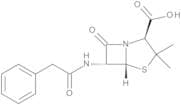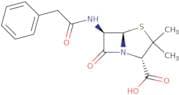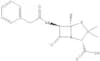
CAS 61-33-6
:Penicillin G
Beschreibung:
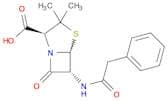
Penicillin G, auch bekannt als Benzylpenicillin, ist ein weit verbreitetes Antibiotikum, das zur Klasse der Penicillin-Medikamente gehört. Seine chemische Formel ist C16H18N2O4S, und es weist einen Beta-Lactam-Ring auf, der für seine antibakterielle Aktivität entscheidend ist. Diese Verbindung ist gegen eine Vielzahl von grampositiven Bakterien und einige gramnegative Bakterien wirksam, was sie wertvoll bei der Behandlung von Infektionen wie Pneumonie, Meningitis und Syphilis macht. Penicillin G wird typischerweise durch Injektion verabreicht, da es in sauren Umgebungen instabil ist, was seine orale Bioverfügbarkeit einschränkt. Es ist durch seine relativ geringe Toxizität gekennzeichnet, was es sicher für den Einsatz beim Menschen macht, obwohl bei einigen Personen allergische Reaktionen auftreten können. Die Substanz ist auch empfindlich gegenüber Beta-Lactamase-Enzymen, die von bestimmten Bakterien produziert werden, was eine Resistenz verleihen kann. Die Lagerungsbedingungen für Penicillin G erfordern Schutz vor Licht und Feuchtigkeit, um seine Wirksamkeit zu erhalten. Insgesamt markierte seine Entdeckung einen bedeutenden Fortschritt in der Antibiotikatherapie und revolutionierte die Behandlung bakterieller Infektionen.
Formel:C16H18N2O4S
InChl:InChI=1S/C16H18N2O4S/c1-16(2)12(15(21)22)18-13(20)11(14(18)23-16)17-10(19)8-9-6-4-3-5-7-9/h3-7,11-12,14H,8H2,1-2H3,(H,17,19)(H,21,22)/t11-,12+,14-/m1/s1
InChI Key:InChIKey=JGSARLDLIJGVTE-MBNYWOFBSA-N
SMILES:C(O)(=O)[C@@H]1N2[C@@]([C@H](NC(CC3=CC=CC=C3)=O)C2=O)(SC1(C)C)[H]
Synonyme:- (2S,5R,6R)-3,3-Dimethyl-6-(2-(phenylacetylamino)-7-oxo-4-thia-1-azabicyclo[3.2.0]heptane-2-carboxylic acid
- (2S,5R,6R)-3,3-Dimethyl-7-oxo-6-(2-phenylacetamido)-4-thia-1-azabicyclo[3.2.0]heptan-2-carboxylic acid
- (2S,5R,6R)-3,3-Dimethyl-7-oxo-6-[(2-phenylacetyl)amino]-4-thia-1-azabicyclo[3.2.0]heptane-2-carboxylic acid
- (2S,5R,6R)-3,3-dimethyl-7-oxo-6-[(phenylacetyl)amino]-4-thia-1-azabicyclo[3.2.0]heptane-2-carboxylic acid
- (5R,6R)-3,3-dimethyl-7-oxo-6-[(phenylacetyl)amino]-4-thia-1-azabicyclo[3.2.0]heptane-2-carboxylic acid
- (5R,6R)-Benzylpenicillin
- 4-Thia-1-azabicyclo[3.2.0]heptane-2-carboxylic acid, 3,3-dimethyl-7-oxo-6-(2-phenylacetamido)-
- 4-Thia-1-azabicyclo[3.2.0]heptane-2-carboxylic acid, 3,3-dimethyl-7-oxo-6-[(2-phenylacetyl)amino]- (2S,5R,6R)-
- 4-Thia-1-azabicyclo[3.2.0]heptane-2-carboxylic acid, 3,3-dimethyl-7-oxo-6-[(phenylacetyl)amino]- (2S,5R,6R)-
- 4-Thia-1-azabicyclo[3.2.0]heptane-2-carboxylic acid, 3,3-dimethyl-7-oxo-6-[(phenylacetyl)amino]- [2S-(2α,5α,6β)]-
- 6-(2-Phenylacetamido)Penicillanic Acid
- 6-(2-Phenylacetamido)penicillansaure
- Acide 6-(2-Phenylacetamido)Penicillanique
- Acido 6-(2-Fenilacetamido)Penicilanico
- Allpen
- Benzyl-6-aminopenicillinic acid
- Benzylpenicillin G
- Benzylpenicillinic acid
- Cilloral
- Cilopen
- Crysticillin 300 AS
- Dropcillin
- Free benzylpenicillin
- Free penicillin G
- Free penicillin II
- Gelacillin
- Liquacillin
- Nsc 193396
- Penicillin
- Penicillin G
- Penicillin, (phenylmethyl)-
- Penicillinic acid, (phenylmethyl)-
- Pfizerpen
- Pharmacillin
- Phenylacetamidopenicillanic acid
- Phenylacetyl-6-aminopenicillanic acid
- Pradupen
- Specilline G
- Weitere Synonyme anzeigen
Sortieren nach
Reinheit (%)
0
100
|
0
|
50
|
90
|
95
|
100
6 Produkte.
Penicillin G Potassium Salt
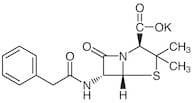
CAS:Formel:C16H17KN2O4SReinheit:>98.0%(HPLC)(N)Farbe und Form:White to Almost white powder to crystalMolekulargewicht:372.48Penicillin G Sodium Salt
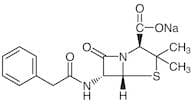
CAS:Formel:C16H17N2NaO4SReinheit:>98.0%(HPLC)(N)Farbe und Form:White to Almost white powder to crystalMolekulargewicht:356.37Benzylpenicillin
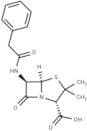
CAS:Benzylpenicillin, a penicillin derivative, treats infections using sodium or potassium salts. Effective against gram-positive bacteria and gram-negative cocci.Formel:C16H18N2O4SReinheit:98%Farbe und Form:Amorphous White Powder SolidMolekulargewicht:334.39Benzylpenicillin 1000 µg/mL in Acetonitrile:Water
CAS:Kontrolliertes ProduktFormel:C16H18N2O4SFarbe und Form:Single SolutionMolekulargewicht:334.39Penicilling
CAS:Penicillin is an antibiotic that inhibits bacterial growth by binding to penicillin-binding proteins, which in turn prevents the bacteria from producing peptidoglycan. Penicillin binds to the enzyme cell wall synthesis and inhibits protein synthesis and cell division. Penicilling can be administered as an intramuscular injection or intravenous injection. The most common adverse reaction is pain at the site of injection, which may be due to toxic epidermal necrolysis. Other adverse reactions include fever, rash, and seizures.
Formel:C16H18N2O4SReinheit:Min. 95%Farbe und Form:PowderMolekulargewicht:334.39 g/mol