CAS 610-78-6
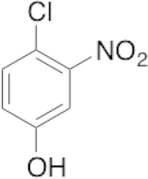
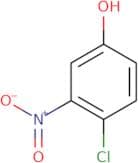
:4-Chlor-3-nitrophenol
Beschreibung:
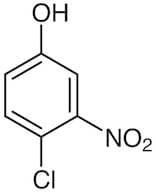
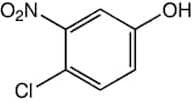
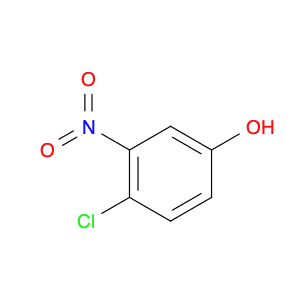
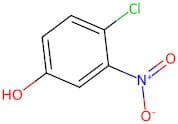
4-Chlor-3-nitrophenol ist eine organische Verbindung, die durch das Vorhandensein eines Chloratoms und einer Nitrogruppe, die an einen phenolischen Ring gebunden sind, gekennzeichnet ist. Ihre molekulare Formel lautet C6H4ClN O3 und sie weist eine Hydroxylgruppe (-OH) auf, die dem Stoff saure Eigenschaften verleiht. Diese Substanz erscheint typischerweise als gelb-brauner Feststoff und ist bekannt für ihre moderate Löslichkeit in Wasser sowie für ihre höhere Löslichkeit in organischen Lösungsmitteln. Die Verbindung zeigt sowohl saure als auch basische Eigenschaften aufgrund der Anwesenheit der Hydroxylgruppe und der elektronenziehenden Effekte der Nitro- und Chlorsubstituenten. Sie wird häufig in der Synthese von Farbstoffen, Arzneimitteln und Agrochemikalien verwendet. Darüber hinaus kann 4-Chlor-3-nitrophenol giftig sein und Umweltgefahren darstellen, was eine sorgfältige Handhabung und Entsorgung erforderlich macht. Ihre Reaktivität kann durch die Substituenten am aromatischen Ring beeinflusst werden, was sie zu einem nützlichen Zwischenprodukt in verschiedenen chemischen Reaktionen macht.
Formel:C6H4ClNO3
InChl:InChI=1S/C6H4ClNO3/c7-5-2-1-4(9)3-6(5)8(10)11/h1-3,9H
InChI Key:InChIKey=JUIKCULGDIZNDI-UHFFFAOYSA-N
SMILES:N(=O)(=O)C1=C(Cl)C=CC(O)=C1
Synonyme:- 3-Nitro-4-chlorophenol
- 2-Chloro-5-hydroxynitrobenzene
- 4-Chloro-3-nitrophenol
- NSC 211001
- Phenol, 4-chloro-3-nitro-
Sortieren nach
Reinheit (%)
0
100
|
0
|
50
|
90
|
95
|
100
8 Produkte.
4-Chloro-3-nitrophenol
CAS:Formel:C6H4ClNO3Reinheit:>98.0%(GC)(T)Farbe und Form:Light yellow to Yellow to Green powder to crystalMolekulargewicht:173.554-Chloro-3-nitrophenol, 99%
CAS:This Thermo Scientific Chemicals brand product was originally part of the Alfa Aesar product portfolio. Some documentation and label information may refer to the legacy brand. The original Alfa Aesar product / item code or SKU reference has not changed as a part of the brand transition to Thermo SciFormel:C6H4ClNO3Reinheit:99%Farbe und Form:Crystals or powder or crystalline powder, Yellow to brownMolekulargewicht:173.55Phenol, 4-chloro-3-nitro-
CAS:Formel:C6H4ClNO3Reinheit:97%Farbe und Form:SolidMolekulargewicht:173.55394-Chloro-3-nitrophenol
CAS:Formel:C6H4ClNO3Reinheit:98.0%Farbe und Form:Yellow to olive green crystalline powderMolekulargewicht:173.554-Chloro-3-nitrophenol
CAS:Kontrolliertes ProduktApplications 4-Chloro-3-nitrophenol is degraded by Burkholderia sp. strain SJ98 and utilizes it as sole source of carbon, nitrogen and energy under aerobic conditions. Also it is an intermediate of 8-Hydroxychlorpromazine (H824905), which is a metabolite of chlorpromazine (C424750) which is used as an antiemetic.
References Pandey, J., et al.: Appl. Microbiol. Biotechnol., 92, 597-607 (2011); Roth, J., et al.: Comm. Psychopharmacol., 3, 235 (1979); Zhang, Z.: Handbook of Metabolic Pathways of Xenobiotics, 3, 1102 (2014); Anden, N.-E., et al.: Eur. J. Pharmacol., 11, 303 (1970), Curzon, G., et al.: Trends Pharmacol. Sci., 11, 61 (1990)Formel:C6H4ClNO3Farbe und Form:NeatMolekulargewicht:173.554-Chloro-3-nitrophenol
CAS:4-Chloro-3-nitrophenol is a chemical compound that has been used as a dye and as an intermediate in the synthesis of other chemicals. 4-Chloro-3-nitrophenol is not found in nature, but it is produced by the reaction of nitric acid with phenols. The functional theory of 4-chloro-3-nitrophenol suggests that this chemical may be toxic to aquatic life because it can inhibit photosynthesis by blocking the light reactions of photosystem II. This chemical also has been shown to have endpoints for chlorine and chloride, which are essential for aerobic respiration.Formel:C6H4ClNO3Reinheit:Min. 95%Molekulargewicht:173.55 g/mol