CAS 610794-20-2
:L-Tyrosin, O-2-propinyl-
Beschreibung:
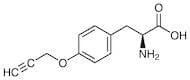
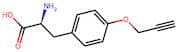
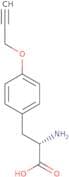
L-Tyrosin, O-2-propinyl- ist ein Derivat der Aminosäure L-Tyrosin, die eine nicht essentielle Aminosäure ist, die wichtig für die Proteinsynthese und die Produktion von Neurotransmittern ist. Diese spezifische Verbindung weist eine Propinylgruppe auf, die an den Sauerstoff der Hydroxylgruppe im aromatischen Ring von Tyrosin gebunden ist, was ihre Löslichkeit und Reaktivität beeinflussen kann. Im Allgemeinen können Derivate von L-Tyrosin verschiedene biologische Aktivitäten aufweisen, einschließlich potenzieller Rollen bei der Synthese von Neurotransmittern, antioxidativen Eigenschaften und Auswirkungen auf Stimmung und kognitive Funktion. Die Anwesenheit der Propinylgruppe kann auch einzigartige chemische Eigenschaften verleihen, wie veränderte Reaktivität oder Wechselwirkungen mit biologischen Zielen. Wie bei vielen Aminosäurederivaten könnte die Verbindung von Interesse in der pharmazeutischen Forschung sein, insbesondere bei der Entwicklung neuer therapeutischer Mittel. Bestimmte Eigenschaften wie Schmelzpunkt, Löslichkeit und Stabilität erfordern jedoch empirische Daten für eine präzise Bewertung. Konsultieren Sie immer die relevanten Sicherheitsdatenblätter und die Literatur für Informationen zur Handhabung und Anwendung.
Formel:C12H13NO3
Synonyme:- O-2-Propyn-1-yl-L-tyrosine HCl
- (2S)-2-amino-3-(4-prop-2-ynoxyphenyl)propanoicacid
- L-Tyrosine, O-2-propyn-1-yl-
- O-2-propyn-1-yl-L-tyrosine
- H-L-Tyr(Propargyl)-OH
Sortieren nach
Reinheit (%)
0
100
|
0
|
50
|
90
|
95
|
100
4 Produkte.
H-L-Tyr(Propargyl)-OH
CAS:Formel:C12H13NO3Reinheit:>98.0%(T)(HPLC)Farbe und Form:White to Light yellow powder to crystalMolekulargewicht:219.24(S)-2-Amino-3-(4-(prop-2-yn-1-yloxy)phenyl)propanoic acid
CAS:(S)-2-Amino-3-(4-(prop-2-yn-1-yloxy)phenyl)propanoic acidReinheit:95%(S)-2-Amino-3-(4-(prop-2-yn-1-yloxy)phenyl)propanoic acid
CAS:Formel:C12H13NO3Reinheit:95%Molekulargewicht:219.24O-2-Propyn-1-yl-L-tyrosine HCl
CAS:O-2-Propyn-1-yl-L-tyrosine (OPT) is a synthetase that catalyzes the formation of covalent linkages between L-tyrosine and propyne. It has been shown to be upregulated in response to light exposure and is involved in the synthesis of proteins with reactive cyclic peptides. OPT has also been used as a model for studying protein synthesis, which is important for structural biology and cell lysis. OPT has been shown to exhibit biomimetic properties, such as uptake by cells and cell lysis, which are similar to those of the natural substrate, L-tyrosine.Formel:C12H14ClNO3Reinheit:Min. 95%Molekulargewicht:255.7 g/mol