CAS 611-64-3
:9-Methylacridin
Beschreibung:
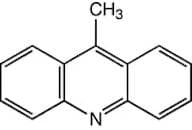
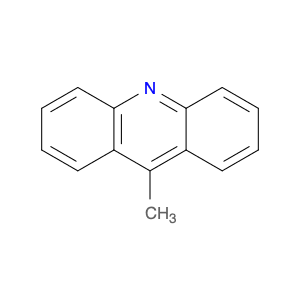
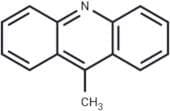
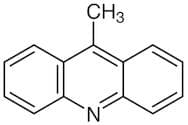
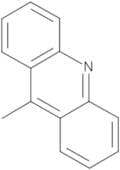
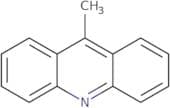
9-Methylacridin ist eine organische Verbindung, die zur Familie der Acridine gehört und durch eine verschmolzene Dreiringstruktur mit einem Stickstoffatom gekennzeichnet ist. Es handelt sich um einen blassgelben bis bräunlichen Feststoff bei Raumtemperatur, der für seine aromatischen Eigenschaften bekannt ist. Die Anwesenheit der Methylgruppe an der 9-Position des Acridinringsystems beeinflusst sein chemisches Verhalten und macht es zu einem potenziellen Kandidaten für verschiedene Anwendungen in der organischen Synthese und als fluoreszierende Sonde. 9-Methylacridin ist mäßig in organischen Lösungsmitteln wie Ethanol und Aceton löslich, hat jedoch eine begrenzte Löslichkeit in Wasser. Seine chemische Reaktivität wird hauptsächlich dem Stickstoffatom zugeschrieben, das an verschiedenen Reaktionen teilnehmen kann, einschließlich elektrophiler Substitution und Oxidation. Darüber hinaus weist 9-Methylacridin photophysikalische Eigenschaften auf, die es nützlich für Studien im Zusammenhang mit Fluoreszenz und Photochemie machen. Sicherheitsdaten zeigen, dass es mit Vorsicht behandelt werden sollte, da es bei Exposition gesundheitliche Risiken darstellen kann. Insgesamt ist 9-Methylacridin eine Verbindung von Interesse sowohl in der akademischen Forschung als auch in industriellen Anwendungen.
Formel:C14H11N
InChl:InChI=1/C14H11N/c1-10-11-6-2-4-8-13(11)15-14-9-5-3-7-12(10)14/h2-9H,1H3
InChI Key:InChIKey=FLDRLXJNISEWNZ-UHFFFAOYSA-N
SMILES:CC=1C2=C(N=C3C1C=CC=C3)C=CC=C2
Synonyme:- 5-Methylacridine
- 5-Methylacridine (European)
- 9-Methylakridin
- 9-Methylakridin [Czech]
- Acridine, 9-methyl-
- Brn 0133084
- Nsc 1234
- 9-Methylacridine
- 5-20-08-00253 (Beilstein Handbook Reference)
- 9-Methylacridine
- 9-Methylacridine, 99+%
- 9-Methylacridin
- 9-Methylacridine, 99+% 1GR
- 9-methyl-acridin
- Weitere Synonyme anzeigen
Sortieren nach
Reinheit (%)
0
100
|
0
|
50
|
90
|
95
|
100
12 Produkte.
9-Methylacridine, 96%
CAS:This Thermo Scientific Chemicals brand product was originally part of the Alfa Aesar product portfolio. Some documentation and label information may refer to the legacy brand. The original Alfa Aesar product / item code or SKU reference has not changed as a part of the brand transition to Thermo SciFormel:C14H11NReinheit:96%Farbe und Form:Yellow to brown, Powder or crystalline powderMolekulargewicht:193.259-Methylacridine
CAS:Heterocyclic compounds with nitrogen hetero-atom(s) only, aromatic or modified aromatic, nesoiFormel:C14H11NFarbe und Form:Yellow PowderMolekulargewicht:193.089159-Methylacridine
CAS:9-Methylacridine is an environmentally sensitive fluorescent probe that can couple with carboxylic acid molecules.Formel:C14H11NFarbe und Form:SolidMolekulargewicht:193.249-Methylacridine
CAS:Formel:C14H11NReinheit:>97.0%(GC)Farbe und Form:Light yellow to Brown to Dark green powder to crystalMolekulargewicht:193.259-Methylacridine
CAS:Kontrolliertes ProduktApplications 9-Methylacridine is an derivative of Acridine (A190900), a quinoline derivative used as manufacturing dyes and as an intermediate for the synthesis of antileishmanial agents.
References Pathak, D. et al.: Pharma Chemica, 3, 239 (2011); Mathieu, O. et al.: Xenobiotica, 41, 91 (2011); Rubbo, S.D. et al.: Br. J. Exp. Pathol., 28, 1 (1947);Formel:C14H11NFarbe und Form:NeatMolekulargewicht:193.249-methylacridine
CAS:9-Methylacridine is a chemical compound that is a member of the acridine family. It has shown anticancer activity in animal studies and also has been used as an immunosuppressant. 9-Methylacridine can be synthesized by reacting sodium carbonate with intramolecular hydrogen, which is then purified by Langmuir adsorption isotherm. The antiviral effect of 9-methylacridine was tested on herpes simplex virus and it was found that this compound inhibited the transfer reactions of viral DNA to host cells, leading to inhibition of viral replication. Studies have also shown that 9-methylacridine has anti-inflammatory effects against caproic acid and malonic acid in rats. One study found that 9-methylacridine inhibits the cationic polymerization and biological samples are usually anhydrous sodium chloride or human serum.Formel:C14H11NReinheit:Min. 95%Molekulargewicht:193.24 g/mol