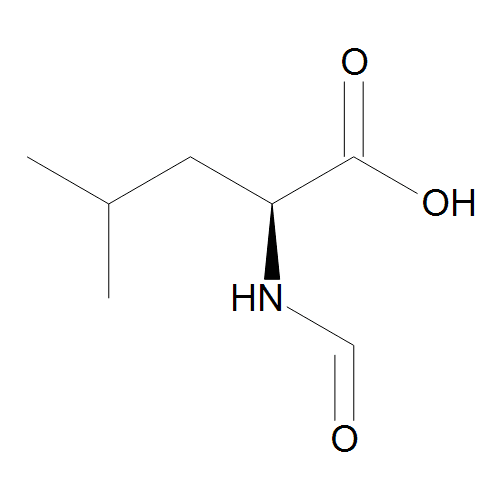
CAS 6113-61-7
:N-Formyl-L-Leucin
Beschreibung:
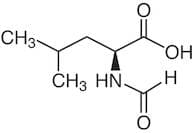
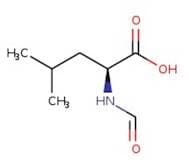
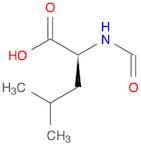
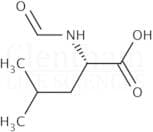
N-Formyl-L-Leucin ist ein Aminosäurederivat, das durch das Vorhandensein einer Formylgruppe (-CHO) gekennzeichnet ist, die an den Stickstoff der Leucin-Seitenkette gebunden ist. Es handelt sich um einen weißen bis schneeweißen kristallinen Feststoff, der in Wasser und polaren organischen Lösungsmitteln löslich ist, was seine polaren funktionellen Gruppen widerspiegelt. Diese Verbindung wird häufig in der biochemischen Forschung und Synthese verwendet, insbesondere in der Studie der Peptidsynthese und der Proteinmodifikation. N-Formyl-L-Leucin kann an verschiedenen chemischen Reaktionen teilnehmen, einschließlich Acylierung und Amidierung, aufgrund seiner reaktiven funktionellen Gruppen. Seine Struktur umfasst eine verzweigte aliphatische Seitenkette, die zu seinen hydrophoben Eigenschaften beiträgt, während die Formylgruppe einen polaren Aspekt einführt, der vielfältige Wechselwirkungen in biologischen Systemen ermöglicht. Als Derivat von Leucin behält es einige der Eigenschaften dieser essentiellen Aminosäure, die eine entscheidende Rolle bei der Proteinsynthese und dem Stoffwechsel spielt. Sicherheitsdaten sollten vor der Handhabung konsultiert werden, wie bei jeder chemischen Substanz, um sicherzustellen, dass die richtigen Vorsichtsmaßnahmen getroffen werden.
Formel:C7H13NO3
InChl:InChI=1S/C7H13NO3/c1-5(2)3-6(7(10)11)8-4-9/h4-6H,3H2,1-2H3,(H,8,9)(H,10,11)/t6-/m0/s1
InChI Key:InChIKey=HFBHOAHFRNLZGN-LURJTMIESA-N
SMILES:[C@@H](CC(C)C)(NC=O)C(O)=O
Synonyme:- (2S)-2-Formamido-4-methylpentanoic acid
- (S)-(+)-2-Formamido-4-methylpentanoic acid
- <span class="text-smallcaps">L</span>-Leucine, N-formyl-
- For-Leu-OH
- Leucine, N-formyl-, <span class="text-smallcaps">L</span>-
- N-Formyl-<span class="text-smallcaps">L</span>-leucine
- N-Formyl-Leu-OH
- N-Formyl-S-leucine
- N-formylleucine
- NSC 334321
- Leucine, N-formyl-, L-
- N-Formyl-L-leucine
- Weitere Synonyme anzeigen
Sortieren nach
Reinheit (%)
0
100
|
0
|
50
|
90
|
95
|
100
14 Produkte.
N-Formyl-L-leucine
CAS:Formel:C7H13NO3Farbe und Form:White to Almost white powder to crystalMolekulargewicht:159.19N-Formyl-L-leucine, tech. 90%
CAS:This Thermo Scientific Chemicals brand product was originally part of the Alfa Aesar product portfolio. Some documentation and label information may refer to the legacy brand. The original Alfa Aesar product / item code or SKU reference has not changed as a part of the brand transition to Thermo SciFormel:C7H13NO3Reinheit:90%Farbe und Form:White, Crystals or powder or crystalline powderMolekulargewicht:159.19Formyl Leucine (N-Formyl-L-leucine)
CAS:Acyclic amides (including acyclic carbamates) and their derivatives and salts thereof, nesoiFormel:C7H13NO3Farbe und Form:White PowderMolekulargewicht:159.08954Ref: IN-DA003T1I
500gNachfragen250mg25,00€100mg28,00€1g49,00€5g103,00€10g136,00€25g212,00€100g529,00€2-Formamido-4-methylpentanoic acid
CAS:2-Formamido-4-methylpentanoic acidReinheit:95%Molekulargewicht:159.18g/molN-Formyl-L-leucine
CAS:Kontrolliertes ProduktApplications A synthetic substrate of the lipase inhibitor lipstatin.
References Eisenreich, W., et al.: J. Biol. Chem., 272, 867 (1997), Goese, M., et al.: J. Biol. Chem., 275, 21192 (2000).Formel:C7H13NO3Farbe und Form:NeatMolekulargewicht:159.18N-Formyl-L-leucine
CAS:N-Formyl-L-leucine, also known as N-formyl-L-leucine amide, is an amino acid that is used in the biosynthesis of formic acid. It is a diastereomer of L-leucine and has been shown to activate metabotropic glutamate receptors, which are involved in the regulation of pain and inflammation. N-Formyl-L-leucine has also been shown to be an endocannabinoid that binds to cannabinoid receptors. This amino acid may be synthesized from glutamate by the enzymes glutamate formyltransferase or formyltetrahydrofolate synthetase. The functional groups on this molecule include a formyl group and a fatty acid group, which are attached at carbons 1 and 2 respectively. Formylation of leucine occurs through the addition of a methylene group to the alpha carbon atom with concomitant elimination of water. A synthase gene for this moleculeFormel:C7H13NO3Reinheit:Min. 95%Molekulargewicht:159.18 g/mol