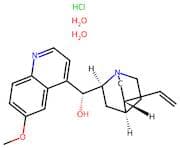
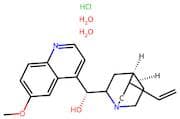
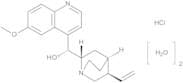
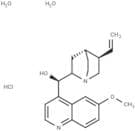
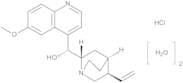
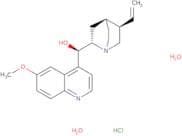
CAS 6119-47-7
:Chininhydrochlorid-Dihydrat
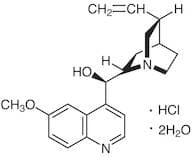
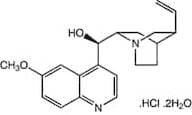
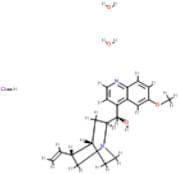
- (4beta,8alpha,9R)-6'-methoxycinchonan-9-ol hydrochloride dihydrate
- (9R)-6'-methoxycinchonan-1'-ium-9-ol chloride dihydrate
- (R)(6-Methoxy-4-quinolyl)(5-vinyl-1-azabicyclo[2.2.2]oct-2-yl)methanol hydrochloride
- Cinchonan-9-ol, 6′-methoxy-, hydrochloride, hydrate (1:1:2), (8α,9R)-
- Cinchonan-9-ol, 6′-methoxy-, monohydrochloride, dihydrate, (8α,9R)-
- Quinine Hydrochloride Dihydrate
Quinine Hydrochloride Dihydrate
CAS:Formel:C20H24N2O2·HCl·2H2OReinheit:>98.0%(T)Farbe und Form:White to Almost white powder to crystalMolekulargewicht:396.91Quinine monohydrochloride dihydrate, 99% (total base), may contain up to 10% Dihydroquinine
CAS:It is used as pharmaceutical intermediate. Benzoylthiophenes are allosteric enhancers (AE) of agonist activity at the A1 adenosine receptor. This Thermo Scientific Chemicals brand product was originally part of the Alfa Aesar product portfolio. Some documentation and label information may refer to tFormel:C20H29ClN2O4Reinheit:99%Farbe und Form:Powder or crystalline powder or needles, White to pale creamMolekulargewicht:396.91Quinine Hydrochloride Dihydrate
CAS:Quinine and its saltsFormel:C20H24N2O2·HCl·2H2OFarbe und Form:Colorless NeedlesMolekulargewicht:396.18159Quinine hydrochloride dihydrate
CAS:Formel:C20H24N2O2·HCl·2H2OReinheit:99.0 - 101.0 %Farbe und Form:White or almost white crystalline powderMolekulargewicht:396.91Quinine monohydrochloride dihydrate
CAS:Quinine monohydrochloride dihydrateFormel:C20H24N2O2·ClH·2H2OReinheit:By hplc: 99.6% by area (Typical Value in Batch COA)Farbe und Form: white crystalline powderMolekulargewicht:396.91g/molQuinine hydrochloride dihydrate, 10mM (in DMSO)
CAS:Quinine hydrochloride dihydrate, 10mM (in DMSO)Reinheit:≥98%Molekulargewicht:396.91g/molQuinine Hydrochloride Dihydrate
CAS:Kontrolliertes ProduktFormel:C20H24N2O2·ClHH2OFarbe und Form:NeatMolekulargewicht:396.91Quinine hydrochloride dihydrate
CAS:Formel:C20H29ClN2O4Reinheit:95.0%Farbe und Form:SolidMolekulargewicht:396.91Quinine hydrochloride dihydrate
CAS:Quinine hydrochloride dihydrate (Quinine HCl Dihydrate) is a white crystalline K+ channel blocker, used to treat malaria.Formel:C20H24N2O2·HCl·2H2OReinheit:99.91%Farbe und Form:White To Light Yellow Crystal PowderMolekulargewicht:396.91Quinidine Hydrochloride Dihydrate
CAS:Kontrolliertes ProduktApplications Quinidine Hydrochloride Dihydrate is a salt of Quinidine (Q685000), a dextrorotatory stereoisomer of Quinine. Antiarrhythmic (class IA). Antimalarial.
References Loutfy, M.A., et al.: Anal. Profiles Drug Subs., 12, 483 (1983), Mason, J. W., et al.: Ann. N. Y. Acad. Sci., 432, 162 (1984),Formel:C20H24N2O2·ClH·2H2OFarbe und Form:NeatMolekulargewicht:396.91Quinine hydrochloride dihydrate
CAS:Quinine hydrochloride dihydrate is a natural compound that has been used for centuries as a treatment for malaria. It is an effective anti-malarial agent and is also used to treat nocturnal leg cramps, although it has a low potency. Quinine hydrochloride dihydrate is active against the parasite Plasmodium falciparum in vitro. It binds to hemozoin, which is the pigment that the malaria parasites produce during digestion of hemoglobin from red blood cells. This binding inhibits the growth of the parasite and causes cell death by inhibiting protein synthesis. Quinine hydrochloride dihydrate has been shown to be genotoxic in vivo, but not in vitro. The genotoxic effects may be due to its ability to create reactive oxygen species (ROS) through photochemical reactions with light exposure and other chemical reactions, such as thermal expansion or matrix effects.
Formel:C20H24N2O2·HCl·2H2OFarbe und Form:PowderMolekulargewicht:396.91 g/mol