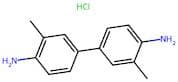
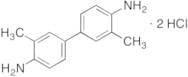
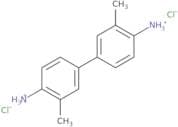
![[1,1′-Biphenyl]-4,4′-diamine, 3,3′-dimethyl-, hydrochloride (1:2)](/_next/image/?url=https%3A%2Fstatic.cymitquimica.com%2Fcas-image%2Fthumb-webp%2F169508-11-biphenyl-44-diamine-33-dimethyl-hydrochloride-1-2.webp&w=3840&q=75)
CAS 612-82-8
:[1,1'-Biphenyl]-4,4'-diamin, 3,3'-dimethyl-, hydrochlorid (1:2)
Beschreibung:
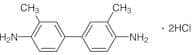
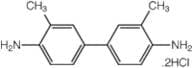
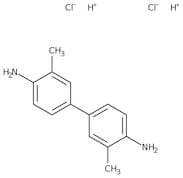
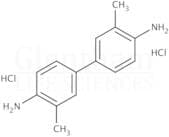
[1,1'-Biphenyl]-4,4'-diamin, 3,3'-dimethyl-, hydrochlorid (1:2), allgemein als Diaminderivat bezeichnet, ist eine chemische Verbindung, die durch ihre Biphenylstruktur mit Aminogruppen an den Para-Positionen und Methylgruppen an den Meta-Positionen gekennzeichnet ist. Diese Verbindung erscheint typischerweise als kristalliner Feststoff und ist in polaren Lösungsmitteln löslich, da die Anwesenheit der Salzform des Hydrochlorids ihre Löslichkeit erhöht. Sie wird hauptsächlich in der organischen Synthese und als Zwischenprodukt in der Herstellung von Farbstoffen, Pigmenten und Polymeren verwendet. Die Anwesenheit von Aminogruppen macht sie zu einem potenziellen Kandidaten für verschiedene chemische Reaktionen, einschließlich Kupplungsreaktionen und Polymerisationsprozesse. Sicherheitsüberlegungen sollten berücksichtigt werden, da viele Amine reizend oder schädlich bei Kontakt sein können. Angemessene Handhabungs- und Lagerbedingungen sind entscheidend, um Sicherheit und Stabilität zu gewährleisten. Wie bei jeder chemischen Substanz ist es wichtig, Sicherheitsdatenblätter und relevante Literatur zu konsultieren, um detaillierte Informationen über ihre Eigenschaften und potenziellen Gefahren zu erhalten.
Formel:C14H16N2·2ClH
InChl:InChI=1S/C14H16N2.2ClH/c1-9-7-11(3-5-13(9)15)12-4-6-14(16)10(2)8-12;;/h3-8H,15-16H2,1-2H3;2*1H
InChI Key:InChIKey=LUKPNZHXJRJBAN-UHFFFAOYSA-N
SMILES:CC=1C=C(C=CC1N)C2=CC(C)=C(N)C=C2.Cl
Synonyme:- (1,1'-Biphenyl)-4,4'-diamine, 3,3'-dimethyl-, dihydrochloride
- 210-322-5
- 3,3'-Dimethyl-4,4'-biphenyldiamine dihydrochloride
- 3,3'-Dimethyl-4,4'-diaminobiphenyl dihydrochloride
- 3,3'-Dimethyl-[1,1'-biphenyl]-4,4'-diamine dihydrochloride
- 3,3'-Dimethylbenzidine dihydrochloride
- 3,3'-Dimethylbiphenyl-4,4'-Diaminium Dichloride
- 3,3'-Dimethylbiphenyl-4,4'-diamine dihydrochloride
- Benzidine, 3,3′-dimethyl-, dihydrochloride
- O-Tolidine Dihydrochloride
- [1,1'-Biphenyl]-4,4'-Diamine, 3,3'-Dimethyl-, Hydrochloride (1:2)
Sortieren nach
Reinheit (%)
0
100
|
0
|
50
|
90
|
95
|
100
8 Produkte.
o-Tolidine Dihydrochloride
CAS:Formel:C14H16N2·2HClReinheit:>98.0%(HPLC)(qNMR)Farbe und Form:White to Gray to Red powder to crystalMolekulargewicht:285.21o-Tolidine dihydrochloride, ACS
CAS:o-Tolidine is employed as a colorimetric reagent for gold and free chlorine in water. Used in the synthesis of 9,9-bis(3-methyl-4-aminophenyl)fluorine. It is utilized for the detection of reducing sugars by thin layer chromatography. It is used in hair dyes, as a pharmaceutical intermediate and laboFormel:C14H18Cl2N2Molekulargewicht:285.21o-Tolidine dihydrochloride, 97%
CAS:o-Tolidine dihydrochloride is used as a sensitive colorimetric reagent for gold and for free chlorine in water. This Thermo Scientific Chemicals brand product was originally part of the Alfa Aesar product portfolio. Some documentation and label information may refer to the legacy brand. The originalFormel:C14H18Cl2N2Reinheit:97%Farbe und Form:White to cream to pale grey, Crystals or powder or crystalline powderMolekulargewicht:285.21o-Tolidine dihydrochloride
CAS:Formel:C14H16N22HClReinheit:≥ 98.0%Farbe und Form:White to faint beige or light grey powder or crystalsMolekulargewicht:285.22O-Tolidine Dihydrochloride
CAS:Kontrolliertes ProduktApplications O-TOLIDINE DIHYDROCHLORIDE (cas# 612-82-8) is a useful research chemical.
Not a dangerous good if item is equal to or less than 1g/ml and there is less than 100g/ml in the packageFormel:C14H16N2·2HClFarbe und Form:NeatMolekulargewicht:285.23,3'-Dimethylbenzidene dihydrochloride
CAS:Kontrolliertes ProduktA diacidic dye which is sparingly soluble in water and easily soluble in ether and alcohol. On exposure to chlorine or bromine vapours, it forms an intense blue colour. This forms the basis for detection of chlorine, nitrates and hydrogen peroxide in air or water. It turns yellow on reacting with free chlorine.Formel:C14H16N2•(HCl)2Reinheit:Min. 95%Farbe und Form:PowderMolekulargewicht:285.21 g/mol