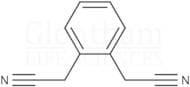
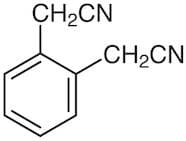
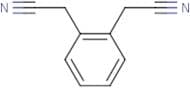
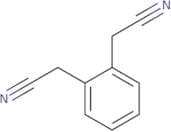
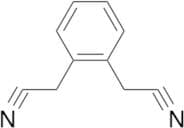
CAS 613-73-0
:1,2-Benzoldiacetonitril
- (2-(Cyanomethyl)phenyl)acetonitrile
- 1,2-Benzenediacetonitrile
- 1,2-Bis(cyanomethyl)benzene
- 2,2'-Benzene-1,2-Diyldiacetonitrile
- 2,2′-(1,2-Phenylene)-diacetonitrile
- 2-[2-(Cyanomethyl)phenyl]acetonitrile
- Alpha,Alpha-Dicyano-O-Xylene
- NSC 5170
- Phthalic diacetonitrile
- o-Benzenediacetonitrile
- o-Bis(cyanomethyl)benzene
- o-Phenylenediacetonitrile
- o-Xylylene dicyanide
- Weitere Synonyme anzeigen
1,2-Phenylenediacetonitrile, 98%
CAS:1,2-Phenylenediacetonitrile is used as API and intermediate. This Thermo Scientific Chemicals brand product was originally part of the Alfa Aesar product portfolio. Some documentation and label information may refer to the legacy brand. The original Alfa Aesar product / item code or SKU reference haFormel:C10H8N2Reinheit:98%Farbe und Form:White to pale yellow to pale brown, Crystals or powder or crystalline powderMolekulargewicht:156.192-[2-(cyanomethyl)phenyl]acetonitrile
CAS:Formel:C10H8N2Reinheit:98%Farbe und Form:SolidMolekulargewicht:156.18391,2-Phenylenediacetonitrile
CAS:Formel:C10H8N2Reinheit:≥ 98.0%Farbe und Form:White to yellow or orange powder to crystalsMolekulargewicht:156.19o-Xylylene Dicyanide
CAS:Formel:C10H8N2Reinheit:>98.0%(GC)Farbe und Form:White to Yellow to Orange powder to crystalMolekulargewicht:156.192-Xylylenedicyanide
CAS:2-Xylylenedicyanide is a chemical compound that reacts with oxygen to form carbon dioxide and hydrogen cyanide. It is stable at room temperature but reacts violently with water or other nucleophiles, such as thiols, amines, and metal ions. 2-Xylylenedicyanide has been shown to induce apoptosis in tumor cells by binding to the factor receptor on the cell surface, which initiates a cascade of events leading to growth inhibition. This reaction is dependent on the presence of nitrogen atoms in the molecule. 2-Xylylenedicyanide also reacts with diacetonitrile to form intermediate compounds that react with sulfonic acid groups in platelet-derived growth factor (PDGF) receptors. The resulting products are fluorescent and have a lifetime of 0.5 seconds at high concentrations.
Formel:C10H8N2Reinheit:Min. 95%Farbe und Form:PowderMolekulargewicht:156.18 g/mol2,2′-(1,2-Phenylene)diacetonitrile
CAS:Formel:C10H8N2Reinheit:98%Farbe und Form:SolidMolekulargewicht:156.1881,2-Phenylenediacetonitrile
CAS:Kontrolliertes ProduktFormel:C10H8N2Farbe und Form:NeatMolekulargewicht:156.18
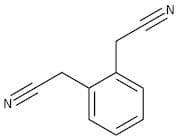

![2-[2-(cyanomethyl)phenyl]acetonitrile](/_next/image/?url=https%3A%2Fstatic.cymitquimica.com%2Fproducts%2FIN%2Fthumb%2FDA003DCD.jpg&w=3840&q=75)