CAS 6138-79-0
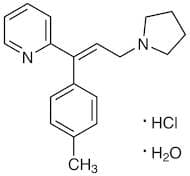
:Monohydrat von Triprolidinhydrochlorid
Beschreibung:
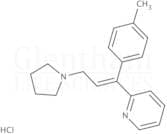
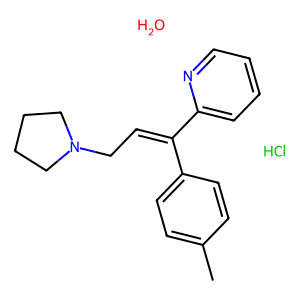
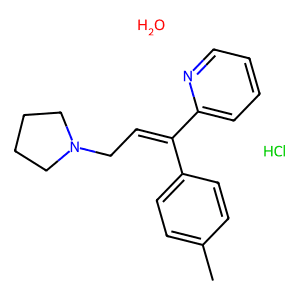
Monohydrat von Triprolidinhydrochlorid ist ein Antihistaminikum, das hauptsächlich zur Linderung von Allergiesymptomen wie laufender Nase, Niesen und Juckreiz eingesetzt wird. Es wird als Antihistaminikum der ersten Generation klassifiziert, was bedeutet, dass es die Blut-Hirn-Schranke überwinden kann, was potenziell zu sedierenden Effekten führen kann. Die chemische Struktur von Triprolidin umfasst einen Piperidinring, der zu seinen pharmakologischen Eigenschaften beiträgt. Als Hydrochloridsalz ist es typischerweise besser in Wasser löslich als seine freie Basenform, was seine Bioverfügbarkeit erhöht. Die Monohydratform weist auf das Vorhandensein eines Wassermoleküls hin, das mit jedem Molekül des Verbindungsstoffs assoziiert ist, was seine Stabilität und Löslichkeit beeinflussen kann. Triprolidin ist bekannt für seine relativ lange Wirkungsdauer im Vergleich zu anderen Antihistaminika der ersten Generation, was es effektiv für eine verlängerte Linderung der Symptome macht. Es kann jedoch auch Nebenwirkungen wie Schläfrigkeit, trockenen Mund und Schwindel verursachen. Wie bei jedem Medikament ist es wichtig, Triprolidin unter ärztlicher Aufsicht zu verwenden, um potenzielle Wechselwirkungen und Kontraindikationen effektiv zu managen.
Formel:C19H22N2·ClH·H2O
InChl:InChI=1S/C19H22N2.ClH.H2O/c1-16-7-9-17(10-8-16)18(19-6-2-3-12-20-19)11-15-21-13-4-5-14-21;;/h2-3,6-12H,4-5,13-15H2,1H3;1H;1H2/b18-11+;;
InChI Key:InChIKey=CUZMOIXUFHOLLN-UMVVUDSKSA-N
SMILES:C(=C\CN1CCCC1)(\C2=CC=C(C)C=C2)/C3=CC=CC=N3.Cl.O
Synonyme:- 1-[(2E)-3-(4-methylphenyl)-3-pyridin-2-ylprop-2-en-1-yl]pyrrolidinium chloride hydrate
- Pyridine, 2-[(1E)-1-(4-methylphenyl)-3-(1-pyrrolidinyl)-1-propen-1-yl]-, hydrochloride, hydrate (1:1:1)
- Pyridine, 2-[(1E)-1-(4-methylphenyl)-3-(1-pyrrolidinyl)-1-propenyl]-, monohydrochloride, monohydrate
- Pyridine, 2-[1-(4-methylphenyl)-3-(1-pyrrolidinyl)-1-propenyl]-, monohydrochloride, monohydrate, (E)-
- Pyridine, 2-[3-(1-pyrrolidinyl)-1-p-tolylpropenyl]-, monohydrochloride, monohydrate, stereoisomer
- Triprolidine hydrochloride monohydrate
Sortieren nach
Reinheit (%)
0
100
|
0
|
50
|
90
|
95
|
100
12 Produkte.
Triprolidine Hydrochloride
CAS:Compounds containing an unfused pyridine ring in the structure, nesoiFormel:C19H22N2·ClH·H2OFarbe und Form:White Crystalline PowderMolekulargewicht:332.87Pyridine, 2-[(1E)-1-(4-methylphenyl)-3-(1-pyrrolidinyl)-1-propen-1-yl]-, hydrochloride, hydrate (1:1:1)
CAS:Formel:C19H25ClN2OReinheit:99%Farbe und Form:SolidMolekulargewicht:332.8676Triprolidine hydrochloride monohydrate
CAS:Triprolidine hydrochloride monohydrate is a histamine H1 antagonist used in allergic rhinitis, asthma.Formel:C19H25ClN2OReinheit:99.68% - 99.81%Farbe und Form:White Crystalline PowderMolekulargewicht:332.87Triprolidine hydrochloride
CAS:Formel:C19H22N2·HClReinheit:≥ 99.0%Farbe und Form:White to light-yellow crystalline powderMolekulargewicht:314.85Triprolidine Hydrochloride Monohydrate
CAS:Triprolidine Hydrochloride MonohydrateReinheit:99%Molekulargewicht:332.87g/molTriprolidine hydrochloride monohydrate
CAS:Triprolidine hydrochloride monohydrateReinheit:≥95%Molekulargewicht:332.87g/molTriprolidine Hydrochloride Monohydrate
CAS:Formel:C19H22N2·HCl·H2OReinheit:>98.0%(T)(HPLC)Farbe und Form:White to Light yellow powder to crystalMolekulargewicht:332.88trans-Triprolidine Hydrochloride
CAS:Kontrolliertes ProduktFormel:C19H22N2·HCl·H2OFarbe und Form:NeatMolekulargewicht:332.87Triprolidine Hydrochloride Monohydrate
CAS:Formel:C19H22N2HClH2OMolekulargewicht:278.4 : 36.46 : 18.0Triprolidine HCl
CAS:Triprolidine is a medicine that belongs to the class of medicines known as antihistamines. It is used to relieve symptoms associated with allergic reactions such as hay fever, asthma and other respiratory allergies. Triprolidine HCl is used in the treatment of pain, including cancer pain and bone cancer pain. This drug also has a potential use in treating or preventing cancerous cells from spreading to other body parts. The most common side effects reported by people who take triprolidine are headache, dry mouth, dizziness, and drowsiness. Triprolidine HCl is available in tablet form for oral administration at doses of 0.25 mg, 0.5 mg, 1 mg, 2 mg, 3 mg and 4 mg. The recommended effective dose for adults is 1mg taken every 12 hours orally or every six hours when needed for a maximum of five days unless directed otherwise by a physician. The absorption of triprolidine HCl into theFormel:C19H22N2HClReinheit:Min. 95%Molekulargewicht:314.85 g/mol


![Pyridine, 2-[(1E)-1-(4-methylphenyl)-3-(1-pyrrolidinyl)-1-propen-1-yl]-, hydrochlo…](/_next/image/?url=https%3A%2Fstatic.cymitquimica.com%2Fproducts%2FIN%2Fthumb%2FDA01E4US.jpg&w=3840&q=75)