CAS 616-13-7
:1-chlor-2-methylbutan
Beschreibung:
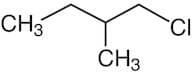
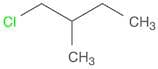
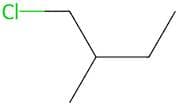
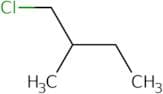
1-chlor-2-methylbutan ist eine organische Verbindung, die als Alkylhalogenid klassifiziert ist, speziell als Chloroalkane. Es weist ein vierkohliges Butan-Rückgrat auf, an dem ein Chloratom und eine Methylgruppe am zweiten Kohlenstoffatom angebracht sind. Diese Struktur verleiht ihm die chemische Formel C5H11Cl. Die Verbindung ist typischerweise eine farblose Flüssigkeit mit einem charakteristischen Geruch und ist bekannt für ihre moderate Flüchtigkeit. Sie ist in organischen Lösungsmitteln löslich, hat jedoch eine begrenzte Löslichkeit in Wasser aufgrund ihrer hydrophoben Kohlenwasserstoffkette. 1-chlor-2-methylbutan wird in der organischen Synthese und als Zwischenprodukt bei der Herstellung verschiedener Chemikalien verwendet. Sie kann nucleophile Substitutionsreaktionen durchlaufen, was sie zu einem nützlichen Reagenz in der synthetischen organischen Chemie macht. Sicherheitsvorkehrungen sind beim Umgang mit dieser Verbindung erforderlich, da sie die Haut und die Augen reizen kann und gesundheitliche Risiken birgt, wenn sie eingeatmet oder eingenommen wird. Eine ordnungsgemäße Lagerung in einem kühlen, gut belüfteten Bereich, fern von inkompatiblen Substanzen, ist unerlässlich, um die Sicherheit zu gewährleisten.
Formel:C5H11Cl
InChl:InChI=1S/C5H11Cl/c1-3-5(2)4-6/h5H,3-4H2,1-2H3
InChI Key:InChIKey=IWAKWOFEHSYKSI-UHFFFAOYSA-N
SMILES:C(CC)(CCl)C
Synonyme:- 2-Methylbutyl chloride
- Butane, 1-chloro-2-methyl-
- Chloromethylbutane
- (±)-1-Chloro-2-methylbutane
- 1-Chloro-2-methylbutane
Sortieren nach
Reinheit (%)
0
100
|
0
|
50
|
90
|
95
|
100
4 Produkte.
1-Chloro-2-methylbutane
CAS:Formel:C5H11ClReinheit:>95.0%(GC)Farbe und Form:Colorless to Light yellow to Light orange clear liquidMolekulargewicht:106.591-Chloro-2-methylbutane
CAS:1-Chloro-2-methylbutane is a reactive, chiral molecule that has been used as a reagent to introduce the methyl group into organic compounds. 1-Chloro-2-methylbutane reacts with iodides in an acid solution to form the methyliodide salt and hydrogen gas. The reaction occurs at temperatures between 50°C and 150°C, but not at higher temperatures. The yield of this reaction depends on the concentration of iodide ions present, with lower concentrations producing a higher yield of product. A variety of frequencies can be used to irradiate the compound with light energy, each producing different results. At low frequencies (less than 10 Hz), the compound absorbs energy and heats up to produce vibrational modes. At high frequencies (greater than 100 Hz), the compound breaks down into two molecules, one containing chlorine and one containing iodine. Irradiation at wavelengths between 250 nm and 400 nm causes bond cleavage in the molecule, yieldingFormel:C5H11ClReinheit:Min. 95%Farbe und Form:Clear LiquidMolekulargewicht:106.59 g/mol