CAS 616-23-9
:(±)-2,3-Dichlor-1-propanol
Beschreibung:
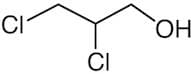
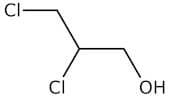
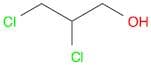
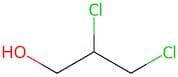
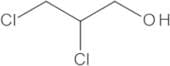
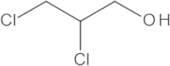
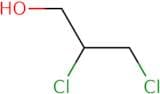
(±)-2,3-Dichlor-1-propanol, mit der CAS-Nummer 616-23-9, ist eine organische Verbindung, die durch das Vorhandensein von zwei Chloratomen gekennzeichnet ist, die an das zweite und dritte Kohlenstoffatom einer drei-Kohlenstoff-Alkoholkette gebunden sind. Diese Verbindung existiert als racemische Mischung, was bedeutet, dass sie gleiche Teile beider Enantiomere enthält, die unterschiedliche Eigenschaften in biologischen Systemen aufweisen können. Es ist eine farblose bis blassgelbe Flüssigkeit mit einem charakteristischen Geruch und ist aufgrund der Anwesenheit der Hydroxylgruppe (-OH) in Wasser löslich. Die Dichlorierung führt zu einer signifikanten Polarität, die ihre Reaktivität und Wechselwirkungen mit anderen Substanzen beeinflusst. (±)-2,3-Dichlor-1-propanol wird hauptsächlich in der chemischen Synthese und als Zwischenprodukt in der Herstellung verschiedener Arzneimittel und Agrochemikalien verwendet. Es ist jedoch wichtig, diese Verbindung mit Vorsicht zu behandeln, da sie Gesundheitsrisiken, einschließlich potenzieller Toxizität und Umweltgefahren, darstellen kann. Angemessene Sicherheitsmaßnahmen sollten beachtet werden, wenn mit dieser Substanz in Labor- oder Industrieumgebungen gearbeitet wird.
Formel:C3H6Cl2O
InChl:InChI=1S/C3H6Cl2O/c4-1-3(5)2-6/h3,6H,1-2H2
InChI Key:InChIKey=ZXCYIJGIGSDJQQ-UHFFFAOYSA-N
SMILES:C(CCl)(CO)Cl
Synonyme:- (2R)-2,3-dichloropropan-1-ol
- (2S)-2,3-dichloropropan-1-ol
- (RS)-2,3-Dichloro-1-propanol
- 1,2-Dichloro-3-Propanol
- 1,2-Dichlorohydrin
- 1,2-Dichloropropanol-3
- 1-Propanol,2,3-Dichloro-
- 2,3-Dichloro-1-Propano
- 2,3-Dichlorohydrin
- 2,3-Dichloropropanol
- 2,3-Dichloropropyl Alcohol
- 2,3-dichloro-1-Propanol
- Alpha,Beta-Dichlorohydrin
- B-Dichlorohydrin
- Beta,Gamma-Dichlorohydrin
- Beta-Dichlorohydrin
- Glycerol 1,2-Dichlorohydrin
- Glycerol Alpha,Beta-Dichlorohydrin
- Glycerol α,β-dichlorohydrin
- α,β-Dichlorohydrin
- Weitere Synonyme anzeigen
Sortieren nach
Reinheit (%)
0
100
|
0
|
50
|
90
|
95
|
100
9 Produkte gefunden.
2,3-Dichloro-1-propanol
CAS:Formel:C3H6Cl2OReinheit:>98.0%(GC)Farbe und Form:Colorless to Almost colorless clear liquidMolekulargewicht:128.982,3-Dichloro-1-propanol, 97+%
CAS:This Thermo Scientific Chemicals brand product was originally part of the Alfa Aesar product portfolio. Some documentation and label information may refer to the legacy brand. The original Alfa Aesar product / item code or SKU reference has not changed as a part of the brand transition to Thermo SciFormel:C3H6Cl2OReinheit:97+%Farbe und Form:Clear colorless, LiquidMolekulargewicht:128.982,3-Dichloropropan-1-ol
CAS:Formel:C3H6Cl2OReinheit:98%Farbe und Form:LiquidMolekulargewicht:128.9851Chloropropan(di)ols Mixture 584 100 µg/mL in Methanol
CAS:Kontrolliertes ProduktFarbe und Form:Mixture2,3-Dichloro-1-propanol
CAS:Kontrolliertes ProduktFormel:C3H6Cl2OFarbe und Form:NeatMolekulargewicht:128.992,3-Dichloro-1-propanol
CAS:Kontrolliertes ProduktFormel:C3H6Cl2OFarbe und Form:NeatMolekulargewicht:128.992,3-Dichloro-1-propanol
CAS:2,3-Dichloro-1-propanol is a metabolic byproduct of chlorinated solvents. It has been shown to be toxic to mitochondria and can cause mitochondrial membrane potential disruption in rat liver cells. The chemical reacts with fatty acids to form a reactive carbonyl group that can react with the hydrogen bond of membrane phospholipids. This reaction disrupts the structure of the lipid bilayer, leading to mitochondrial degeneration. 2,3-Dichloro-1-propanol also reacts with glutathione and carbonic anhydrase, which leads to the formation of reactive intermediates that react with DNA or proteins. These reactions are responsible for the observed toxicity effects in animals.Formel:C3H6Cl2OReinheit:Min. 95%Farbe und Form:Clear LiquidMolekulargewicht:128.98 g/mol