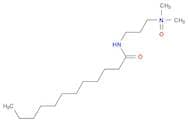
CAS 61792-31-2
:Laurylamidopropyldimethylaminoxid
Beschreibung:
Laurylamidopropyldimethylaminoxid, mit der CAS-Nummer 61792-31-2, ist ein Tensid, das häufig in Formulierungen für die persönliche Pflege und Kosmetik verwendet wird. Es wird als amphoteres Tensid klassifiziert, was bedeutet, dass es je nach pH-Wert der Lösung sowohl als kationisches als auch als anionisches Mittel wirken kann. Diese Verbindung zeichnet sich durch ihre Fähigkeit aus, milde Reinigungseigenschaften, hervorragende Schäumfähigkeit und pflegende Effekte zu bieten, was sie für die Verwendung in Shampoos, Duschgels und anderen Reinigungsprodukten geeignet macht. Laurylamidopropyldimethylaminoxid ist bekannt für seine Verträglichkeit mit verschiedenen anderen Tensiden und seine Fähigkeit, die Stabilität und Textur von Formulierungen zu verbessern. Darüber hinaus zeigt es eine gute biologische Abbaubarkeit, was eine wichtige Überlegung bei der Formulierung umweltfreundlicher Produkte ist. Seine Sanftheit macht es für Anwendungen auf empfindlicher Haut geeignet, und es wird häufig in Formulierungen verwendet, die darauf abzielen, ein sanftes Reinigungserlebnis zu bieten, ohne natürliche Öle von Haut oder Haar zu entfernen.
Formel:C17H36N2O2
InChl:InChI=1S/C17H36N2O2/c1-4-5-6-7-8-9-10-11-12-14-17(20)18-15-13-16-19(2,3)21/h4-16H2,1-3H3,(H,18,20)
InChI Key:InChIKey=JNGWKQJZIUZUPR-UHFFFAOYSA-N
SMILES:C(NCCCN(C)(C)=O)(CCCCCCCCCCC)=O
Synonyme:- (3-Lauramidopropyl)dimethylamine oxide
- 3-Lauramido-N,N-dimethylpropylamine oxide
- 3-Lauramidopropyl-N,N-dimethylamine oxide
- Amides, lauric, N-(3-(dimethylamino)propyl), N-oxide
- Aromox APA 12W
- Cadenax APA 12W
- Dodecanamide, N-(3-(dimethylamino)propyl)-, N-oxide
- Dodecanamide, N-(3-(dimethyloxidoamino)propyl)-
- Dodecylamidopropyldimethylamine oxide
- Genaminox AP
- LAO
- Lao 30
- Lapao
- Lauramidopropyl amine oxide
- Lauramidopropylamine oxide
- Lauroamide propyl amine oxide
- Lauroylamidopropyldimethylamine oxide
- Lauroylaminopropyldimethylamine oxide
- Laurylamidopropyl Dimethylamine Oxide
- Laurylamidopropyldimethylamine oxide
- Mackamine LAO
- N,N-Dimethylaminopropyldodecylamide oxide
- N-(Dodecylamidetrimethylene)dimethylamine oxide
- N-Lauroylaminopropyl-N,N-dimethylamine oxide
- N-[3-(Dimethyloxidoamino)propyl]dodecanamide
- N-[3-(dimethylnitroryl)propyl]dodecanamide
- Softazoline LAO
- Softazoline LAO-C
- N-(3-(Dimethylamino)propyl)dodecanamide-N-oxide
- Weitere Synonyme anzeigen
Sortieren nach
Reinheit (%)
0
100
|
0
|
50
|
90
|
95
|
100
4 Produkte.
Laurylamidopropyldimethylamine oxide
CAS:Formel:C17H36N2O2Reinheit:2%Farbe und Form:LiquidMolekulargewicht:300.4799Lauramidopropylamine oxide
CAS:Lauramidopropylamine oxide is a chemical that is used as an emulsifier, surfactant, and solvent. This product has been shown to inhibit the growth of influenza virus in vitro. It also has a high viscosity and thermal expansion coefficient, which make it useful in a variety of applications. Lauramidopropylamine oxide is used as an emulsifying agent for fatty acids and triglycerides to form oil-in-water emulsions. Lauramidopropylamine oxide can be used in the manufacture of ethylene diamine by reacting with sodium citrate and amide at high temperatures. This chemical is also used in the synthesis of sodium carbonate from anhydrous sodium and sodium chloride, which are combined with dry weight or diamine tetraacetic acid (DTA) to produce sodium carbonate. Lauramidopropylamine oxide can be used as a surfactant in benzalkonium chloride formulations to helpFormel:C17H36N2O2Reinheit:Min. 95%Farbe und Form:PowderMolekulargewicht:300.48 g/molLAPAO
CAS:Lauramide propyl amine oxide is an amphoteric surfactantFormel:C17H36N2O2Farbe und Form:SolidMolekulargewicht:300.48Lauramidopropylamine oxide
CAS:Lauramidopropylamine oxide is a chemical compound that can be used as a reaction component and reagent. It is a fine chemical, useful scaffold, speciality chemical, versatile building block, useful intermediate, or useful building block. Lauramidopropylamine oxide has been used in the synthesis of complex compounds such as N-methyl-N-(2-hydroxyethyl)propane-1,3-diamine (HEDPA).
Formel:C17H36N2O2Molekulargewicht:300.48 g/mol