CAS 6205-14-7
:1,2-Dihydroxypropan-1,2,3-tricarbonsäure
Beschreibung:
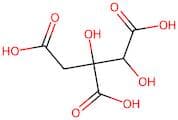
1,2-Dihydroxypropan-1,2,3-tricarbonsäure, allgemein bekannt als Zitronensäure, ist eine schwache organische Säure, die durch ihre drei Carboxylgruppen (-COOH) und zwei Hydroxylgruppen (-OH) gekennzeichnet ist. Diese Verbindung ist ein farbloser, geruchloser kristalliner Feststoff, der hoch wasserlöslich ist, was sie zu einer wichtigen Substanz in verschiedenen biologischen und industriellen Prozessen macht. Zitronensäure spielt eine entscheidende Rolle im Zitronensäurezyklus (Krebs-Zyklus), der für den Zellstoffwechsel in lebenden Organismen unerlässlich ist. Sie wird häufig als natürliches Konservierungsmittel und Aromastoff in Lebensmitteln und Getränken aufgrund ihres sauren Geschmacks verwendet. Darüber hinaus dient Zitronensäure als Chelatbildner, der hilft, Metallionen in Lösungen zu binden, was in verschiedenen Anwendungen, einschließlich Reinigungsprodukten und Pharmazeutika, von Vorteil ist. Ihre Fähigkeit, als pH-Puffer zu wirken, macht sie in kosmetischen Formulierungen und Laborumgebungen wertvoll. Insgesamt ist Zitronensäure eine vielseitige Verbindung von erheblicher Bedeutung sowohl in der Natur als auch in der Industrie.
Formel:C6H8O8
InChl:InChI=1S/C6H8O8/c7-2(8)1-6(14,5(12)13)3(9)4(10)11/h3,9,14H,1H2,(H,7,8)(H,10,11)(H,12,13)
InChI Key:InChIKey=ZMJBYMUCKBYSCP-UHFFFAOYSA-N
SMILES:C(C(C(O)=O)O)(CC(O)=O)(C(O)=O)O
Synonyme:- 1,2,3-Propanetricarboxylic acid, 1,2-dihydroxy-
- 1,2-Dihydroxy-1,2,3-propanetricarboxylic acid
- 1,2-Dihydroxypropane-1,2,3-tricarboxylic acid
- 3-C-carboxy-2-deoxypentaric acid
- Hca-K
- Hydroxycitric acid
- Hydroxycitricacidanditstrisodiumsalt
- N~3~-cyclohexyl-2-(2,3-dihydro-1,4-benzodioxin-2-ylmethyl)-N~7~-[3-(methylsulfanyl)phenyl]-1-oxo-1,2,3,6,7,7a-hexahydro-3a,6-epoxyisoindole-3,7-dicarboxamide
- Pentaric acid, 3-C-carboxy-2-deoxy-
- Potassium Hydroxycitrate
- Regulator
- Tripotassium-2-Hydroxycditracte
- Weitere Synonyme anzeigen
Sortieren nach
Reinheit (%)
0
100
|
0
|
50
|
90
|
95
|
100
6 Produkte.
Hydroxycitric acid
CAS:(-)-Hydroxycitric acid (HCA) can inhibit fat synthesis and reduces food intake, the primary mechanism of action of HCA appears to be related to its ability toFormel:C6H8O8Farbe und Form:SolidMolekulargewicht:208.12Hydroxycitric Acid Tripotassium Salt Monohydrate
CAS:Stability Hygroscopic
Applications Hydroxycitric Acid is the hydroxyl derivative of citric acid with potential for modulation of lipid metabolism.
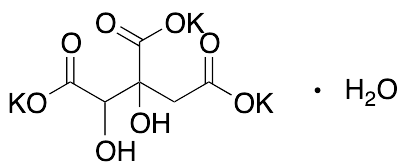
References Shara, M. et al.: Mol. Chem. Biochem., 254, 339 (2003);Formel:C6H5O8K3·H2OFarbe und Form:NeatMolekulargewicht:340.411,2-Dihydroxypropane-1,2,3-tricarboxylic acid
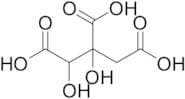
CAS:1,2-Dihydroxypropane-1,2,3-tricarboxylic acid is the sodium salt of a plant metabolite that is found in beans and has been shown to have anti-inflammatory effects. It has been shown to inhibit the enzyme activities of lipoxygenase and cyclooxygenase as well as the toxicity of metal hydroxides in vitro. 1,2-Dihydroxypropane-1,2,3-tricarboxylic acid also inhibits protein synthesis and induces apoptosis in k562 cells.Formel:C6H8O8Reinheit:Min. 95%Farbe und Form:PowderMolekulargewicht:208.12 g/mol