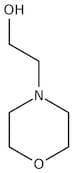
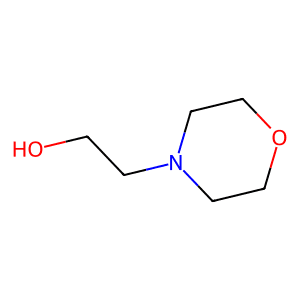
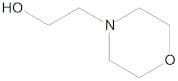
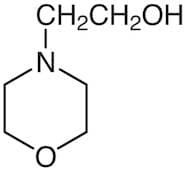
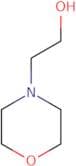
CAS 622-40-2
:4-Morpholinethanol
- 1-(2-Hydroxyethyl)morpholine
- 1-(Morpholin-4-Yl)Ethanol
- 2-(4-Morpholino)ethanol
- 2-(4-Morpholino)ethyl alcohol
- 2-(4-Morpholinyl)-1-ethanol
- 2-(4-Morpholinyl)ethanol
- 2-(Morpholin-4-Yl)Ethanol
- 2-Morfolinoetanol
- 2-Morpholinethanol
- 2-Morpholinoethan-1-ol
- 2-Morpholinoethanol
- 4-(2-Hydroxyaethyl)-Morpholin
- 4-(2-Hydroxyethyl)Morpholin-4-Ium
- 4-(2-Hydroxyethyl)morpholine
- 4-Morpholineethanol
- Ethanol-Morpholine (1:1)
- Hydroxyethylphosphonicaciddimethylester
- Morpholine Ethanol
- Morpholine, 4-(2-Hydroxyethyl)-
- N-(β-Hydroxyethyl)morpholine
- Nsc 1946
- β-Morpholinoethanol
- Weitere Synonyme anzeigen
4-(2-Hydroxyethyl)morpholine, 99%
CAS:4-(2-Hydroxyethyl)morpholine is used as an organic chemical synthesis intermediate. This Thermo Scientific Chemicals brand product was originally part of the Alfa Aesar product portfolio. Some documentation and label information may refer to the legacy brand. The original Alfa Aesar product / item cFormel:C6H13NO2Reinheit:99%Farbe und Form:Clear colorless to yellow to orange, LiquidMolekulargewicht:131.184-(2-Hydroxyethyl)morpholine
CAS:Formel:C6H13NO2Reinheit:≥ 99.0%Farbe und Form:Clear, colourless to light yellow liquidMolekulargewicht:131.182-Morpholinoethanol
CAS:Formel:C6H13NO2Reinheit:95.0%Farbe und Form:Liquid, ViscousMolekulargewicht:131.1754-(2-Hydroxyethyl)morpholine
CAS:Formel:C6H13NO2Reinheit:>99.0%(GC)Farbe und Form:Colorless to Light orange to Yellow clear liquidMolekulargewicht:131.184-Morpholineethanol
CAS:Kontrolliertes ProduktApplications 4-(2-Hydroxyethyl)morpholine is a morphiline derivative used in the preparation of ester prodrugs of naproxen. 4-(2-Hydroxyethyl)morpholine was also shown to induce repair in rat hepatocyte primary culture/DNA.
References Conaway, C.C. et al.: Mutat. Res. Gen. Toxicol. Test., 136, 153 (1984); Tsai, S.-W. et al.: Chem. Technol. Biotechnol., 74, 751 (1999);Formel:C6H13NO2Farbe und Form:YellowMolekulargewicht:131.174-(2-Hydroxyethyl)morpholine (4-HEM) extrapure, 99%
CAS:Formel:C6H13NO2Reinheit:min. 99 %Farbe und Form:Clear, Colourless to yellow, LiquidMolekulargewicht:131.172-Morpholinoethanol
CAS:2-Morpholinoethanol is a potent inhibitor of the enzyme nitric oxide synthase, which is involved in the synthesis of nitric oxide. Nitric oxide is an important molecule that regulates many physiological processes, such as inflammation and blood flow. 2-Morpholinoethanol has been shown to have high resistance to thermal expansion, due to its intramolecular hydrogen bonding. It also inhibits the activity of amine oxidases, which are enzymes that catalyze reactions involving amines and oxygen. The mechanism of action of 2-morpholinoethanol has been studied by using group P2 fatty acids and amines as substrates for nitric oxide synthase.
Formel:C6H13NO2Reinheit:Min. 95%Molekulargewicht:131.17 g/molRef: 3D-FM140549
Ausgelaufenes produkt