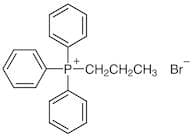
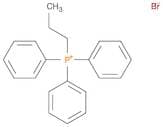
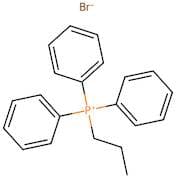
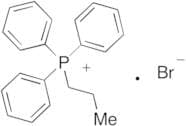
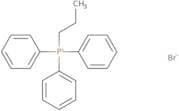
CAS 6228-47-3
:Propyltriphenylphosphoniumbromid
- (1-Propyl)triphenylphosphonium bromide
- Bromo(propyl)triphenylphosphorane
- N-Propyltriphenyl phosphonium Bromide
- NSC 50539
- Phosphonium, triphenylpropyl-, bromide
- Phosphonium, triphenylpropyl-, bromide (1:1)
- Propyl Triphenyl Phosphonium Bromide
- Propyl Triphenylphosphonium Bromide
- Triphenyl-n-propylphosphonium bromide
- Triphenylpropylphosphonium bromide
- n-Propyltriphenylphosphonium bromide
- Weitere Synonyme anzeigen
Triphenylpropylphosphonium Bromide
CAS:Formel:C21H22BrPReinheit:>98.0%(T)(HPLC)Farbe und Form:White to Almost white powder to crystalMolekulargewicht:385.28(1-Propyl)triphenylphosphonium bromide, 99%
CAS:It is employed as a catalyst for the carboxylation of styrene oxide and as a reactant involved in epoxidation of arylalkenes, boration of allylic epoxides, Wittig reactions, selective dimerization of -olefins, and synthesis of indoles. It has also been shown to be part of Phosphonium salts, having aFormel:C21H22BrPReinheit:99%Farbe und Form:White, Crystals or powder or crystalline powderMolekulargewicht:385.29Phosphonium, triphenylpropyl-, bromide
CAS:Formel:C21H22BrPReinheit:95%Farbe und Form:SolidMolekulargewicht:385.2771Propyl(triphenyl)phosphonium bromide
CAS:Propyl(triphenyl)phosphonium bromideFormel:C21H22P·BrReinheit:99%Farbe und Form: white. crystalline powderMolekulargewicht:385.28g/moln-Propyl-2,2,3,3,3-d5-triphenylphosphonium Bromide
CAS:Formel:CD3CD2CH2P(C6H5)3BrReinheit:98 atom % DFarbe und Form:White SolidMolekulargewicht:389.09563Propyltriphenylphosphonium bromide
CAS:Formel:C21H22BrPReinheit:95%Farbe und Form:SolidMolekulargewicht:385.285n-Propyltriphenylphosphonium Bromide
CAS:Kontrolliertes ProduktStability Hygroscopic
Applications n-Propyltriphenylphosphonium Bromide, is an analogue of phosphonium, acting as reversible inhibitors of cholinesterases of different animals. It has also been shown to be part of Phosphonium salts, having antiviral activity against influenza virus A.
References Basova, N. E., et al.: oklady Biochem. Biophys., 434, 245 (2010); Romanov, G. V., et al.: Khimiko-Farmatsevticheskii Zhurnal, 24, 28 (1990);Formel:C21H22BrPFarbe und Form:NeatMolekulargewicht:385.28(1-Propyl)triphenylphosphonium bromide
CAS:(1-Propyl)triphenylphosphonium bromide is an organic chemical compound. It is a colorless solid that is soluble in organic solvents such as chloroform and ether, but insoluble in water. The chemical structure of (1-propyl)triphenylphosphonium bromide was determined by NMR spectra and chemical ionization mass spectroscopy. The viscosity of the liquid at room temperature is 0.5 Pa·s. Reaction intermediates have been detected by GC/MS analysis, which includes protonated 1-propyl triphenylphosphonium cation, phosphonium ylide, and phosphonium carbenoid. This product has shown inhibitory effects on the reaction between aldehyde groups and fatty acid chains in the presence of potassium hydroxide or sodium hydroxide solutions.
Reinheit:Min. 95%