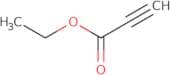
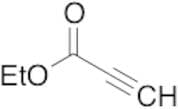
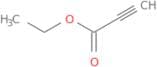
CAS 623-47-2
:Ethylpropiolat
Beschreibung:
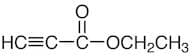
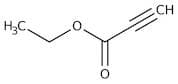
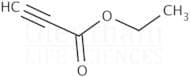
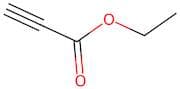
Ethylpropiolat ist eine organische Verbindung, die als aliphatischer Ester klassifiziert ist, mit der chemischen Formel C5H8O2. Sie ist durch eine charakteristische Dreifachbindung zwischen den Kohlenstoffatomen in ihrer Propiolgruppe gekennzeichnet, was zu ihrer Reaktivität beiträgt. Ethylpropiolat erscheint als farblose bis blassgelbe Flüssigkeit mit einem fruchtigen Geruch, was sie in verschiedenen Anwendungen bemerkenswert macht, einschließlich als Aromastoff und in der organischen Synthese. Sie hat einen relativ niedrigen Siedepunkt und ist in organischen Lösungsmitteln löslich, aber weniger löslich in Wasser. Die Verbindung ist bekannt für ihre Fähigkeit, an verschiedenen chemischen Reaktionen teilzunehmen, einschließlich nucleophiler Additionen und Cycloadditionen, was sie wertvoll für die Synthese komplexerer Moleküle macht. Sie sollte jedoch mit Vorsicht behandelt werden, da sie potenziell reizende Eigenschaften hat und angemessene Sicherheitsvorkehrungen beim Arbeiten mit ihr in einem Laborumfeld erforderlich sind. Insgesamt dient Ethylpropiolat als wichtiger Baustein in der organischen Chemie und in industriellen Anwendungen.
Formel:C5H6O2
InChl:InChI=1S/C5H6O2/c1-3-5(6)7-4-2/h1H,4H2,2H3
InChI Key:InChIKey=FMVJYQGSRWVMQV-UHFFFAOYSA-N
SMILES:C(OCC)(C#C)=O
Synonyme:- (Ethoxycarbonyl)acetylene
- Acetylenecarboxylate, Ethyl
- Carboethoxyacetylene
- Ethyl 2-propynoate
- Ethyl Propiolate
- Ethyl acetylenecarboxylate
- Ethyl acetylenemonocarboxylate
- Ethyl propargylate
- Ethyl propynoate
- Ethylpropiolat
- Nsc 60551
- Propiolate D'Ethyle
- Propiolato De Etilo
- Propiolic acid, ethyl ester
- Propynoic acid ethyl ester
- Propiolic acid ethylester
- 2-Propynoic acid, ethyl ester
- Weitere Synonyme anzeigen
Sortieren nach
Reinheit (%)
0
100
|
0
|
50
|
90
|
95
|
100
10 Produkte.
Ethyl Propiolate
CAS:Formel:C5H6O2Reinheit:>98.0%(GC)Farbe und Form:Colorless to Light yellow to Light orange clear liquidMolekulargewicht:98.10Ethyl propiolate, 99%
CAS:Ethyl propiolate is used as a precursor in the preparation of substituted anthraquinones and pyrazolo[1,5-a]pyridine, which exhibits anti-inflammatory activity. Further, it is employed in the synthesis of benzene-1,2,3,5-tetracarboxylates promoted by triphenylphosphine. Its halogenated derivatives aFormel:C5H6O2Reinheit:99%Farbe und Form:Liquid, Clear colorless to pale yellowMolekulargewicht:98.1Ethyl propiolate
CAS:Formel:C5H6O2Reinheit:98.0%Farbe und Form:Liquid, Colourless liquidMolekulargewicht:98.101Ethyl prop-2-ynoate
CAS:Ethyl prop-2-ynoateFormel:C5H6O2Reinheit:98%Farbe und Form: clear. colourless liquidMolekulargewicht:98.09994g/molEthyl propiolate
CAS:Ethyl propiolate is a halide that is structurally related to the alkylating agent trifluoroacetic acid. Ethyl propiolate inhibits the activity of several enzymes including phosphofructokinase and pyruvate kinase, which are important for energy metabolism in cells. It also has been shown to have beneficial effects on autoimmune diseases such as lupus erythematosus. The mechanism of action of ethyl propiolate is due to its ability to react with activated oxygen and form an intramolecular hydrogen bond with carbon atoms in the substrate molecule. The reaction between ethyl propiolate and diethyl ketomalonate results in the formation of diethyl 2-propiolate, which can then be hydrolyzed by water into acetaldehyde and diethyl ketomalonate.Formel:C5H6O2Reinheit:Min. 98 Area-%Farbe und Form:Colorless Clear LiquidMolekulargewicht:98.1 g/molEthyl Propargylate
CAS:Kontrolliertes ProduktApplications Ethyl Propargylate is used in the synthesis of substituted anthraquinones. Also used in the preparation of inhibitory pyrazolo[1,5-a]pyridines for anti-inflammatory activity.
Not a dangerous good if item is equal to or less than 1g/ml and there is less than 100g/ml in the package
References Chang, M. et al: Synth. Comm., 43, 3363 (2013); Kojima, A. et al.: Bioorg. Med. Chem. Lett., 23, 5311 (2013);Formel:C5H6O2Farbe und Form:NeatMolekulargewicht:98.1