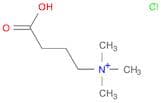
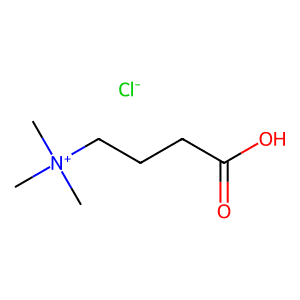
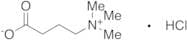
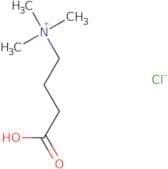
CAS 6249-56-5
:(3-Carboxypropyl)trimethylammoniumchlorid
Beschreibung:
(3-Carboxypropyl)trimethylammoniumchlorid, mit der CAS-Nummer 6249-56-5, ist eine quartäre Ammoniumverbindung, die durch ihre Trimethylammoniumgruppe und eine Carboxypropyl-Seitenkette gekennzeichnet ist. Diese Verbindung ist typischerweise ein weißer kristalliner Feststoff, der aufgrund seiner ionischen Natur, die sich aus der Anwesenheit von quartären Ammonium- und Chloridionen ergibt, in Wasser löslich ist. Sie weist Eigenschaften wie Hygroskopizität auf und kann in verschiedenen Bereichen Anwendung finden, einschließlich Biochemie und Pharmazie, insbesondere als Tensid oder in der Arzneimittelherstellung. Die Anwesenheit der Carbonsäuregruppe trägt zu ihrer potenziellen Reaktivität und Fähigkeit bei, Salze oder Komplexe mit anderen Molekülen zu bilden. Darüber hinaus verleiht ihre quartäre Ammoniumstruktur kationische Eigenschaften, was sie in Anwendungen mit antimikrobieller Aktivität oder als Phasentransferkatalysator nützlich macht. Sicherheitsdaten sollten für den Umgang und die Lagerung konsultiert werden, wie bei allen chemischen Substanzen, um sicherzustellen, dass die richtigen Vorsichtsmaßnahmen getroffen werden.
Formel:C7H16NO2·Cl
InChl:InChI=1S/C7H15NO2.ClH/c1-8(2,3)6-4-5-7(9)10;/h4-6H2,1-3H3;1H
InChI Key:InChIKey=GNRKTORAJTTYIW-UHFFFAOYSA-N
SMILES:C(CCC(O)=O)[N+](C)(C)C.[Cl-]
Synonyme:- (3-Carboxypropyl)Trimethyl-Ammoniuchloride
- (3-Carboxypropyl)Trimethylammonium Chlor Ide, Tech.
- (3-Carboxypropyl)Trimethylammoniumchlori De Practic
- 1-Propanaminium, 3-carboxy-N,N,N-trimethyl-, chloride
- 1-Propanaminium, 3-carboxy-N,N,N-trimethyl-, chloride (1:1)
- 3-Carboxy-N,N,N-Trimethyl-1-Propanaminiuchloride
- 3-Carboxy-N,N,N-Trimethyl-1-Propanaminiumchloride
- 3-Carboxy-N,N,N-trimethylpropan-1-aminiumchloride
- 3-carboxy-N,N,N-trimethylpropan-1-aminium chloride
- Ammonium, (3-carboxypropyl)trimethyl-, chloride
- Deoxycarnitine Hydrochloride
- Gamma-Butyrobetain-Chlorid
- Gamma-Butyrobetaine Hydrochloride
- N-Trimethyl-γ-aminobutyric acid chloride
- Trimethylaminobutyrate
- Γ-Butyrobetaine Hydrochloride
- Weitere Synonyme anzeigen
Sortieren nach
Reinheit (%)
0
100
|
0
|
50
|
90
|
95
|
100
9 Produkte.
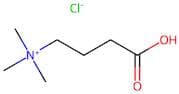
(3-Carboxypropyl)trimethylammonium chloride
CAS:Formel:C7H16ClNO2Reinheit:97%Farbe und Form:SolidMolekulargewicht:181.6604(3-Carboxypropyl)trimethylammonium chloride
CAS:(3-Carboxypropyl)trimethylammonium chlorideReinheit:≥98%Molekulargewicht:181.66g/mol(3-Carboxypropyl)Trimethylammonium Chloride
CAS:(3-Carboxypropyl)Trimethylammonium ChlorideReinheit:97%Molekulargewicht:181.66g/mol(3-Carboxypropyl)trimethylammonium chloride
CAS:Synthetic carnitine analog used for cloning & sequencing human CT2.Formel:C7H16ClNO2Reinheit:99.70% - 99.97%Farbe und Form:SolidMolekulargewicht:181.66γ-Butyrobetaine Hydrochloride
CAS:Kontrolliertes ProduktApplications γ-Butyrobetaine is a synthetic carnitine related compound used as a transporter substrate in the cloning and sequencing of human carnitine transporter 2 (CT2).
References Enomoto, A. et al.: J. Biol. Chem., 277, 36262 (2002);Formel:C7H16NO2·ClFarbe und Form:NeatMolekulargewicht:181.663-Carboxy-N,N,N-trimethylpropan-1-aminium chloride
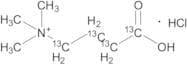
CAS:Formel:C7H16ClNO2Reinheit:95%Farbe und Form:Solid, White powderMolekulargewicht:181.66γ-Butyrobetaine-13C4 Hydrochloride
CAS:Kontrolliertes ProduktFormel:C3C4H16NO2•HClFarbe und Form:NeatMolekulargewicht:222.09gamma-Butyrobetaine hydrochloride
CAS:Gamma-butyrobetaine hydrochloride (GBB) is a metabolite of gamma-butyrobetaine, which is found in the human body. GBB is synthesized from lysine and methionine through an enzymatic pathway that starts with the conversion of lysine to homocysteine. GBB is then converted to gamma-butyrobetaine by methylating the hydroxyl group on its terminal carbon. GBB can be found in urine samples as well as in carnitine and fatty acid metabolism. It has been shown to have an inhibitory effect on creatine kinase and can be used to diagnose metabolic disorders such as carnitine deficiency or prognosis following a heart attack.Formel:C7H16ClNO2Reinheit:Min. 95%Farbe und Form:PowderMolekulargewicht:181.66 g/mol