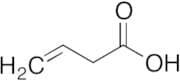
CAS 625-38-7
:3-Butensäure
Beschreibung:
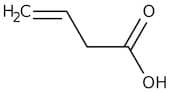
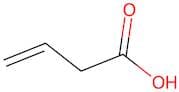
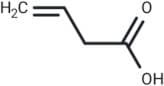
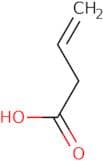
3-Butensäure, auch bekannt als Crotonsäure, ist eine ungesättigte Carbonsäure, die durch ihre vier Kohlenstoffatome mit einer Doppelbindung zwischen dem zweiten und dritten Kohlenstoffatom gekennzeichnet ist. Ihre chemische Formel ist C4H6O2, und sie weist an einem Ende der Kette eine Carbonsäurefunktion (-COOH) auf. Diese Verbindung ist eine farblose Flüssigkeit mit einem stechenden Geruch und ist in Wasser, Alkohol und Ether löslich. 3-Butensäure ist bekannt für seine Reaktivität aufgrund der Doppelbindung, die es ihm ermöglicht, an verschiedenen chemischen Reaktionen teilzunehmen, einschließlich Polymerisation und Veresterung. Es wird in der Synthese verschiedener Chemikalien verwendet, einschließlich pharmazeutischer Produkte, Agrochemikalien und als Baustein in der organischen Synthese. Darüber hinaus kann es an der Herstellung von Polymeren und Tensiden beteiligt sein. Sicherheitsüberlegungen umfassen das Potenzial, Haut- und Augenreizungen zu verursachen, was angemessene Handhabungsmaßnahmen in Labor- und Industrieumgebungen erforderlich macht.
Formel:C4H6O2
InChl:InChI=1S/C4H6O2/c1-2-3-4(5)6/h2H,1,3H2,(H,5,6)
InChI Key:InChIKey=PVEOYINWKBTPIZ-UHFFFAOYSA-N
SMILES:C(C(O)=O)C=C
Synonyme:- 3-Butenoic acid
- Acetic acid, ethenyl-
- But-3-Enoate
- But-3-Enoic Acid
- NSC 44546
- Vinylacetic acid, (3-Butenoic acid)
- β-Butenoic acid
- Vinylacetic acid
Sortieren nach
Reinheit (%)
0
100
|
0
|
50
|
90
|
95
|
100
8 Produkte.
Vinylacetic acid, 96%
CAS:Vinylacetic acid used in the preparation of strained nitroso Diels-Aldrer adducts which undergo a domino ROC metathesis in the presence of Ru-carbene catalysts and olefins. It is used in the synthesis of polyethylene glycolated boltorn coatings. It was used to study the inhibition of the enzyme-cataFormel:C4H6O2Reinheit:96%Farbe und Form:Liquid, Clear colorless to yellowMolekulargewicht:86.093-Butenoic acid
CAS:3-Butenoic acid aids in creating 3,6-dihydro-1,2-oxazine for domino metathesis with alkenes.Formel:C4H6O2Farbe und Form:SolidMolekulargewicht:86.093-Butenoic acid
CAS:3-Butenoic acid is a versatile compound that has various applications across different industries. In the field of healthcare, it has been found to be effective in treating bacterial vaginosis, a common vaginal infection caused by an imbalance of bacteria. Additionally, it has shown virologic properties, making it potentially useful in antiviral therapies.
Formel:C4H6O2Reinheit:Min. 95 Area-%Molekulargewicht:86.09 g/mol3-Butenoic acid
CAS:3-Butenoic acid is a fatty acid that belongs to the group of short chain carboxylic acids. It is used in detergent compositions where it functions as a cationic surfactant and has a hydroxyl group that can be used for polymerization reactions. 3-Butenoic acid is also used as an analytical reagent, e.g., in electrochemical impedance spectroscopy, in which it has been shown to have phase transition temperature of around 38°C. 3-Butenoic acid can be synthesized by reacting butanol with hydrochloric acid and copper chloride in the presence of a cationic surfactant such as alkyltrimethylammonium chloride or benzalkonium chloride. 3-Butenoic acid also acts as a Jak1 inhibitor and has receptor activity against all types of receptors, including those for histamine, acetylcholine, dopamine, serotonin, and GABA (gamma aminobFormel:C4H6O2Reinheit:Min. 95 Area-%Farbe und Form:Colorless Clear LiquidMolekulargewicht:86.09 g/molVinylacetic Acid
CAS:Kontrolliertes ProduktStability Light Sensitive
Applications Vinylacetic Acid can be used as a reagent in the synthesis of 4-Phenyl-3-butenoic Acid which is an in vivo inhibitor of the peptide amidating enzyme peptidylglycine hydroxylase.
Not a dangerous good if item is equal to or less than 1g/ml and there is less than 100g/ml in the package
References Bradbury, A.F., et al.: Eur. J. Biochem., 189, 33 (1990)Formel:C4H6O2Farbe und Form:NeatMolekulargewicht:86.09