CAS 626-05-1
:2,6-Dibrompyridin
Beschreibung:
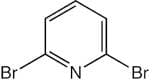
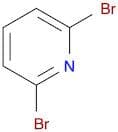
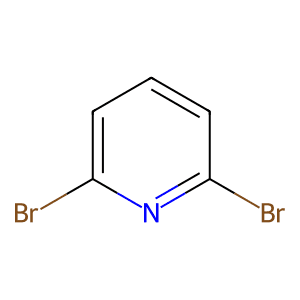
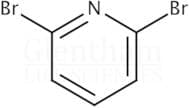
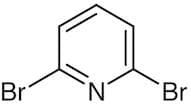
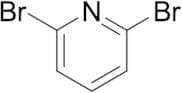
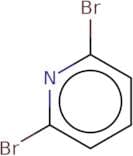
2,6-Dibrompyridin ist eine organische Verbindung, die durch einen Pyridinring gekennzeichnet ist, der an den Positionen 2 und 6 mit zwei Bromatomen substituiert ist. Sie hat die chemische Formel C5H3Br2N und wird als halogenierte heterocyclische Verbindung klassifiziert. Diese Substanz erscheint typischerweise als farblose bis hellgelbe Flüssigkeit oder Feststoff, abhängig von der Temperatur. Sie ist bekannt für ihre moderate Löslichkeit in organischen Lösungsmitteln und ihre begrenzte Löslichkeit in Wasser. 2,6-Dibrompyridin wird in verschiedenen chemischen Synthesen verwendet, insbesondere in der Herstellung von Arzneimitteln und Agrochemikalien, aufgrund ihrer Reaktivität und Fähigkeit, als Baustein in der organischen Synthese zu dienen. Die Anwesenheit von Bromatomen verstärkt ihren elektrophilen Charakter, was sie zu einem nützlichen Zwischenprodukt in Reaktionen wie nucleophilen Substitutionen macht. Sicherheitsvorkehrungen sind beim Umgang mit dieser Verbindung erforderlich, da sie Gesundheitsrisiken darstellen kann, einschließlich Haut- und Augenreizungen sowie potenziellen Umweltrisiken. Es sollten geeignete Lagerungs- und Entsorgungsmethoden befolgt werden, um Risiken im Zusammenhang mit ihrer Verwendung zu mindern.
Formel:C5H3Br2N
InChl:InChI=1S/C5H3Br2N/c6-4-2-1-3-5(7)8-4/h1-3H
InChI Key:InChIKey=FEYDZHNIIMENOB-UHFFFAOYSA-N
SMILES:BrC=1N=C(Br)C=CC1
Synonyme:- 2,6-Dibromo Pyridine
- NSC 613
- Pyridine, 2,6-dibromo-
- 2,6-Dibromopyridine
Sortieren nach
Reinheit (%)
0
100
|
0
|
50
|
90
|
95
|
100
8 Produkte.
2,6-Dibromopyridine, 98%
CAS:2,6-Dibromopyridine is used as a tridentate chelating ligand and in the formation of macrocycles containing the terpyridine moiety. It is also used to produce 6-bromo-2-methoxypyridine. This Thermo Scientific Chemicals brand product was originally part of the Alfa Aesar product portfolio. Some documFormel:C5H3Br2NReinheit:98%Farbe und Form:Crystals or powder or crystalline powder or fused solid, White to cream to pale brown to grayMolekulargewicht:236.89Ref: IN-DA003311
5kgNachfragen5g24,00€10g25,00€25g25,00€50g31,00€100g40,00€250g63,00€500g119,00€1kg185,00€2,6-Dibromopyridine
CAS:2,6-DibromopyridineFormel:C5H3Br2NReinheit:≥95%Farbe und Form: white to light brown solidMolekulargewicht:236.89201g/mol2,6-Dibromopyridine
CAS:Formel:C5H3Br2NReinheit:≥ 98.0%Farbe und Form:White to off-white powderMolekulargewicht:236.902,6-Dibromopyridine
CAS:Formel:C5H3Br2NReinheit:>98.0%(GC)Farbe und Form:White to Almost white powder to crystalMolekulargewicht:236.892,6-Dibromopyridine
CAS:Kontrolliertes ProduktApplications 2,6-Dibromopyridine is used as a starting material to synthesize 2,2’-bipyridines (such as 5-Cyano-1,6-dihydro-6-oxo-[3,4'-bipyridine]-2-carboxylic Acid [C979150]) via a Stille-type cross-coupling reaction. 2,6-Dibromopyridine is also used as a reagent to synthesize pyridylpyrimidine fungicides, compounds that eliminate fungi by cycling copper through the cell membrane, where it reaches toxic levels.
References Hargreaves, S., et al.: Tetrahedron Lett., 41, 1653 (2000); Heller, M. & Schubert, U.: J. Org. Chem., 67, 8269 (2002); Simkovsky, N., et al.: J. Chem. Soc. Perk. Trans. 1, 16, 1847 (2002)Formel:C5H3Br2NFarbe und Form:NeatMolekulargewicht:236.892,6-Dibromopyridine
CAS:2,6-Dibromopyridine (2,6-DBP) is a chemical compound that has been used in the synthesis of other organic compounds. It is an aromatic heterocycle with nitrogen atoms at the 2 and 6 positions. 2,6-DBP is a monosubstituted pyridine derivative that undergoes a palladium-catalyzed coupling reaction with an aryl halide to form pyrazoles. This process can be done unsymmetrically by protonating the 2 position of the dibromopyridine molecule. The presence of serine protease has been shown to promote this reaction by increasing the surface area of the substrate.Formel:C5H3Br2NReinheit:Min. 98 Area-%Farbe und Form:Off-White Yellow PowderMolekulargewicht:236.89 g/mol