CAS 626-43-7
:3,5-Dichloranilin
Beschreibung:
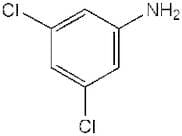
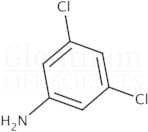
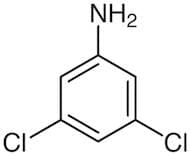
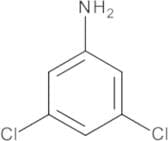
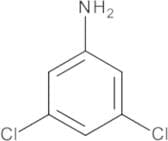
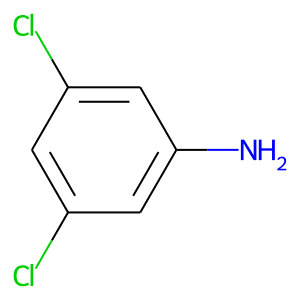
3,5-Dichloranilin ist eine organische Verbindung, die durch das Vorhandensein von zwei Chloratomen gekennzeichnet ist, die an den aromatischen Ring eines Anilinmoleküls gebunden sind. Genauer gesagt befinden sich die Chlor-Substituenten an den Positionen 3 und 5 relativ zur Aminogruppe (-NH2). Diese Verbindung erscheint als Feststoff, typischerweise weiß bis hellgelb, und ist bekannt für ihre moderate Löslichkeit in Wasser und höhere Löslichkeit in organischen Lösungsmitteln. Sie hat einen ausgeprägten Amin-Geruch und wird hauptsächlich in der Synthese von Farbstoffen, Arzneimitteln und Agrochemikalien verwendet. 3,5-Dichloranilin wird als gefährliche Substanz eingestuft, mit potenziellen Gesundheitsrisiken, einschließlich Haut- und Augenreizungen, und kann Umweltgefahren darstellen, wenn sie nicht ordnungsgemäß gehandhabt wird. Ihre chemische Struktur trägt zu ihrer Reaktivität bei, was sie zu einem nützlichen Zwischenprodukt in verschiedenen chemischen Reaktionen macht. Wie bei vielen chlorierten Verbindungen ist es wichtig, ihren Gebrauch und ihre Entsorgung zu verwalten, um die Umweltauswirkungen zu minimieren und die Sicherheit bei der Handhabung zu gewährleisten.
Formel:C6H5Cl2N
InChl:InChI=1S/C6H5Cl2N/c7-4-1-5(8)3-6(9)2-4/h1-3H,9H2
InChI Key:InChIKey=UQRLKWGPEVNVHT-UHFFFAOYSA-N
SMILES:ClC1=CC(Cl)=CC(N)=C1
Synonyme:- 3,5-Dca
- 3,5-Dichloranilin
- 3,5-Dichlorobenzenamine
- 3,5-Dichlorolaniline
- 3,5-Dichlorophenylamine
- 3,5-Dicloroanilina
- Aniline, 3,5-dichloro-
- Benzenamine, 3,5-dichloro-
- Ccris 2396
- Hsdb 5437
- 3,5-Dichloroaniline
Sortieren nach
Reinheit (%)
0
100
|
0
|
50
|
90
|
95
|
100
12 Produkte gefunden.
3,5-Dichloroaniline, 98%
CAS:This Thermo Scientific Chemicals brand product was originally part of the Alfa Aesar product portfolio. Some documentation and label information may refer to the legacy brand. The original Alfa Aesar product / item code or SKU reference has not changed as a part of the brand transition to Thermo SciFormel:C6H5Cl2NReinheit:98%Farbe und Form:Crystals, crystalline powder, flakes or chunks, White to cream to brownMolekulargewicht:162.013,5-Dichloroaniline
CAS:Formel:C6H5Cl2NReinheit:>98.0%(GC)Farbe und Form:White to Light yellow to Light red powder to crystalMolekulargewicht:162.013,5-Dichloroaniline
CAS:Kontrolliertes ProduktFormel:C6H5Cl2NFarbe und Form:NeatMolekulargewicht:162.023,5-Dichloroaniline 100 µg/mL in Methanol
CAS:Kontrolliertes ProduktFormel:C6H5Cl2NFarbe und Form:Single SolutionMolekulargewicht:162.023,5-Dichloroaniline
CAS:3,5-DichloroanilineFormel:C6H5Cl2NReinheit:≥95%Farbe und Form: dark grey crystalline solidMolekulargewicht:162.02g/mol3,5-Dichlorobenzenamine
CAS:Kontrolliertes ProduktApplications Dichlorobenzenamine is used in the synthesis of effective inhibitors of plant δ1-pyrroline-4-carboxylate reductase. Also used in the preparation of anti-tumor agents based upon diaryl urea derivatives.
References Forlani, G. et al.: J. Agri. Food Chem., 61, 6792 (2013); Zhai, X. et al.: Molecules, 18, 2904 (2013);Formel:C6H5Cl2NFarbe und Form:NeatMolekulargewicht:162.023,5-Dichloroaniline
CAS:3,5-Dichloroaniline is an organic compound that exists in two forms. The form that is of most interest to chemists is the para form, which is also called 3,5-dichloro-4-nitroaniline. It has been shown to be an inhibitor of the P450 enzyme system and can be used as a probe for this enzyme activity. 3,5-Dichloroaniline inhibits the activity of bacterial enzymes such as urease, nitroreductase, and cytochrome C reductase. This compound also inhibits the reaction between hydrochloric acid and ammonia to produce ammonium chloride and water. Solubility data for this compound have been obtained by a variety of methods including in vitro studies and experiments on Sprague-Dawley rats.Formel:C6H5Cl2NReinheit:Min. 95%Molekulargewicht:162.02 g/mol