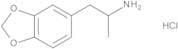
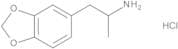
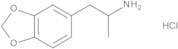
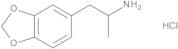
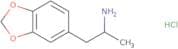
CAS 6292-91-7
:3,4-Methylendioxyamphetaminhydrochlorid
- (?à)-3,4-Methylenedioxyamphetamine hydrochloride
- 1,3-Benzodioxole-5-ethanamine, α-methyl-, hydrochloride
- 1,3-Benzodioxole-5-ethanamine,a-methyl-, hydrochloride (9CI)
- 1-(3,4-Methylenedioxyphenyl)-2-aminopropane hydrochloride
- 3,4-Methylenedioxy-a-methyl-b-phenylethylamine hydrochloride
- 3,4-Methylenedioxyamphetamine hydrochloride
- Nsc 27106
- Nsc 9978
- Phenethylamine, a-methyl-3,4-(methylenedioxy)-,hydrochloride (6CI,7CI,8CI)
- Phenethylamine, α-methyl-3,4-(methylenedioxy)-, hydrochloride
- dl-3,4-Methylenedioxyamphetamine hydrochloride
- Weitere Synonyme anzeigen
d,l-MDA.HCl, 1mg/ml in Methanol (as free base)
CAS:Kontrolliertes ProduktFarbe und Form:Single Solutionrac-MDA HCl (rac-3,4-Methylenedioxy-amphetamine Hydrochloride)
CAS:Kontrolliertes ProduktFarbe und Form:NeatTenamfetamine Hydrochloride (1 mg/ml in Methanol)
CAS:Kontrolliertes ProduktFormel:C10H13NO2·ClHFarbe und Form:Single SolutionMolekulargewicht:215.68Tenamfetamine Hydrochloride
CAS:Kontrolliertes ProduktApplications A metabolite of MDMA. Entactogen; synthetic amphetamine derivative with stimulant and hallucinogenic properties.Controlled substance (hallucinogen).
Not a dangerous good if item is equal to or less than 1g/ml and there is less than 100g/ml in the package
References Hardman, H.F., et al.: Toxicol. Appl. Pharmacol., 25, 299 (1973), Braun, U., et al.: J. Pharm. Sci., 69, 192 (1980), Michel, R.E., et al.: J. Neurosci. Methods, 50, 61 (1993),Formel:C10H13NO2·ClHFarbe und Form:NeatMolekulargewicht:215.683,4-Methylenedioxy amphetamine hydrochloride
CAS:Kontrolliertes Produkt3,4-Methylenedioxy amphetamine hydrochloride is an enantiomer of methylenedioxyamphetamine. It is a synthetic molecule that has been used as a drug and chemical intermediate. 3,4-MDA has not been detected in any natural products. 3,4-MDA is not soluble in water but is soluble in most organic solvents and oils. 3,4-MDA can be made into a non-polymeric form by adding acid to the molecule. The impurities are typically related to the solvent used during synthesis and include unreacted starting materials, side products from chemical reactions, and traces of other chemicals such as acetyl derivatives or polymers. 3,4-MDA can be assayed using high performance liquid chromatography (HPLC) with fluorescent detection; however, due to the impurities present in this substance it may be difficult to obtain a reliable result. There are two polymorphs for 3,4-MDA:
Formel:C10H14ClNO2Reinheit:Min. 95%Farbe und Form:PowderMolekulargewicht:215.68 g/mol