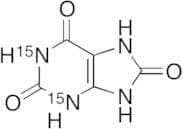
CAS 62948-75-8
:Harnsäure-1,3-15N2
Beschreibung:
Harnsäure-1,3-15N2 ist ein stickstoffmarkiertes Derivat von Harnsäure, die ein Purinderivat und ein Produkt des Purinstoffwechsels bei Menschen und anderen Organismen ist. Diese Verbindung zeichnet sich durch die Incorporation von zwei stabilen Stickstoffisotopen (15N) an den Positionen 1 und 3 des Harnsäuremoleküls aus, was ihre Verwendung in verschiedenen biochemischen und metabolischen Studien ermöglicht, insbesondere zur Verfolgung des Stickstoffstoffwechsels. Die Harnsäure selbst ist eine schwache Säure mit einem pKa von etwa 5,4 und ist relativ unlöslich in Wasser, was zu ihrer Ausfällung unter bestimmten physiologischen Bedingungen führt. Das Vorhandensein der 15N-Isotope kann mittels Massenspektrometrie oder NMR-Spektroskopie nachgewiesen werden, was sie zu einem wertvollen Werkzeug in der Forschung zu Stoffwechselwegen, dem Stickstoffkreislauf und der Untersuchung von Krankheiten macht, die mit dem Purinstoffwechsel verbunden sind, wie Gicht. Darüber hinaus spielt Harnsäure eine Rolle als Antioxidans im Körper, obwohl erhöhte Werte zu Gesundheitsproblemen führen können.
Formel:C5H4N4O3
InChl:InChI=1/C5H4N4O3/c10-3-1-2(7-4(11)6-1)8-5(12)9-3/h(H4,6,7,8,9,10,11,12)/i8+1,9+1
Synonyme:- (1,3-15N2)-7,9-dihydro-1H-purine-2,6,8(3H)-trione
- URIC ACID-1,3-15N2, 99 ATOM % 15N
- URIC ACID (1,3-15N2)
- Uric Acid-[15N2
- 15N Labeled uric acid
- URIC ACID-13-15N2 99%
- 2,6,8-Trihydroxypurine-1,3-15N2
- 7,9-Dihydro-1H-purine-2,6,8(3H)-trione-1,3-15N2
- 7,9-dihydro-3H-purine-2,6,8-trione
Sortieren nach
Reinheit (%)
0
100
|
0
|
50
|
90
|
95
|
100
3 Produkte.
Uric Acid-1,3-15N2
CAS:Applications Uric Acid-1,3-15N2 is the labeled analogue of Uric Acid (U829200), a heterocyclcic compound that is created when purine nucleotides are broken down of by the human body. High blood concetration of Uric Acid is known as hyperuricemia and is often associated with a wide range of disorders and medical conditions such as gout, diabetes and metabolic syndrome. Uric acid may be a marker of oxidative stress and may have a potential therapeutic role as an antioxidant.
References Heinig, M. et al.: Cle. Clin. J. Med., 73, 1059 (2006); Glantzounis, G.K. et al.: Curr. Pharmac. Des., 11, 4145 (2005); Dehghan, A. et al.: Diab. Care, 31, 361 (2008); Nakagawa, T. et al.: Am. J. Physiol. Renal Physiol., 290, F625 (2006)Formel:C5H415N2N2O3Farbe und Form:NeatMolekulargewicht:170.1