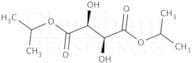
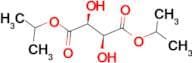
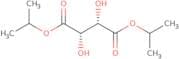
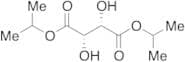
CAS 62961-64-2
:Diisopropyl (-)-tartrat
Beschreibung:
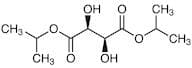
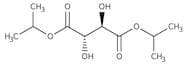
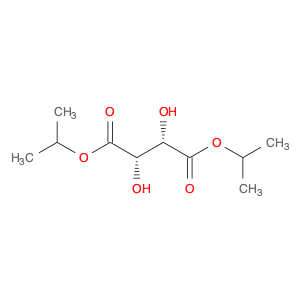
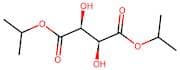
Diisopropyl (-)-tartrat, mit der CAS-Nummer 62961-64-2, ist eine organische Verbindung, die zur Klasse der Tartrate gehört, die Ester sind, die aus Weinsäure abgeleitet sind. Diese Substanz zeichnet sich durch ihre chirale Natur aus und zeigt optische Aktivität aufgrund der Anwesenheit mehrerer Stereozentren. Sie erscheint typischerweise als farblose bis blassgelbe Flüssigkeit und ist bekannt für ihre geringe Flüchtigkeit und moderate Löslichkeit in organischen Lösungsmitteln. Diisopropyl (-)-tartrat wird häufig als chirales Hilfsmittel in der asymmetrischen Synthese verwendet, um die Herstellung von enantiomerenreinen Verbindungen zu erleichtern. Ihre Anwendungen erstrecken sich auf die Pharmaindustrie, wo sie eine Rolle bei der Entwicklung verschiedener Medikamente spielt. Die Verbindung ist unter Standardbedingungen im Allgemeinen stabil, sollte jedoch mit Vorsicht behandelt werden, wie viele organische Chemikalien, um potenzielle Gefahren zu vermeiden. Insgesamt wird Diisopropyl (-)-tartrat für seine Nützlichkeit in der Stereochemie und seine Rolle bei der Verbesserung der Effizienz synthetischer Prozesse geschätzt.
Formel:C10H18O6
InChl:InChI=1S/C10H18O6/c1-5(2)15-9(13)7(11)8(12)10(14)16-6(3)4/h5-8,11-12H,1-4H3/t7-,8-/m0/s1
InChI Key:InChIKey=XEBCWEDRGPSHQH-YUMQZZPRSA-N
SMILES:[C@H]([C@@H](C(OC(C)C)=O)O)(C(OC(C)C)=O)O
Synonyme:- (-)-Dipt
- (2S,3S)-Diisopropyl tartrate
- <span class="text-smallcaps">D</span>-(-)-Diisopropyl tartrate
- <span class="text-smallcaps">D</span>-(-)-Tartaric acid diisopropyl ester
- Butanedioic acid, 2,3-dihydroxy-, 1,4-bis(1-methylethyl) ester, (2S,3S)-
- Butanedioic acid, 2,3-dihydroxy-, bis(1-methylethyl) ester, (2S,3S)-
- Butanedioic acid, 2,3-dihydroxy-, bis(1-methylethyl) ester, [S-(R*,R*)]-
- D-(-)-Tartaric Acid Diisopropyl Ester
- Diisopropyl (-)-<span class="text-smallcaps">D</span>-tartrate
- Diisopropyl (-)-tartrate
- Diisopropyl (S,S)-tartrate
- Diisopropyl D-Tartrate
- bis(1-methylethyl) (2R,3S)-2,3-dihydroxybutanedioate
- dipropan-2-yl (2S,3S)-2,3-dihydroxybutanedioate
- Weitere Synonyme anzeigen
Sortieren nach
Reinheit (%)
0
100
|
0
|
50
|
90
|
95
|
100
8 Produkte.
Diisopropyl D-(-)-Tartrate
CAS:Formel:C10H18O6Reinheit:>98.0%(GC)Farbe und Form:Colorless to Almost colorless clear liquidMolekulargewicht:234.25(-)-Diisopropyl D-tartrate, 98%
CAS:This Thermo Scientific Chemicals brand product was originally part of the Alfa Aesar product portfolio. Some documentation and label information may refer to the legacy brand. The original Alfa Aesar product / item code or SKU reference has not changed as a part of the brand transition to Thermo Sci
Formel:C10H18O6Reinheit:98%Farbe und Form:Clear colorless, Liquid or viscous liquidMolekulargewicht:234.25(2S,3S)-Diisopropyl 2,3-dihydroxysuccinate
CAS:Formel:C10H18O6Reinheit:98%Farbe und Form:LiquidMolekulargewicht:234.2463D-(-)-Tartaric acid diisopropyl ester
CAS:D-(-)-Tartaric acid diisopropyl esterReinheit:98%Molekulargewicht:234.25g/mol(2S,3S)-Diisopropyl 2,3-dihydroxysuccinate
CAS:Reinheit:95.0%Farbe und Form:Liquid, ClearMolekulargewicht:234.2480010986328Diisopropyl D-tartrate
CAS:Diisopropyl tartrate is a chemical compound that has been used in the synthesis of antibiotics. It is bifunctional, meaning that it can act as both a nucleophile and a base. The chloride forms a nucleophilic addition with the allyl group, forming an intermediate that is an excellent leaving group for the final product. Diisopropyl tartrate is used to synthesize monomers for polymers, such as chloroprene and styrene, which are used in the manufacture of plastics and rubber. This chemical is also used in catalytic asymmetric reactions, where it acts as a catalyst by stabilizing one enantiomer over another to promote stereoselective reactions.Formel:C10H18O6Reinheit:Min. 95%Farbe und Form:Colorless Clear LiquidMolekulargewicht:234.25 g/molD-(-)-Diisopropyl Tartrate
CAS:Kontrolliertes ProduktApplications D-(-)-Diisopropyl Tartrate is a reagent for kinetic resolution of racemic allylic alcohols and α-furfuryl amides by enantioselective epoxidation.
References Lee, E., et al.: J. Org. Chem., 1994, 59 1444; Jung, M., et al.: J. Am. Chem. Soc., 115, 12208 (1993); Wang, Z., et al.: Tetrahedron, 49, 2641 (1993)Formel:C16H17N3O4S2Farbe und Form:NeatMolekulargewicht:379.454