CAS 630-13-7
:Propan, 2,2-diiod-
Beschreibung:
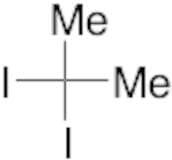
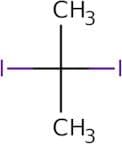
Propan, 2,2-diiod- ist eine organische Verbindung, die durch das Vorhandensein von zwei Iodatomen gekennzeichnet ist, die am zweiten Kohlenstoff eines Propanrückgrats angebracht sind. Ihre molekulare Formel ist C3H6I2, was darauf hinweist, dass sie drei Kohlenstoffatome, sechs Wasserstoffatome und zwei Iodatome enthält. Diese Verbindung gehört zur Familie der Haloalkane, die für ihre Reaktivität aufgrund des Vorhandenseins von Halogenatomen bekannt sind. Die Iodsubstituenten beeinflussen erheblich die physikalischen und chemischen Eigenschaften des Moleküls, einschließlich seines Siedepunkts, seiner Löslichkeit und Reaktivität. Im Allgemeinen weisen Verbindungen wie 2,2-Diiodopropan höhere Dichten und Siedepunkte im Vergleich zu ihren nicht jodierten Gegenstücken auf, was auf die größere Atommasse und Polarizierbarkeit von Iod zurückzuführen ist. Darüber hinaus kann die Anwesenheit von Iod die Reaktivität der Verbindung in nucleophilen Substitutionsreaktionen erhöhen. Sicherheitsüberlegungen sind wichtig, wenn man mit dieser Verbindung umgeht, da iodhaltige Verbindungen gefährlich sein können. Es sollten geeignete Lager- und Handhabungsprotokolle befolgt werden, um Risiken im Zusammenhang mit der Exposition zu mindern.
Formel:C3H6I2
Sortieren nach
Reinheit (%)
0
100
|
0
|
50
|
90
|
95
|
100
2 Produkte.
2,2-Diiodopropane
CAS:Kontrolliertes ProduktApplications 2,2-Diiodopropane is used in studying the Raman effect (isomerism rotation) and is used as a reagent in some synthetic preparations.
Not a dangerous good if item is equal to or less than 1g/ml and there is less than 100g/ml in the package
References Kahovec, L., et al: Z. Physik. Chem., B47, 48 (1940); Charette, A., et al: Synlett, 1, 176 (2002)Formel:C3H6I2Farbe und Form:NeatMolekulargewicht:295.892,2-Diiodopropane
CAS:2,2-Diiodopropane is a chemical compound that is prepared in the laboratory by the reaction of an alcohol with iodine and deuterium. The reactant can be either an alcohol or a deuterated alcohol. The product has been studied using synchrotron radiation and absorption spectroscopy to determine its kinetics. When the reactant is an alcohol, the product has two different isotopes: one with mass number 2 and one with mass number 3. When the reactant is a deuterated alcohol, the product has two different isotopes: one with mass number 2 and one with mass number 3. The kinetic isotope effect refers to the change in rate of reaction due to substitution of atoms by their heavier isotopes (i.e., hydrogen). This effect can be observed when studying reactions involving water molecules as reactants or products.Formel:C3H6I2Reinheit:Min. 95%Molekulargewicht:295.89 g/mol