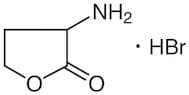
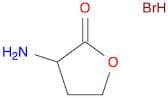
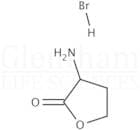
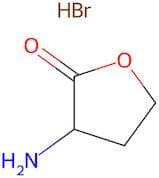
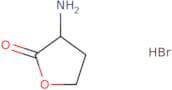
CAS 6305-38-0
:Homoserinlacton-Hydrobromid
Beschreibung:
Homoserinlacton-Hydrobromid ist eine chemische Verbindung, die zur Klasse der Laktone gehört, spezifisch zu einem zyklischen Ester, der von Homoserin abgeleitet ist. Sie zeichnet sich durch ihre molekulare Struktur aus, die einen Laktone-Ring umfasst, der durch die Kondensation der Aminosäure Homoserin gebildet wird. Diese Verbindung tritt typischerweise als weißer bis off-weißer kristalliner Feststoff auf und ist in Wasser und verschiedenen organischen Lösungsmitteln löslich. Homoserinlacton-Hydrobromid ist bekannt für seine Rolle in der bakteriellen Kommunikation, insbesondere im Quorum-Sensing, wo es als Signalmolekül wirkt. Ihre Hydrobromid-Form weist auf das Vorhandensein von Hydrobromsäure hin, die ihre Löslichkeit und Stabilität beeinflussen kann. Die Verbindung ist in verschiedenen Bereichen von Interesse, einschließlich Mikrobiologie und organischer Synthese, aufgrund ihrer biologischen Aktivität und potenziellen Anwendungen bei der Entwicklung von antimikrobiellen Mitteln oder beim Studium des bakteriellen Verhaltens. Sicherheitsvorkehrungen sollten beim Umgang mit dieser Verbindung getroffen werden, wie bei jeder chemischen Substanz, um potenzielle Gefahren im Zusammenhang mit ihrer Verwendung zu vermeiden.
Formel:C4H7NO2·BrH
InChl:InChI=1S/C4H7NO2.BrH/c5-3-1-2-7-4(3)6;/h3H,1-2,5H2;1H
InChI Key:InChIKey=MKLNTBLOABOJFZ-UHFFFAOYSA-N
SMILES:NC1C(=O)OCC1.Br
Synonyme:- (±)-3-Aminodihydro-2(3H)-furanone hydrobromide
- 2(3H)-Furanone, 3-aminodihydro-, hydrobromide
- 2(3H)-Furanone, 3-aminodihydro-, hydrobromide (1:1)
- 2-Amino-4-butyrolactone hydrobromide
- 2-Aminobutyrolactone hydrobromide
- 3-Aminodihydrofuran-2(3H)-one hydrobromide (1:1)
- 3-Aminooxolan-2-one hydrobromide
- <span class="text-smallcaps">DL</span>-Homoserine lactone hydrobromide
- Homoserine lactone hydrobromide
- NSC 41120
- α-Amino-g-butyrolactone hydrobromide
- Weitere Synonyme anzeigen
Sortieren nach
Reinheit (%)
0
100
|
0
|
50
|
90
|
95
|
100
6 Produkte.
α-Amino-γ-butyrolactone Hydrobromide
CAS:Formel:C4H7NO2·HBrReinheit:>98.0%(T)(N)Farbe und Form:White to Almost white powder to crystalMolekulargewicht:182.023-Aminodihydrofuran-2(3H)-one hydrobromide
CAS:Formel:C4H8BrNO2Reinheit:97%Farbe und Form:SolidMolekulargewicht:182.01583-Aminodihydrofuran-2(3H)-one hydrobromide
CAS:3-Aminodihydrofuran-2(3H)-one hydrobromideReinheit:97%Farbe und Form:SolidMolekulargewicht:182.02g/mol3-Aminodihydrofuran-2(3H)-one hydrobromide
CAS:Formel:C4H8BrNO2Reinheit:97%;RGFarbe und Form:SolidMolekulargewicht:182.017±-Amino-³-butyrolactone hydrobromide
CAS:±-Amino-³-butyrolactone hydrobromide (±-ABL) is a chemical compound that can be found in chloroform. It is a synthetic activator of mutant strains of the bacterium Escherichia coli. ±-ABL emits light when mixed with chloroform, and this emission can be detected using a spectrophotometer. The emission spectrum of ±-ABL has been shown to have peaks at 510 nm and 530 nm, which correspond to the λmax values for ECL luminescence. This chemical also has the ability to activate mutant strains of E. coli when dissolved in liquid chromatography, and it can be extracted from plates exposed to light.Formel:C4H7NO2·HBrReinheit:Min. 95%Molekulargewicht:182.02 g/mol