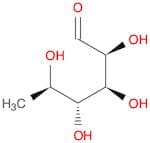
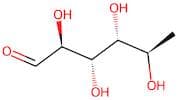
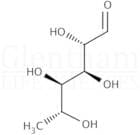
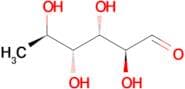
CAS 634-74-2
:D-Rhamnose
Beschreibung:
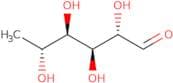
D-Rhamnose ist ein natürlich vorkommender Zucker und ein Monosaccharid, das als Desoxyzucker klassifiziert ist, speziell als Methylpentose. Es ist ein Aldohexose, was bedeutet, dass es eine Aldehydgruppe enthält und sechs Kohlenstoffatome hat. D-Rhamnose kommt typischerweise in verschiedenen Pflanzen vor, insbesondere in den Glykosiden von Flavonoiden und anderen sekundären Metaboliten. Es zeichnet sich durch sein weißes kristallines Aussehen aus und ist in Wasser löslich, wobei es einen süßen Geschmack aufweist. Die chemische Formel von D-Rhamnose ist C6H12O5, und es hat eine spezifische Drehung von etwa +20 Grad. Dieser Zucker spielt eine bedeutende Rolle im Pflanzenstoffwechsel und wird auch in der Lebensmittel- und Pharmaindustrie aufgrund seiner potenziellen gesundheitlichen Vorteile, einschließlich seiner präbiotischen Eigenschaften, verwendet. Darüber hinaus ist D-Rhamnose an der Synthese bestimmter Polysaccharide und Glykoproteine beteiligt, die zur Zellwandstruktur in Pflanzen beitragen. Seine einzigartige Struktur und Eigenschaften machen ihn zu einem interessanten Thema in verschiedenen biochemischen und industriellen Anwendungen.
Formel:C6H12O5
InChl:InChI=1S/C6H12O5/c1-3(8)5(10)6(11)4(9)2-7/h2-6,8-11H,1H3/t3-,4-,5-,6-/m1/s1
InChI Key:InChIKey=PNNNRSAQSRJVSB-KVTDHHQDSA-N
SMILES:[C@H]([C@@H]([C@@H](C)O)O)([C@@H](C=O)O)O
Synonyme:- 6-Deoxy-<span class="text-smallcaps">D</span>-mannose
- <span class="text-smallcaps">D</span>-Mannose, 6-deoxy-
- <span class="text-smallcaps">D</span>-Rhamnose
- Isodulcite
- Rhamnose, <span class="text-smallcaps">D</span>-
- alpha-D-mannopyranose, 6-deoxy-
- D-Mannose, 6-deoxy-
- Rhamnose, D-
- 6-Deoxy-D-mannose
- D-Rhamnose
Sortieren nach
Reinheit (%)
0
100
|
0
|
50
|
90
|
95
|
100
7 Produkte.
D-Rhamnose
CAS:Formel:C6H12O5Reinheit:(HPLC) ≥ 97.0%Farbe und Form:White to off-white crystalline powderMolekulargewicht:164.16D-Rhamnose
CAS:Chiral-pool sugar used to mirror syntheses based on natural L-RhaFormel:C6H12O5Reinheit:Min. 97 Area-%Farbe und Form:White PowderMolekulargewicht:164.16 g/mol1-13C-D-Rhamnose
CAS:1-13C-D-Rhamnose is a monosaccharide that belongs to the group of pentoses. It is an inhibitor of bacterial growth and has been shown to inhibit the growth of P. aeruginosa strains. The mechanism of action for 1-13C-D-Rhamnose is not yet known, but it may be due to its ability to inhibit bacterial DNA polymerase, which prevents chain reactions from occurring and leads to cell death. 1-13C-D-Rhamnose has a homologous structure to GDP-D-mannose and can interact with hydrogen bonding interactions. It is found in papillae on the tongue and inhibits taste receptor cells by binding to the sweet taste receptors on the surface of these cells. The optimal pH for 1-13C-D-Rhamnose's inhibitory properties is 5.5Formel:C6H12O5Reinheit:Min. 95%Molekulargewicht:164.16 g/mol