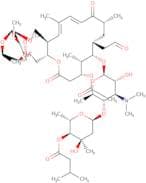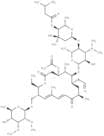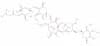
CAS 63409-12-1
:Tylvalosin
Beschreibung:
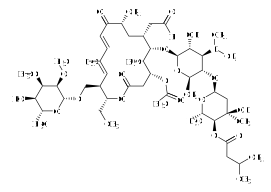
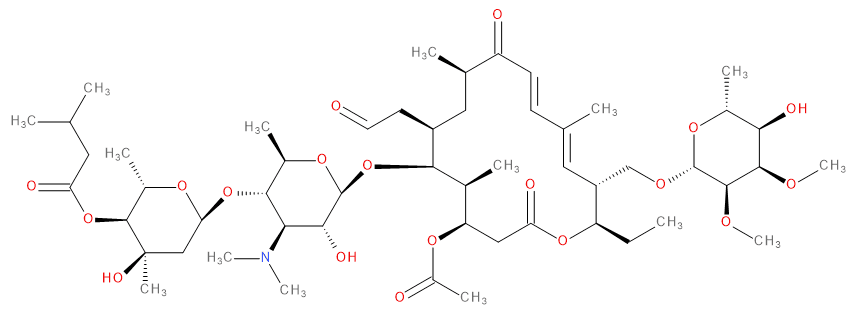
Tylvalosin ist ein Makrolid-Antibiotikum, das hauptsächlich in der Tiermedizin eingesetzt wird, insbesondere zur Behandlung von Atemwegsinfektionen bei Vieh und Geflügel. Es wird aus der Fermentation bestimmter Actinobakterien gewonnen und ist bekannt für seine Wirksamkeit gegen eine Reihe von grampositiven Bakterien und einige gramnegative Bakterien. Die chemische Struktur von Tylvalosin weist einen großen Laktone-Ring auf, der für Makrolide charakteristisch ist und zu seinen antibakteriellen Eigenschaften beiträgt. Es wird typischerweise in Futter- oder Wasserformulierungen verabreicht, was es für die Behandlung von Tieren im großen Maßstab praktisch macht. Tylvalosin wirkt, indem es die bakterielle Proteinsynthese hemmt und so das Wachstum und die Fortpflanzung von Bakterien verhindert. Seine Pharmakokinetik zeigt eine gute Absorption und Verteilung in Tiergeweben, obwohl seine Verwendung bei Lebensmittelliefernden Tieren reguliert ist, um sicherzustellen, dass Rückstände nicht in die menschliche Nahrungskette gelangen. Wie bei vielen Antibiotika gibt es Bedenken hinsichtlich der Entwicklung von Antibiotikaresistenzen, was eine sorgfältige Abwägung seines Einsatzes in der Tiermedizin erforderlich macht.
Formel:C53H87NO19
InChl:InChI=1S/C53H87NO19/c1-16-38-36(26-65-52-49(64-15)48(63-14)44(60)31(7)67-52)22-28(4)17-18-37(57)29(5)23-35(19-20-55)46(30(6)39(69-34(10)56)24-41(59)70-38)73-51-45(61)43(54(12)13)47(32(8)68-51)72-42-25-53(11,62)50(33(9)66-42)71-40(58)21-27(2)3/h17-18,20,22,27,29-33,35-36,38-39,42-52,60-62H,16,19,21,23-26H2,1-15H3/b18-17+,28-22+/t29-,30+,31-,32-,33+,35+,36-,38-,39-,42+,43-,44-,45-,46-,47-,48-,49-,50+,51+,52-,53-/m1/s1
InChI Key:InChIKey=KCJJINQANFZSAM-HZDSEHBESA-N
SMILES:O([C@H]1[C@H](N(C)C)[C@@H](O)[C@H](O[C@H]2[C@@H](CC=O)C[C@@H](C)C(=O)/C=C/C(/C)=C/[C@H](CO[C@H]3[C@H](OC)[C@H](OC)[C@H](O)[C@@H](C)O3)[C@@H](CC)OC(=O)C[C@@H](OC(C)=O)[C@@H]2C)O[C@@H]1C)[C@H]4C[C@@](C)(O)[C@@H](OC(CC(C)C)=O)[C@H](C)O4
Synonyme:- (4R,5S,6S,7R,9R,11E,13E,15R,16R)-15-(((6-Deoxy-2,3-di-O-methyl-beta-D-allopyranosyl)oxy)methyl)-6-((3,6-dideoxy-4-O-(2,6-dideoxy-3-C-methyl-4-O-(3-methylbutanoyl)-alpha-L-ribo-hexopyranosyl)-3-(dimethylamino)-beta-D-glucopyranosyl)oxy)-16-ethyl-5,9,13-trimethyl-2,10-dioxo-7-(2-oxoethyl)oxacyclohexadeca-11,13-dien-4-yl acetate
- (4R,5S,6S,7R,9R,11E,13E,15R,16R)-15-{[(6-deoxy-2,3-di-O-methyl-β-D-allopyranosyl)oxy]methyl}-6-({3,6-dideoxy-4-O-[2,6-dideoxy-3-C-methyl-4-O-(3-methylbutanoyl)-α-L-ribo-hexopyranosyl]-3-(dimethylamino)-β-D-glucopyranosyl}oxy)-16-ethyl-5,9,13-trimethyl-2,10-dioxo-7-(2-oxoethyl)oxacyclohexadeca-11,13-dien-4-yl acetate
- 3-Acetyl-4''-isovaleryltylosin
- 3-O-Acetyl-4′′-O-isovaleryltylosin
- Acetylisovaleryltylosin
- Oxacyclohexadecane, tylosin deriv.
- Tylosin, 3-acetate 4<sup>B</sup>-(3-methylbutanoate)
- Tylvalosin
- Tylvalosin [USAN]
- Tylosin, 3-acetate 4B-(3-methylbutanoate)
Sortieren nach
Reinheit (%)
0
100
|
0
|
50
|
90
|
95
|
100
7 Produkte.
Tylvalosin (Acetylisovaleryltylosin)
CAS:Formel:C53H87NO19Farbe und Form:White To Off-White SolidMolekulargewicht:1042.27Tylvalosin 1000 µg/mL in Acetonitrile
CAS:Kontrolliertes ProduktFormel:C53H87NO19Farbe und Form:Single SolutionMolekulargewicht:1042.25Tylvalosin-d9
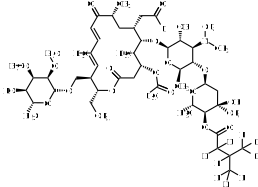
CAS:Kontrolliertes ProduktApplications Tylvalosin-d9 is the labeled analogue of Tylvalosin (T898210), an anti-bacterial agent that is shown through study as a good inhibitor of gram-positive bacteria.
References Okamoto, R. et al.: J. Antibio., 32, 542 (1979)Formel:C53D9H78NO19Reinheit:>90%Farbe und Form:Light Yellow SolidMolekulargewicht:1051.31Tylvalosin
CAS:Tylvalosin is a polymerase chain inhibitor that inhibits the activity of the bacterial DNA polymerase. It is used in antimicrobial treatment to prevent microbial infection due to its immunomodulatory effects. Tylvalosin is active against a wide range of microorganisms and has been shown to be effective against infections caused by bacteria such as Haemophilus influenzae, Streptococcus pyogenes, and Staphylococcus aureus. The drug also has anti-inflammatory properties and can be used for the treatment of synovitis, an inflammation of the synovium. Tylvalosin is not active against Mycobacterium tuberculosis or Mycobacterium avium complex.Formel:C53H87NO19Reinheit:(%) Min. 90%Farbe und Form:PowderMolekulargewicht:1,042.25 g/molTylvalosin
CAS:Tylvalosin (Acetylisovaleryltylosin) is a broad-spectrum macrolide antibiotic with antibacterial and antiviral properties, effective against PRRSV infection.Formel:C53H87NO19Reinheit:98%Farbe und Form:SolidMolekulargewicht:1042.25