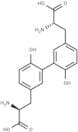
CAS 63442-81-9
:Dityrosin
- o,o'-Dityrosine
- L,L-Dityrosine
- [1,1'-Biphenyl]-3,3'-dipropanoic acid, α3,α3'-diamino-6,6'-dihydroxy-, (α3S,α3'S)-
- Dityrosine USP/EP/BP
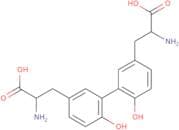
- (2S,2'S)-3,3'-(6,6'-dihydroxy-[1,1'-biphenyl]-3,3'-diyl)bis(2-aminopropanoic acid)
(2S,2'S)-3,3'-(6,6'-Dihydroxy-[1,1'-biphenyl]-3,3'-diyl)bis(2-aminopropanoic acid)
CAS:(2S,2'S)-3,3'-(6,6'-Dihydroxy-[1,1'-biphenyl]-3,3'-diyl)bis(2-aminopropanoic acid)Reinheit:99%Molekulargewicht:360.37g/molL,L-Dityrosine
CAS:L,L-Dityrosine, a component found in the acid hydrolysates of various biological materials, such as insect cuticular resilin, plays a significant role inFormel:C18H20N2O6Reinheit:98%Farbe und Form:SolidMolekulargewicht:360.36L,L-Dityrosine
CAS:L,L-Dityrosine is a byproduct of the enzymatic breakdown of proteins. It can be detected in biological samples such as urine, plasma and serum using an antibody that recognizes the Dityrosine amino acid sequence. L,L-Dityrosine can also be used to measure radiation exposure. The signal peptide is cleaved from the protein when it is exposed to radiation and L,L-Dityrosine accumulates. This signal peptide is then removed by proteases and L,L-Dityrosine levels return to normal. L,L-Dityrosine has been shown to inhibit the growth of atherosclerotic lesions in experimental models and may be a potential biomarker for oxidative injury in alveolar type II cells. In addition, this compound has conformational properties that are similar to those found on proteins associated with Alzheimer's disease (AD) and other neurological disorders.END>
Formel:C18H20N2O6Reinheit:Min. 95%Farbe und Form:PowderMolekulargewicht:360.4 g/mol
![(2S,2'S)-3,3'-(6,6'-Dihydroxy-[1,1'-biphenyl]-3,3'-diyl)bis(2-aminopropanoic acid)](/_next/image/?url=https%3A%2Fstatic.cymitquimica.com%2Fproducts%2F54%2Fthumb%2FOR1074627.jpg&w=3840&q=75)