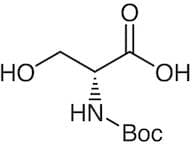
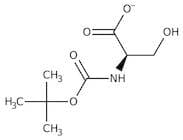
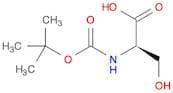
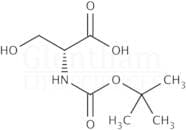
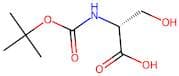
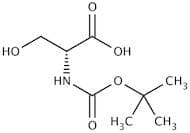
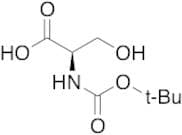
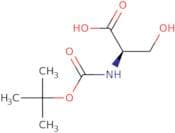
![N-[(1,1-Dimethylethoxy)carbonyl]-D-serine](/_next/image/?url=https%3A%2Fstatic.cymitquimica.com%2Fcas-image%2Fthumb-webp%2F304714-n-11-dimethylethoxy-carbonyl-d-serine.webp&w=3840&q=75)
CAS 6368-20-3
:N-[(1,1-Dimethylethoxycarbonyl)-D-Serin]
Beschreibung:
N-[(1,1-Dimethylethoxycarbonyl)-D-Serin], mit der CAS-Nummer 6368-20-3, ist ein Aminosäurederivat, das durch das Vorhandensein einer Carbonylgruppe, die an den Stickstoff der Aminogruppe gebunden ist, und einer voluminösen 1,1-Dimethylethoxygruppe gekennzeichnet ist. Diese Struktur verleiht einzigartige sterische und elektronische Eigenschaften, die es in verschiedenen chemischen Anwendungen nützlich machen, insbesondere in der Peptidsynthese und als Baustein in der medizinischen Chemie. Die Verbindung ist typischerweise ein weißer bis off-weißer Feststoff, der in polaren organischen Lösungsmitteln löslich ist und unter Standardlaborbedingungen stabil ist. Ihre funktionellen Gruppen ermöglichen eine potenzielle Reaktivität in Kupplungsreaktionen, was sie wertvoll für die Synthese komplexerer Moleküle macht. Darüber hinaus deutet das Vorhandensein der D-Serin-Einheit auf eine potenzielle biologische Aktivität hin, da bekannt ist, dass D-Serin eine Rolle bei der Neurotransmission spielt. Insgesamt veranschaulicht diese Verbindung die Schnittstelle zwischen organischer Chemie und Biochemie, mit Anwendungen sowohl in synthetischen Methoden als auch in der biologischen Forschung.
Formel:C8H15NO5
InChl:InChI=1S/C8H15NO5/c1-8(2,3)14-7(13)9-5(4-10)6(11)12/h5,10H,4H2,1-3H3,(H,9,13)(H,11,12)/t5-/m1/s1
InChI Key:InChIKey=FHOAKXBXYSJBGX-RXMQYKEDSA-N
SMILES:[C@H](NC(OC(C)(C)C)=O)(C(O)=O)CO
Synonyme:- (2R)-2-[(tert-butoxycarbonyl)amino]-3-hydroxypropanoate
- (2R)-2-[[(tert-Butoxy)carbonyl]amino]-3-hydroxypropanoic acid
- (2R)-3-Hydroxy-2-[(2-methylpropan-2-yl)oxycarbonylamino]propanoic acid
- (R)-2-(tert-Butoxycarbonylamino)-3-hydroxypropanoic acid
- (R)-tert-Butoxycarbonyl-<span class="text-smallcaps">D</span>-serine
- <span class="text-smallcaps">D</span>-Serine, N-[(1,1-dimethylethoxy)carbonyl]-
- BOC-<span class="text-smallcaps">D</span>-Serine
- BOC-D-Serine
- Boc-D-Ser-OH
- N-(tert-Butoxycarbonyl)-D-serine
- N-Boc-<span class="text-smallcaps">D</span>-serine
- N-[(1,1-Dimethylethoxy)carbonyl]-<span class="text-smallcaps">D</span>-serine
- N-tert-Butoxycarbonyl-<span class="text-smallcaps">D</span>-serine
- Serine, N-carboxy-, N-tert-butyl ester, <span class="text-smallcaps">D</span>-
- tert-(Butoxycarbonyl)-<span class="text-smallcaps">D</span>-serine
- D-Serine, N-[(1,1-dimethylethoxy)carbonyl]-
- Serine, N-carboxy-, N-tert-butyl ester, D-
- N-[(1,1-Dimethylethoxy)carbonyl]-D-serine
- Weitere Synonyme anzeigen
Sortieren nach
Reinheit (%)
0
100
|
0
|
50
|
90
|
95
|
100
10 Produkte.
N-(tert-Butoxycarbonyl)-D-serine
CAS:Formel:C8H15NO5Reinheit:>98.0%(T)(HPLC)Farbe und Form:White to Almost white powder to crystalMolekulargewicht:205.21N-Boc-D-serine, 98+%
CAS:This Thermo Scientific Chemicals brand product was originally part of the Alfa Aesar product portfolio. Some documentation and label information may refer to the legacy brand. The original Alfa Aesar product / item code or SKU reference has not changed as a part of the brand transition to Thermo SciFormel:C8H14NO5Reinheit:98+%Farbe und Form:Crystals or powder or crystalline powder or lumps, WhiteMolekulargewicht:204.20boc-d-ser-oh
CAS:Formel:C8H15NO5Reinheit:95%Farbe und Form:Solid, White powderMolekulargewicht:205.21Boc-D-serine
CAS:Kontrolliertes ProduktApplications Boc-D-serine is D-serine (S270975) with amine protected from eletrophiles by tert-butyloxycarbonyl group in organic synthesis. Boc-D-serine can be used to synthesize acetamido-methoxypropionamides such as Desacetyl Desmethyl Lacosamide (D288325) which is a potent anticonvulsant.
References Letiran, A., et al.: J. Med. Chem., 45, 4762 (2002); Wadavrao, S., et al.: Synthesis, 45, 3383 (2013)Formel:C8H15NO5Farbe und Form:NeatMolekulargewicht:205.21BOC-D-Ser-OH
CAS:BOC-D-Ser-OH is a synthetic amino acid with an acetylated serine side chain. It is used in the synthesis of glycosidic bonds. BOC-D-Ser-OH reacts with sodium hydrogen carbonate to form the sodium salt of D-serine, which can be used to produce glycoconjugates or as a model protein. The reaction yield is low and can be improved by adding acetyl groups to the substrate, such as galactose. Glycosidic bonds are formed by transfer reactions between nucleophilic hydroxyl groups on sugar molecules and electrophilic amino groups on proteins. The glycoconjugates produced by this reaction have been shown to have anticancer activity in animal models.Formel:C8H15NO5Reinheit:Min. 95%Molekulargewicht:205.21 g/mol