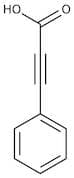
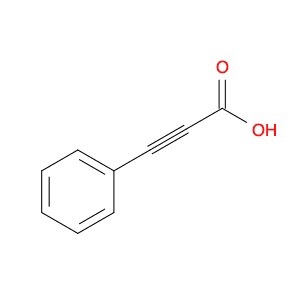
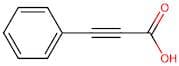
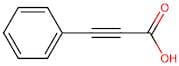
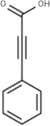
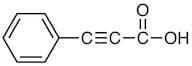
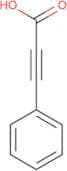
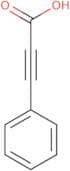
CAS 637-44-5
:Phenylpropionsäure
- 2-Propynoic acid, 3-phenyl-
- 3-Phenyl-2-propynoic acid
- 3-Phenylprop-2-Ynoate
- 3-Phenylprop-2-Ynoic Acid
- 3-Phenylpropargylic acid
- 3-Phenylpropiolic acid
- 3-Phenylpropynoic acid
- 4-Phenylpropynoic acid
- Benzenepropynoic acid
- NSC 13669
- Phenyl Propiolic Acid
- Phenyl-2-propynoic acid
- Phenylacetylenecarboxylic acid
- Phenylacetylenecarboxylic acid~3-Phenylpropynoic acid
- Phenylacetylenemonocarboxylic acid
- Phenylpropargylic acid
- Phenylpropiolic acid, (3-Phenylpropynoic acid)
- Phenylpropioplic Acid
- Phenylpropynoic acid
- Propiolic acid, phenyl-
- β-Phenylpropargylic acid
- Weitere Synonyme anzeigen
Phenylpropiolic acid, 98+%
CAS:Phenylpropiolic acid is used as a Pharmaceutical Intermediates, laboratory chemicals. This Thermo Scientific Chemicals brand product was originally part of the Alfa Aesar product portfolio. Some documentation and label information may refer to the legacy brand. The original Alfa Aesar product / item
Formel:C9H6O2Reinheit:98+%Farbe und Form:White to cream, Crystals or powder or crystalline powderMolekulargewicht:146.15Phenylpropiolic acid, 10mM (in DMSO)
CAS:Phenylpropiolic acid, 10mM (in DMSO)Reinheit:≥98%Molekulargewicht:146.14g/molPhenylpropiolic acid
CAS:Phenylpropiolic acid is an endogenous metabolite.Formel:C9H6O2Reinheit:99.94%Farbe und Form:SolidMolekulargewicht:146.14Phenylpropiolic Acid
CAS:Formel:C9H6O2Reinheit:>98.0%(T)Farbe und Form:White to Light yellow to Light red powder to crystalMolekulargewicht:146.15Phenylpropiolic acid
CAS:Phenylpropiolic acid is a chemical that is used as a reagent in organic synthesis and as a building block for the synthesis of other chemicals. This compound can be used as a building block to produce more complex compounds, such as phenylpropanolamine, which is used in some over-the-counter drugs. Phenylpropiolic acid has been shown to be useful in the synthesis of research chemicals and has also been shown to have high reactivity with many different types of compounds. It can serve as a versatile intermediate or scaffold for reactions that require an aromatic ring or an electron-rich center.
Formel:C9H6O2Molekulargewicht:146.15 g/molPhenylpropiolic acid
CAS:Phenylpropiolic acid is an organic compound that is used as a building block for the synthesis of other organic compounds. It has been shown to have inhibitory effects on squamous cell carcinoma cells and may be useful in the treatment of this type of cancer. This compound is also a strong inhibitor of mitochondrial membrane potential, which leads to the inhibition of cellular respiration and death. Phenylpropiolic acid has been shown to act as a copper chelator in biological systems, which may be due to its ability to form complexes with copper ions at low pH.Formel:C9H6O2Reinheit:Min. 95%Farbe und Form:White PowderMolekulargewicht:146.14 g/mol