CAS 63762-72-1
:6-chlor-5-methoxy-1H-indol
Beschreibung:
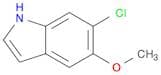
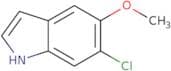
6-chlor-5-methoxy-1H-indol ist eine organische Verbindung, die durch ihre Indolstruktur gekennzeichnet ist, die aus einem fusionierten Benzol- und Pyrrolring besteht. Die Anwesenheit eines Chloratoms an der Position 6 und einer Methoxygruppe an der Position 5 trägt zu ihren einzigartigen chemischen Eigenschaften bei. Diese Verbindung ist typischerweise bei Raumtemperatur ein Feststoff und kann eine moderate Löslichkeit in organischen Lösungsmitteln aufweisen, während sie in Wasser aufgrund ihres hydrophoben Indolkerns weniger löslich ist. Sie kann an verschiedenen chemischen Reaktionen teilnehmen, einschließlich elektrophiler Substitutionen und nucleophiler Angriffe, aufgrund der elektronendichten Natur des Indolrings. Darüber hinaus kann der Chlor-Substituent die Reaktivität und biologische Aktivität der Verbindung beeinflussen, was sie potenziell interessant für die medizinische Chemie und die Arzneimittelentwicklung macht. Die Methoxygruppe kann auch die elektronischen Eigenschaften der Verbindung und die sterische Hinderung beeinflussen. Insgesamt ist 6-chlor-5-methoxy-1H-indol eine Verbindung von Interesse in verschiedenen Bereichen, einschließlich der Pharmazie und der organischen Synthese, aufgrund ihrer strukturellen Merkmale und potenziellen Anwendungen.
Formel:C9H8ClNO
InChl:InChI=1/C9H8ClNO/c1-12-9-4-6-2-3-11-8(6)5-7(9)10/h2-5,11H,1H3
SMILES:COc1cc2cc[nH]c2cc1Cl
Synonyme:- 1H-indole, 6-chloro-5-methoxy-
- 6-Chloro-5-methoxy-1H-indole
Sortieren nach
Reinheit (%)
0
100
|
0
|
50
|
90
|
95
|
100
4 Produkte.
1H-Indole, 6-chloro-5-Methoxy-
CAS:Formel:C9H8ClNOReinheit:98%Farbe und Form:SolidMolekulargewicht:181.61896-chloro-5-methoxy-1H-indole
CAS:6-chloro-5-methoxy-1H-indoleReinheit:98%Molekulargewicht:181.62g/mol6-Chloro-5-methoxy-1H-indole
CAS:Formel:C9H8ClNOReinheit:95%Farbe und Form:SolidMolekulargewicht:181.626-chloro-5-methoxy-1H-indole
CAS:6-chloro-5-methoxy-1H-indole is an aromatic compound that can be synthesized by the amination of acetyl chloride. This reaction is followed by a borohydride reduction of the imine, and then an acetylation of the resulting alcohol. The synthesis method involves two steps: first, a borohydride reduction of the imine using sodium borohydride; and second, an acetylation with chloral. The final product is purified by distillation and elemental analysis to determine yields.Formel:C9H8NOClReinheit:Min. 95%Molekulargewicht:181.61 g/mol