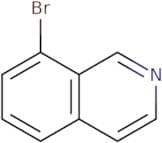
CAS 63927-22-0
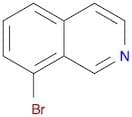
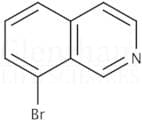
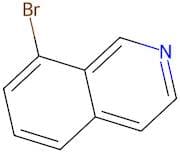
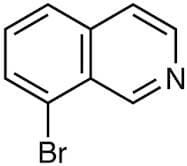
:8-Bromoisochinolin
Beschreibung:
8-Bromoisochinolin ist eine organische Verbindung, die durch ihre Isoquinolinstruktur gekennzeichnet ist, die aus einem fusionierten Benzol- und Pyridinring besteht. Das Vorhandensein eines Bromatoms an der Position 8 des Isoquinolins beeinflusst erheblich seine chemischen Eigenschaften und Reaktivität. Diese Verbindung erscheint typischerweise als ein blassgelber bis brauner Feststoff und ist in Wasser schwer löslich, aber besser löslich in organischen Lösungsmitteln wie Ethanol und Dichlormethan. 8-Bromoisochinolin ist bekannt für seine potenziellen Anwendungen in der medizinischen Chemie, insbesondere in der Entwicklung von Arzneimitteln, aufgrund seiner Fähigkeit, mit biologischen Zielen zu interagieren. Es kann an verschiedenen chemischen Reaktionen teilnehmen, einschließlich nucleophiler Substitutionen und Kupplungsreaktionen, was es zu einem wertvollen Zwischenprodukt in der organischen Synthese macht. Darüber hinaus kann die Bromsubstitution als Ansatzpunkt für eine weitere Funktionalisierung dienen, wodurch seine Vielseitigkeit in chemischen Umwandlungen erhöht wird. Wie bei vielen bromierten Verbindungen ist es wichtig, 8-Bromoisochinolin mit Vorsicht zu behandeln, da potenzielle Toxizität und Umweltbedenken im Zusammenhang mit bromierten organischen Verbindungen bestehen.
Formel:C12H13N
InChl:InChI=1/C12H13N/c1-9(2)12-11-6-4-3-5-10(11)7-8-13-12/h3-9H,1-2H3
SMILES:CC(C)c1c2ccccc2ccn1
Synonyme:- Isoquinoline, 8-bromo-
- 1-(1-Methylethyl)Isoquinoline
Sortieren nach
Reinheit (%)
0
100
|
0
|
50
|
90
|
95
|
100
6 Produkte.
8-Bromoisoquinoline
CAS:8-BromoisoquinolineFormel:C9H6BrNReinheit:95%Farbe und Form:PowderMolekulargewicht:208.05g/mol8-Bromoisoquinoline
CAS:Formel:C9H6BrNReinheit:>97.0%(GC)(T)Farbe und Form:Light orange to Yellow to Green powder to crystalMolekulargewicht:208.068-Bromoisoquinoline
CAS:8-Bromoisoquinoline is a bifunctional alkylating agent that is used to synthesize esters and amides. It is commonly used for the synthesis of amino acids, peptides, and other biologically active molecules. 8-Bromoisoquinoline has been shown to have a synergistic effect with hydroxyalkyl carbamates, which may be due to its ability to form an ionic bond with the carboxylic acid in these compounds. This chemical can also react with nitro groups and serve as a chlorinating agent, as well as react with anions such as phosphate and acetate. 8-Bromoisoquinoline can be synthesized by reacting ethyl bromoacetate with tetrahydroisoquinolinium chloride in hydrochloric acid or isopropyl alcohol.
Formel:C9H6BrNReinheit:Min. 95%Farbe und Form:PowderMolekulargewicht:208.05 g/mol