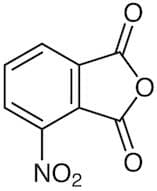
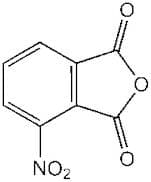
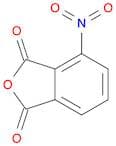
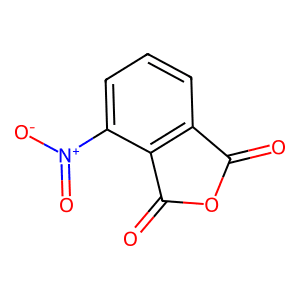
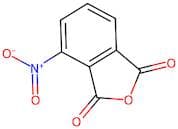
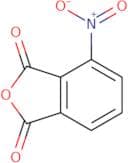
CAS 641-70-3
:3-Nitrophthalsäureanhydrid
- 1,3-Isobenzofurandione, 4-nitro-
- 1-Amino-2-Indolinon (CIS)
- 3 Nitro phthalic anyhydride
- 3-Nitrophthalic acid anhydride
- 4-Nitro-1,3-isobenzofurandione
- 4-Nitro-2-benzofuran-1,3-dione
- 4-Nitroisobenzofuran-1,3-dione
- NSC 27006
- NSC 4134
- Phthalic anhydride, 3-nitro-
- 3-Nitrophthalic anhydride
- 4-NITRO-ISOBENZOFURAN-1,3-DIONE
- 3-Isobenzofurandione,4-nitro-1
- 3-NITROPHTHALIC ANHYDRIDE ,99+%
- 4-Nitro-1,3-iso benzofurandione
- Weitere Synonyme anzeigen
3-Nitrophthalic Anhydride
CAS:Formel:C8H3NO5Reinheit:>97.0%(GC)(T)Farbe und Form:White to Orange to Green powder to crystalMolekulargewicht:193.113-Nitrophthalic anhydride, 97%
CAS:4-Nitrophthalic Anhydride is an intermediate for the synthesis of the benzimidazole PARP inhibitor I, ABT-472. It reacts with aminoquinazolinones to yield phthalimidoquinazolinones. This Thermo Scientific Chemicals brand product was originally part of the Alfa Aesar product portfolio. Some documentaFormel:C8H3NO5Reinheit:97%Farbe und Form:White to yellow to pale brown or cream, Crystalline powderMolekulargewicht:193.113-Nitrophthalic Anhydride
CAS:Formel:C8H3NO5Reinheit:97%Farbe und Form:SolidMolekulargewicht:193.11313-Nitrophthalic anhydride
CAS:3-Nitrophthalic anhydrideFormel:C8H3NO5Reinheit:95%Farbe und Form: yellow crystalline solidMolekulargewicht:193.11g/mol3-Nitrophthalic anhydride
CAS:3-Nitrophthalic anhydrideFormel:C8H3NO5Reinheit:98%Farbe und Form: light yellow crystalline needlesMolekulargewicht:193.11g/mol3-Nitrophthalic anhydride
CAS:Formel:C8H3NO5Reinheit:≥ 98.0%Farbe und Form:Beige, light-yellow or yellow crystalline powder or crystalsMolekulargewicht:193.113-Nitrophthalic anhydride
CAS:Formel:C8H3NO5Reinheit:95%Farbe und Form:Crystalline Powder,PowderMolekulargewicht:193.1143-Nitrophthalic anhydride
CAS:3-Nitrophthalic anhydride is a nucleophilic compound that is activated by the addition of hydrochloric acid and chloride. It reacts with dimethyl formamide to produce nitrobenzene, which can be oxidized to nitrobenzoic acid. 3-Nitrophthalic anhydride has been used as a precursor for pomalidomide, a drug used in the treatment of multiple myeloma and other cancers. In this reaction, n-dimethyl formamide reacts with 3-nitrophthalic anhydride to produce nitromethane, which can then be oxidized to nitrobenzoic acid. Molecular modeling studies have shown that 3-nitrophthalic anhydride binds to DNA through hydrogen bonding interactions and the formation of covalent bonds. The solubility data for 3-nitrophthalic anhydride show that it is soluble in water and organic solvents such as acetone or met
Formel:C8H3NO5Reinheit:Min. 85%Farbe und Form:PowderMolekulargewicht:193.11 g/molRef: 3D-FN26343
Ausgelaufenes produkt