CAS 642-31-9
:9-Anthracencarboxaldehyd
Beschreibung:
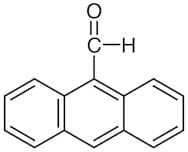
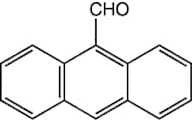
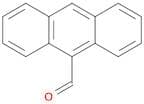
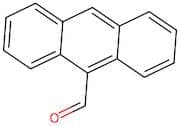
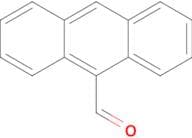
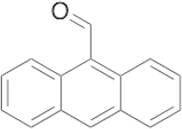
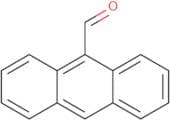
9-Anthracencarboxaldehyd, mit der CAS-Nummer 642-31-9, ist eine organische Verbindung, die zur Klasse der Aldehyde gehört. Es weist ein Anthracen-Rückgrat auf, das ein polycyclischer aromatischer Kohlenwasserstoff ist, mit einer Formylgruppe (-CHO), die an der Position 9 angebracht ist. Diese Verbindung zeichnet sich durch ihren festen Zustand bei Raumtemperatur aus und erscheint typischerweise als eine kristalline Substanz von gelb bis hellbraun. Sie hat einen relativ hohen Schmelzpunkt und ist in Wasser nur schwer löslich, aber besser in organischen Lösungsmitteln wie Ethanol und Dichlormethan. 9-Anthracencarboxaldehyd ist bekannt für seine Anwendungen in der organischen Synthese, insbesondere bei der Herstellung verschiedener Derivate und als Baustein in der Entwicklung von fluoreszierenden Materialien und Farbstoffen. Darüber hinaus zeigt es interessante photophysikalische Eigenschaften, die es nützlich für die Forschung im Zusammenhang mit optoelektronischen Geräten machen. Wie viele aromatische Aldehyde kann es Gesundheitsrisiken darstellen, wenn es eingeatmet oder eingenommen wird, was angemessene Sicherheitsvorkehrungen beim Umgang erforderlich macht.
Formel:C15H10O
InChl:InChI=1S/C15H10O/c16-10-15-13-7-3-1-5-11(13)9-12-6-2-4-8-14(12)15/h1-10H
InChI Key:InChIKey=YMNKUHIVVMFOFO-UHFFFAOYSA-N
SMILES:C(=O)C=1C2=C(C=C3C1C=CC=C3)C=CC=C2
Synonyme:- 9-Anthracenaldehyde
- 9-Anthracenealdehyde
- 9-Anthracenecarbaldehyde
- 9-Anthracenecarboxaldehyde
- 9-Anthracenemethanal
- 9-Anthrylaldehyde
- 9-Anthrylcarboxaldehyde
- 9-Formylanthracene
- A-9-A
- Akos B029849
- Akos Bbs-00003154
- Antharacene-1-carboxaldehyde
- Anthracen-9-carbaldehyd
- Anthracene-9-Carbaldehyde
- Anthracene-9-Carboxaldehyde
- Anthraldehyde(9)
- Antraceno-9-Carbaldehido
- Nsc 15
- Weitere Synonyme anzeigen
Sortieren nach
Reinheit (%)
0
100
|
0
|
50
|
90
|
95
|
100
8 Produkte.
9-Anthracenecarboxaldehyde
CAS:Formel:C15H10OReinheit:>99.0%(GC)Farbe und Form:White to Amber powder to crystalMolekulargewicht:206.249-Anthraldehyde, 98%
CAS:9-Anthraldehyde is used to prepare asymmetrical tridentate Schiff base ligands, 2-(9-anthrylmethyl-ideneamino)-4-methyl-phenol and functionalized ligand like 2-(anthracen-9-ylidene)-4,5-bis(diphenylphosphino)-4-cyclopentene-1,3-dione through Knoevenangel condensation with the diphosphine ligand 4,5-Formel:C15H10OReinheit:98%Farbe und Form:Yellow to green, PowderMolekulargewicht:206.249-Anthraldehyde
CAS:9-AnthraldehydeFormel:C15H10OReinheit:98%Farbe und Form: yellow solidMolekulargewicht:206.24g/mol9-Formylanthracene
CAS:9-Formylanthracene is a hydroxylated derivative of anthracene. This molecule has significant cytotoxicity and shows high resistance to cancer cells. It is also capable of inducing apoptosis in carcinoma cell lines. 9-Formylanthracene binds to DNA polymerase, inhibiting the enzyme activity and blocking synthesis of DNA. It also inhibits other enzymes that are necessary for cellular metabolism, such as the ribonucleotide reductase enzyme. 9-Formylanthracene is a potential anticancer drug candidate due to its ability to inhibit DNA polymerase and induce apoptosis in cancer cells, but it does not show any effect on normal liver cells.
Reinheit:Min. 95%