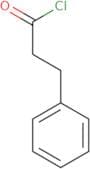
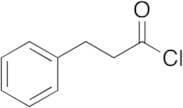
CAS 645-45-4
:Benzolpropanoylchlorid
Beschreibung:
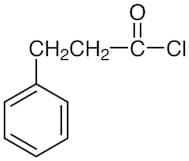
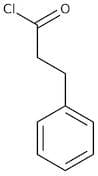
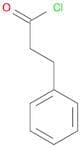
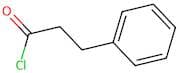
Benzolpropanoylchlorid, auch bekannt als Benzoylchlorid, ist ein aromatisches Acylchlorid, das durch seine Struktur gekennzeichnet ist, die einen Benzolring zeigt, der an eine Propanoylgruppe gebunden ist. Diese Verbindung ist typischerweise eine farblose bis blassgelbe Flüssigkeit mit einem stechenden Geruch, der auf ihre Reaktivität hinweist. Sie ist bekannt als ein starkes acylierendes Mittel, das häufig in der organischen Synthese verwendet wird, um die Benzoylgruppe in verschiedene Substrate einzuführen. Benzolpropanoylchlorid ist in organischen Lösungsmitteln wie Ether und Chloroform löslich, jedoch nicht in Wasser aufgrund ihrer hydrophoben Natur. Sie reagiert heftig mit Wasser, Alkoholen und Aminen und setzt dabei Salzsäure frei, was eine sorgfältige Handhabung und Lagerung unter inertem Schutz erfordert. Die Verbindung wird in der Herstellung von Arzneimitteln, Agrochemikalien und Farbstoffen verwendet, was ihre Bedeutung in industriellen Anwendungen unterstreicht. Sicherheitsvorkehrungen sind beim Umgang mit dieser Substanz unerlässlich, da sie schwere Reizungen der Haut, der Augen und der Atemwege verursachen kann.
Formel:C9H9ClO
InChl:InChI=1S/C9H9ClO/c10-9(11)7-6-8-4-2-1-3-5-8/h1-5H,6-7H2
InChI Key:InChIKey=MFEILWXBDBCWKF-UHFFFAOYSA-N
SMILES:C(CC(Cl)=O)C1=CC=CC=C1
Synonyme:- 2-Ethoxybenzyl Chloride
- 3-Phenylpropanoic acid chloride
- 3-Phenylpropanoyl chloride
- 3-Phenylpropanoyl chlovide
- 3-Phenylpropionic acid chloride
- 3-Phenylpropionoyl chloride
- 3-Phenylpropionyl Chloride
- 3-Phenylpropionylchlorid
- Benzenepropanoyl chloride
- Chlorure de 3-phenylpropionyle
- Cloruro De 3-Fenilpropionilo
- Dihydrocinnamoyl chloride
- Hydrocinnamoylchlorid
- Hydrocinnamyl chloride
- Nsc 2854
- Phenylpropionyl Chloride
- Propionyl Chloride, 3-Phenyl-
- beta-Phenylpropanoyl chloride
- β-Phenylpropanoyl chloride
- β-Phenylpropionyl chloride
- Weitere Synonyme anzeigen
Sortieren nach
Reinheit (%)
0
100
|
0
|
50
|
90
|
95
|
100
7 Produkte.
3-Phenylpropionyl Chloride
CAS:Formel:C9H9ClOReinheit:>97.0%(GC)(T)Farbe und Form:Colorless to Light yellow to Light orange clear liquidMolekulargewicht:168.623-Phenylpropionyl chloride, 98%
CAS:The 3-phenylpropionate (dihydrocinnamoyl) ester has been used as a protecting group in nucleoside synthesis. Used in the synthesis of 1-Phenyl-3-methyl-4-acyl-5- pyrazolones. N-(3-phenyl-n-propyl)-1-phenyl-2-aminopropane were prepared by acylation of the appropriate amine with 3-phenylpropionyl chlo
Formel:C9H9ClOReinheit:98%Farbe und Form:Clear colorless to yellow, LiquidMolekulargewicht:168.623-Phenylpropanoyl chloride
CAS:Formel:C9H9ClOReinheit:98%Farbe und Form:LiquidMolekulargewicht:168.6202Ref: IN-DA003JVT
5g20,00€10g25,00€1kg213,00€25g27,00€5kgNachfragen100g58,00€10kgNachfragen250g109,00€25kgNachfragen500g168,00€3-Phenylpropanoyl chloride
CAS:3-Phenylpropanoyl chlorideFormel:C9H9ClOReinheit:98%Farbe und Form: clear. brown to dark brown liquidMolekulargewicht:168.62016g/mol3-Phenylpropionyl chloride
CAS:3-Phenylpropionyl chloride is an acylating agent with antimicrobial properties. It is used as a precursor in the synthesis of many pharmaceuticals, such as amines and cyclohexane derivatives. 3-Phenylpropionyl chloride is a reactive compound that can undergo an acylation reaction with nucleophilic compounds to form an n-oxide. This reaction can be catalyzed by metal ions or bases. 3-Phenylpropionyl chloride has inhibitory properties against enzymes, such as aminoglycoside acetyltransferase and carbonyl reductase. It also has shown antitumor activity in cancer cells and metabolic disorders in the liver due to its ability to inhibit glycosidic bond formation.Formel:C9H9ClOReinheit:Min. 95%Farbe und Form:LiquidMolekulargewicht:168.62 g/mol3-Phenylpropanoyl chloride
CAS:Formel:C9H9ClOReinheit:98%Farbe und Form:LiquidMolekulargewicht:168.623-Phenylpropionyl Chloride
CAS:Kontrolliertes ProduktApplications 3-Phenylpropionyl Chloride is a derivative of phenylpropionic acid used in the preparation of a wide range of pharmaceutical compounds such as antivirals and antitumor agents.
References Ermolova, G.I. et al.: Khim.-Farm. Zh., 24, 35 (1990); Bernier, J.L. et al.: J. Med. Chem., 28, 497 (1985); Jung, J.-C. et al.: Bioorg. Med. Chem. Lett., 14, 5527 (2004);Formel:C9H9ClOFarbe und Form:NeatMolekulargewicht:168.62