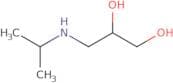
CAS 6452-57-9
:3-Isopropylamino-1,2-propandiol
Beschreibung:
3-Isopropylamino-1,2-propandiol, mit der CAS-Nummer 6452-57-9, ist eine organische Verbindung, die durch ihre Aminoalkoholstruktur gekennzeichnet ist. Sie weist ein Propanolgerüst mit einer Isopropylaminogruppe an der dritten Kohlenstoffposition auf. Diese Verbindung ist typischerweise eine farblose bis blassgelbe Flüssigkeit und in Wasser löslich, was auf das Vorhandensein von Hydroxylgruppen zurückzuführen ist, die ihre Hydrophilie erhöhen. Die Aminogruppe trägt zu ihrer Basizität bei, was es ihr ermöglicht, an verschiedenen chemischen Reaktionen teilzunehmen, einschließlich der typischen Reaktionen von Aminen und Alkoholen. 3-Isopropylamino-1,2-propandiol kann in pharmazeutischen Formulierungen verwendet werden, da es als Stabilisator oder Tensid wirken kann. Seine Eigenschaften machen es relevant für die Synthese anderer chemischer Verbindungen und in Anwendungen, die Biokompatibilität erfordern. Sicherheitsdaten sollten konsultiert werden, um Handhabungs- und Expositionsrichtlinien zu erhalten, wie bei jeder chemischen Substanz, um sicherzustellen, dass während der Verwendung angemessene Sicherheitsmaßnahmen getroffen werden.
Formel:C6H15NO2
InChl:InChI=1S/C6H15NO2/c1-5(2)7-3-6(9)4-8/h5-9H,3-4H2,1-2H3
InChI Key:InChIKey=YKBZGEJJKPNRSI-UHFFFAOYSA-N
SMILES:C(CNC(C)C)(CO)O
Synonyme:- 1,2-Dihydroxy-3-isopropylaminopropane
- 1,2-Propanediol, 3-(isopropylamino)-
- 1,2-Propanediol, 3-[(1-methylethyl)amino]-
- 3-(Isopropylamino)-1,2-Propanediol
- 3-(Propan-2-Ylamino)Propane-1,2-Diol
- 3-[(1-Methylethyl)amino]-1,2-propanediol
- 3-[(Propan-2-yl)amino]propane-1,2-diol
- 3-(Isopropylamino)propane-1,2-diol
Sortieren nach
Reinheit (%)
0
100
|
0
|
50
|
90
|
95
|
100
8 Produkte.
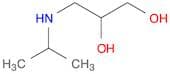
1,2-Dihydroxy-3-isopropylaminopropane
CAS:Formel:C6H15NO2Reinheit:98%Farbe und Form:LiquidMolekulargewicht:133.18883-(Isopropylamino)-1,2-Propanediol
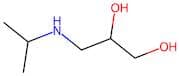
CAS:3-(Isopropylamino)-1,2-PropanediolReinheit:98%Molekulargewicht:133.19g/mol(2RS)-3-[(1-Methylethyl)amino]propane-1,2-diol
CAS:Kontrolliertes ProduktFormel:C6H15NO2Farbe und Form:NeatMolekulargewicht:133.193-Isopropylamino-1,2-propanediol
CAS:Impurity Metoprolol EP Impurity N
Applications 3-Isopropylamino-1,2-propanediol (Metoprolol EP Impurity N) is a versatile organic building block, used in different chemical synthesis. It is used in the preparation of heterocyclic propanolamines, which are shown to have β-adrenergic antagonist activity.
References Dean, V. et al.: Drug Design and Discovery,10, 89 (1993);Formel:C6H15NO2Farbe und Form:ColourlessMolekulargewicht:133.193-Isopropylamino-1,2-propanediol
CAS:Metoprolol tartrate impurity N is an impurity of metoprolol succinate and has been shown to have photocatalytic activity. Metoprolol tartrate impurity N has been found in commercially available pharmaceutical products. It has been validated by both phase chromatography and hydrophilic interaction chromatography, with the latter providing a more detailed separation of the compound's various reaction intermediates. Impurities such as metoprolol tartrate impurity N may be present in commercial products due to the use of pyridinium salt as a solvent in the manufacturing process. The enantiomeric purity of metoprolol tartrate impurity N was determined to be 99%.Formel:C6H15NO2Reinheit:Min. 95%Farbe und Form:PowderMolekulargewicht:133.19 g/mol



![(2RS)-3-[(1-Methylethyl)amino]propane-1,2-diol](/_next/image/?url=https%3A%2Fstatic.cymitquimica.com%2Fproducts%2F86%2Fthumb%2FMM0027.16.jpg&w=3840&q=75)